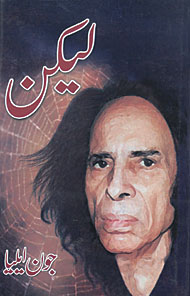
I think John Elia thinks in Greek and writes in Urdu. His latest collection of poems is “Lekin” which means “But” and seems to me to be very philosophical. It is a fact that John spent all his life in the realm of thought. The titles of his previous collections of poems show the same doubt and confusion which is spread throughout his long poetic career. John is from Amroha, a windswept historical town near Delhi. His family migrated to Pakistan and he suffers from a sort of nostalgia. His poems are often monologues. In a crystal-clear style, he speaks of the storms that are shaking his soul. He never speaks to an alien but his soliloquy is overheard by others for which neither John nor his audiences can be blamed.
His first poem Maqula-e-Ankabut (The Spider’s Saying) sheds light on the reality and reason for existence and this 7-line poem can be said to be a preface to John’s collection. In a poem titled Fonees (Phoenix) John talks about the dictates of history and also of his lineage. In this 9-page poem, glimpses of the world and Islamic and family history are visible. The poem is an elegy for a civilization which speaks through the mouth of a poet. The poet himself has adopted the metaphor of the phoenix, a beautiful mythical bird which lives in the Arabian desert for 500 or 600 years and then sets itself on fire, and rises renewed from the ashes to start another long life. John, like the phoenix, is the symbol of resurrection of a civilization.
John often talks about the whirlwinds of his soul. He sees dust, mist and darkness everywhere. These metaphors speak volumes about John’s person. If one understands John’s metaphors one acquires a keyhole through which one could peep into John’s soul. John says:
Hain isi dum roo baroo phir na koi main na too
Us pe ye wade bhi jaan shahr bagoolon ka hai
Dhund hai bikhrao hai dhool hai andhiao hai
Khud se laga chal mian shahr bagoolon ka hai
Wahm guman ka guman aishe yaqin hai yahan
Yeh bhi guman hai guman shahr bagoolon ka hai
Dhool hai saari zamin dhund hai sub aasman
Shakl ki soorat kahan shahr bagoolon ka hai
John is basically a maestro of ghazal. But in other forms of Urdu poetry, he is easily recognizable by his superb style. As mentioned above he is philosophical and very delicate in going into minute details of ancient civilizations with brevity. In ghazal he is not so philosophical and adopts Mir’s versatile style and diction which is easy to understand. He sometimes uses strange but beautiful words. Like all maestros, he coins words. He is plain but not without savor. Although he repeats himself, yet his sonorous tone never loses charm. In this collection of poems, like his previous ones, he tries to lure his readers with his sensuous and, to some extent, off-track sexy symbols. He is more lustful and sensuous than Firaq Gorakhpuri, more open and bold than Nizami Ganjavi but as Urdu ghazal has Jurrat, Insha and Rangeen, John never perturbs his reader. He has his limits and that is why he is acceptable. If one can adjust to John’s eccentric style, it gradually offers his reader glimpses into the depth of his heart, his different shades, feigned fancies and it is not less rewarding. In his own words:
Aawaaz hoon jo hijre-samaa’t men hai sukoot
Per is sukoot per bhi ik aawaazah hai so hai
His silence is speechmaking. His movement of breath has fire in it. From there comes the flickering flame of his poetry. As a flame-voiced songster never waits or cares for any listener, this impatient but warm-hearted poet never thinks about praise or plaudits. He knows his songs will take the world by storm. It is sufficient for him that his poems will create a furor. John knows his power. He says:
Lub wa huay ke fitna fiza ta fiza pada
Yeh jumbishe nafas hai ki tughyane fitna hai
This sedition and mischief about which he talks have become a salient feature of his poetry. In all his rhetoric, there lies a deep melancholy and the moaning of a proud soul. A soul which talks about doubt and suspicion but has a firm belief in the values of love and compassion.
John ‘s 250 page collection of poems, Lekin, easily dazzles the eye. Alhamd Publications Lahore, Pakistan is to be commended for publishing it.