

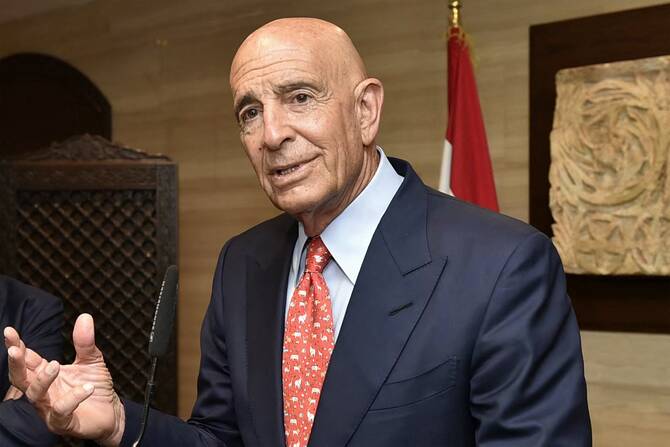

WASHINGTON: US intelligence found no evidence to support Israeli claims that Turkiye was preparing to deploy forces at a Syrian airbase bombed by Israel this week, US special envoy Tom Barrack said.
Barrack, the US ambassador to Turkiye and special presidential envoy for Syria and Iraq, challenged the justification given by Israeli officials for the attack.
He said Washington examined intelligence shared by Israel ahead of Tuesday’s strike on Abu Al-Duhur military airport in northwestern Syria but reached a different conclusion.
Israel informed the US about six days before the attack that its intelligence indicated there “might be Turkish movement” into the airbase, Barrack said.
“We all did our due diligence. We went back to our respective intelligence agencies. The answer we got is, no, that’s not happening,” Barrack said in an interview with entrepreneur and podcaster Mario Nawfal broadcast on Friday.
Barrack also suggested that Israel may have sought to provoke a confrontation with Turkiye ahead of Israel’s Oct. 27 election.
“One theory is they were just baiting Turkiye,” Barrack said, describing the move as “very aggressive” but potentially politically advantageous ahead of the vote.
On Tuesday, Israel bombed the disused Abu Duhur base in northwestern Syria, which was damaged during the country’s civil war and has been out of service since 2012, claiming it wanted to avert Turkish troops deploying to the facility.
Barrack confirmed that Mossad chief Roman Gofman had spoken to Syrian Foreign Minister Asaad Al-Shaibani about Israel’s concerns before the attack.
Tensions between Turkiye and Israel have escalated following the attack and amid a Turkish arrest warrant for Prime Minister Benjamin Netanyahu over alleged “genocide” linked to Israel’s interception of an aid flotilla for Gaza.
Netanyahu’s office responded by calling Turkish President Recep Tayyip Erdogan an “antisemitic dictator” and accusing him of seeking to expand what Israel described as Turkish aggression into Syria.
Israel rejects Barrack’s criticism as ‘full of inaccuracies’
Israeli Defense Minister Israel Katz rejected Barrack’s account on Saturday, saying Israel had received “clear intelligence” indicating that Turkiye intended to carry out activities at Abu Al-Duhur that would threaten Israeli security.
Katz said the Israeli military had recommended striking the airport “several times,” but that Netanyahu and security officials first agreed to issue a direct warning to the Syrian government at the highest level to prevent the alleged deployment, according to Israeli media.
He said the intelligence had also been shared with relevant US authorities and that Israel authorized the strike only after its warning went unanswered.
“We will not allow any actor to endanger the security of the State of Israel and will act against every threat, just as we did today in southern Syria,” Katz said, according to Israeli media.
Katz dismissed suggestions that electoral considerations influenced the attack, saying Barrack’s comments were “full of inaccuracies” and contradicted the position of US President Donald Trump “regarding the Golan Heights”, after Barrack called the territory “occupied.”
Barrack had said that the Golan Heights, which Israel captured from Syria in 1967, and whose annexation was recognised by the US in 2019, and by Columbia this month, were “occupied” by Israel.
The exchange highlighted growing disagreement between Washington and Israel over the circumstances surrounding the strike.
Israel said Syria was on the verge of breaching an agreed security “status quo” by allowing Turkish troops to deploy at the airport, which it considered a threat to Israeli security.
Both Damascus and Ankara disputed the claim.
Al-Shaibani acknowledged that Turkish military officers had visited the facility as part of continuing military cooperation between the two countries but said there were no plans for a permanent Turkish deployment there.
Turkiye also rejected Israel’s allegations and accused it of using security claims to justify attacks on Syrian territory.
Israel has carried out hundreds of strikes in Syria since the fall of Bashar Assad and maintains troops in a buffer zone in southern Syria, while US-mediated efforts to reach a security agreement between Damascus and Israel have yet to produce a deal.
On Saturday, Israel conducted another strike in Syria, saying it targeted a militant southwest of Damascus. Syria condemned the operation as a “flagrant violation” of its sovereignty.


