

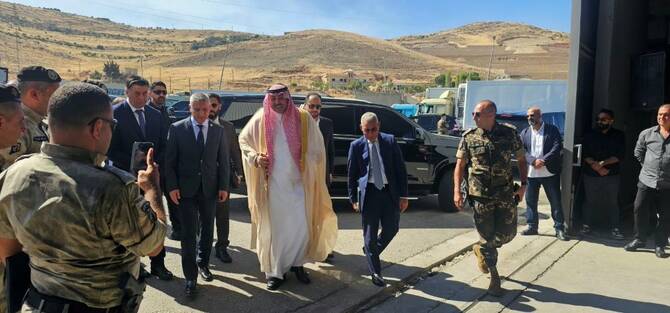

BEIRUT: Lebanon and Saudi Arabia officially relaunched their overland trade route on Thursday, as Lebanese customs authorities began operating an advanced scanner at the Masnaa Border Crossing with the Syrian Arab Republic.
Saudi Ambassador to Lebanon Fahad bin Abdulrahman Al-Dosari took part in the ceremony, which came two months after he announced at the Port of Beirut that the Kingdom would resume imports of Lebanese products by land, following the earlier reopening of the air freight route.
The move comes nearly five years after the Kingdom suspended imports of Lebanese products, particularly agricultural goods, following a series of drug-smuggling attempts.
The new screening equipment is expected to strengthen the Lebanese customs authorities’ ability to detect contraband and tighten controls, while also speeding up the movement of trucks, vehicles and goods through the crossing.
Al-Dosari inspected the scanner, which has been operating at the crossing for several days, and said the reopening of the land route marked a continuation of cooperation between the two countries.
“The Kingdom has confidence in the Lebanese state, and without that confidence we would not be here,” he said.
He praised the efforts of Lebanon’s president, prime minister and ministers, and reaffirmed Saudi Arabia’s support for Lebanon in restoring state sovereignty across its territory.
The official ceremony at the Masnaa crossing was also attended by Public Works and Transport Minister Fayez Rasamny, representing Prime Minister Nawaf Salam, and Higher Customs Council President Misbah Khalil.
Al-Dosari expressed the hope that Lebanese exports to Saudi Arabia would eventually exceed the volumes recorded before the import ban was imposed.
Masnaa is currently Lebanon’s only operational land crossing for overland exports, pending the completion of procedures to reopen the Abboudieh crossing in northern Lebanon.
Rasamny thanked Saudi Arabia for its decision to resume imports from Lebanon and said the government remained committed to the pledge it made upon taking office to safeguard security at the country’s land, sea and air border crossings.
He also praised the decisions of King Salman and Crown Prince Mohammed bin Salman in support of Lebanon and welcomed the reopening of Saudi markets to Lebanese products.
Rasamny said he hoped the move would usher in a new phase of cooperation and exchange of expertise in customs and trade, serving the interests of both countries.
He said partnering with CMA CGM, a shipping and logistics company, had been the fastest way to secure an advanced scanner for the crossing.
Rasamny said: “The government has decided that all Lebanese exports and imports will be subject to scanning because we cannot afford any security or customs problems. (So) 100 percent of them will be screened on our side.”
He also outlined a revised development plan for the Masnaa crossing, saying the necessary approvals had been obtained from the relevant security agencies.
The project would introduce smart lanes separating trucks, buses and passenger vehicles, along with a fast track, a VIP lane and a free zone.
Rasamny said the project would cost about $61 million and could be completed within three years once funding was secured.
He added that the Abboudieh crossing was expected to reopen within weeks, helping to ease pressure on Masnaa.
Khalil said the introduction of modern technology into customs operations was intended not only to combat smuggling but also to facilitate legitimate trade and accelerate procedures.
The aim, he said, was to strike a balance between tighter controls and the smooth movement of goods and transport.
“Our priority is to protect the national economy, serve the state and citizens, and demonstrate that state institutions, whatever circumstances they have endured, are capable of carrying out their role and recovering,” Khalil said.
The new scanner will operate around the clock and has a capacity dozens of times greater than that of conventional scanning equipment.
Authorities said it would allow trucks and vehicles to be inspected more quickly and accurately, improve the detection of smuggled or prohibited goods, and help ensure the secure movement of goods between Lebanon and countries importing from or transiting through its territory.


