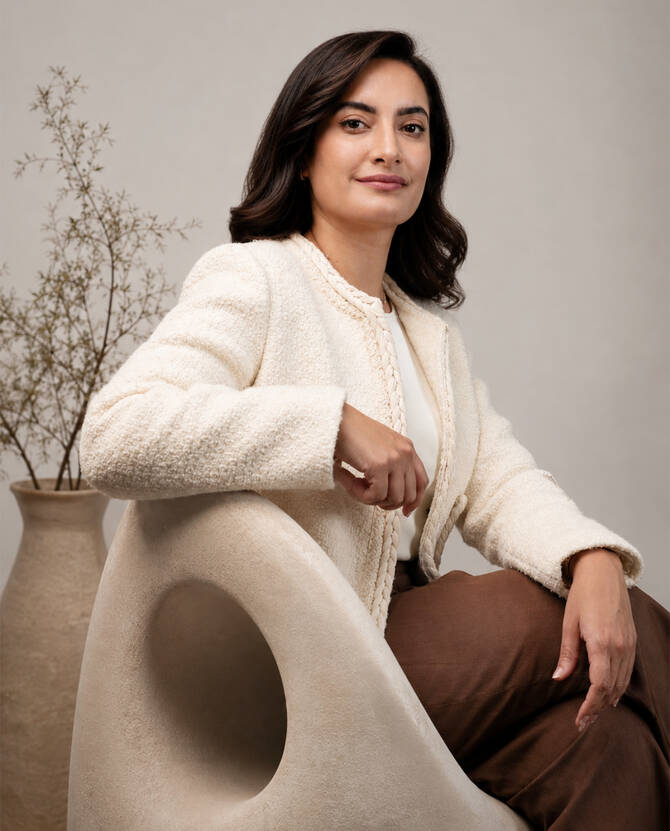

JEDDAH: After many years building and developing digital content teams at major media organizations, Saudi media content creator Farah Al-Ibrahim decided to start her own project to tell stories about art, artists and culture.
The result was Fann Culture, an independent Arabic cultural media platform launched in 2025 to make art, artists and culture more accessible to audiences who may not have an academic background in the field.
For Al-Ibrahim, the move was not about leaving media behind, but using everything she had learned from it to build something of her own.
Speaking to Arab News about her move, she said: “I don’t really see it as stepping away from media. In many ways, Fann Culture is the result of everything I learned working in it.”
Al-Ibrahim studied mass communication at the American University of Sharjah and began her professional career in digital content in 2012, at a time when digital teams were still emerging within traditional media organizations.
She started as a social media producer before moving into management, becoming social media manager at Sayidaty and later digital content manager at Al Arabiya, part of MBC Group.
A one-minute video might make someone curious enough to read more, visit an exhibition or look at an artwork differently. For me, that curiosity is where cultural literacy begins.
Farah Al-Ibrahim. Saudi media content creator
Those years taught Al-Ibrahim not only how to produce content, but also how to understand audiences and tell stories in influential ways.
“Storytelling is really at the heart of what we do,” she said.
As Saudi Arabia’s cultural scene expanded, with new exhibitions, museums, artists and cultural events, Al-Ibrahim began looking for Arabic content that could provide audiences with context without becoming overly academic.
“You can walk into a Picasso exhibition and enjoy it, but knowing how Cubism began, what influenced him and the stories behind the works makes you see it very differently,” she said.
Yet Al-Ibrahim struggled to find Arabic content that offered depth while remaining engaging and easy to understand.
“I felt there had to be a space in between: Content with real substance, but presented in a way that people would actually enjoy, follow and share,” she said.
That idea became the foundation of Fann Culture.
Rather than simply explaining an artwork or an artistic movement, the platform looks for the human story, history or idea behind it.
The objective is to make audiences curious and to encourage them to explore further, she said.
Al-Ibrahim deliberately started small. Instead of attempting to recreate the structure of a large media organization, she launched initially on Instagram and focused on doing one thing well.
Today, Fann Culture has expanded to TikTok and has attracted more than 100,000 followers across the two platforms, generating millions of views during its first year.
For Al-Ibrahim, however, the most significant achievement is not the follower count.
“The real moment was when I started seeing a community form around Fann Culture, not just followers,” she said.
She noticed artists, collectors and younger people with little formal background in art engaging with the content, returning for more and contributing their own knowledge and perspectives.
That interaction has also challenged the traditional perception that art is something people need to be experts to discuss.
“I think one change I’ve noticed is that people seem more comfortable having an opinion about art,” she said.
“You don’t need to be an expert to have a response to art.”
Al-Ibrahim believes social media can play an important role in developing cultural literacy, particularly among younger audiences.
She does not see short-form digital content as a replacement for books, museums or deeper learning, but instead views it as a gateway.
“A one-minute video might make someone curious enough to read more, visit an exhibition or look at an artwork differently,” she said. “For me, that curiosity is where cultural literacy begins.”
With more exhibitions, museums, cultural institutions and conversations emerging across the Kingdom, she believes young Saudis are being exposed to culture on a scale that was previously unavailable.
“Culture is becoming a more natural part of everyday life rather than something reserved for specialists,” she said.
While rooted in Saudi Arabia, Al-Ibrahim has always viewed Fann Culture as an Arabic platform with a wider regional ambition.
Her experience at Sayidaty and Al Arabiya, where content was developed for a broad Arab audience while maintaining a strong Saudi perspective, shaped that approach.
Today, the Saudi cultural storyteller and entrepreneur is already preparing to take Fann Culture beyond social media.
In September, the platform will launch its first digital book, introducing readers to modern art through storytelling, beginning with Realism.
As Fann Culture grew, Al-Ibrahim began receiving messages from followers asking for recommendations for Arabic art-history books that were informative without being overly academic.
When she struggled to find suitable recommendations, she decided to create one herself, drawing on research and reliable sources.
The digital book is only the first step in a much larger ambition.
Five years from now, Al-Ibrahim hopes Fann Culture will have evolved into a broader Arabic cultural platform covering music, theater, heritage, history, fashion, food, travel and the people behind them.
She is thinking of building a multimedia library combining videos, documentaries, books, audio and other formats, a place audiences can return to whenever they want to discover something new.
The platform is a one-person operation, occasionally supported by one or two freelancers.
“The biggest surprise was rediscovering how much I love actually making content,” Al-Ibrahim said.
“I realized that this is still the part I enjoy the most.”
She also discovered an entrepreneurial side of herself and, perhaps most importantly, evidence that there is an audience waiting for Arabic cultural stories told differently.
Fann Culture may still be at the beginning of its journey, but for Al-Ibrahim, the experiment has already answered one important question: People are interested in art and culture.