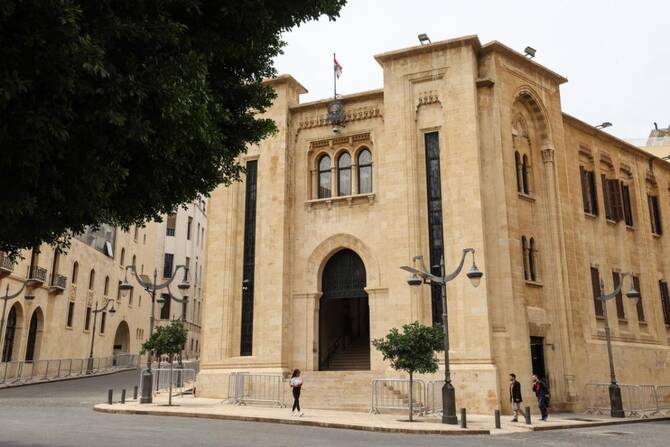

BEIRUT: Prayer chants echoed through Lebanon’s Roumieh Central Prison on Wednesday, minutes after Parliament approved a long-awaited general amnesty law that could see thousands released from the country’s overcrowded jails.
Lebanon’s prisons currently hold about 8,000 convicted prisoners and pretrial detainees accused of a wide range of offenses.
The legislation was approved by roll call following fierce political wrangling and marathon negotiations that stretched from Tuesday night into Wednesday morning.
The vote came during the second of two days of legislative sessions, after parliament on Tuesday approved a law abolishing the death penalty in Lebanon.
Wednesday’s session was marked by political objections and boycotts. MPs from the Free Patriotic Movement and Hezbollah were absent from the vote in protest at a decision not to allow Defense Minister Michel Menassa to address Parliament. His remarks were reportedly intended to convey the Lebanese Army’s position on the legislation.
Under the new law, judges must release detainees who have spent more than 14 prison years in custody without receiving a verdict, although judicial proceedings against them will continue.
It also covers prisoners who completed their sentences but remained behind bars because they were unable to pay fines.
The amnesty extends to drug use and certain drug offenses, as well as ordinary theft, provided cases do not fall under specified exclusions or legal provisions governing repeat offenders. The legislation contains no separate exemption for car theft.
However, a broad range of serious crimes are excluded.
These include cases referred to the Judicial Council, intentional or premeditated murder, terrorism, certain military offenses, treason, espionage and unlawful dealings with the enemy.
The exclusions also cover repeat felony drug offenses, drug crimes committed by members of the military or security services, continuing offenses against public property, corruption, illicit enrichment, money laundering and banking crimes involving depositors’ funds.
Rape, incest, human trafficking, domestic violence, sexual assault of minors, torture, enforced disappearance and crimes involving antiquities and the environment are also excluded.
A special provision applies to some Lebanese citizens who fled to Israel in 2000. Those who were deported to Israel will be permitted to return to Lebanon under the amnesty provided they renounce Israeli citizenship.
For offenses not covered by the amnesty, the legislation replaces the death penalty with a 28-year prison sentence, while life imprisonment with hard labor becomes a 17-year term.
Under an amendment announced during deliberations, life sentences were reduced from 14 “prison years” to 12 actual years, while other remaining sentences will be cut by one-third.
A prison year in Lebanon is nine months in jail.
The legislation also introduces tougher penalties for beneficiaries of the amnesty who later commit another crime, with the provision applying for life rather than only during the first five years following their release.
Once the law is published in the Official Gazette and enters into force, 79 Islamist detainees and more than 2,000 other prisoners and detainees are expected to be released.
Many of the Islamist prisoners at Roumieh prison who stand to benefit were implicated in some of Lebanon’s bloodiest clashes between militants and the army.
They include individuals linked to the 2007 fighting at the Nahr Al-Bared Palestinian refugee camp, where the Lebanese Army fought Fatah Al-Islam militants, as well as detainees connected to other security incidents in northern Lebanon.
Others were imprisoned over the 2013 Abra clashes near the southern city of Sidon, which pitted supporters of Sheikh Ahmad Al-Assir, then a prominent opponent of Hezbollah, against the Lebanese Army.
Al-Assir is expected to remain in prison until mid-May 2028, after serving an additional mandatory 19 months.
Other detainees affected by the legislation have been held in connection with bombings in Lebanon beginning in the summer of 2013.
The issue of a general amnesty has been among Lebanon’s most politically sensitive for years, exposing divisions over lengthy pretrial detention, sectarian grievances and the fate of those accused of attacking the Lebanese Army.
Successive political leaders had promised prisoners and their families an amnesty, while inmates — particularly those who had spent years awaiting trial — repeatedly staged protests and riots over prison conditions and delays in judicial proceedings.
Their families have also demonstrated in Tripoli, Sidon and Beirut, arguing that detainees were being subjected to prolonged and unjust incarceration.
On the other side of the debate, families of Lebanese soldiers killed in clashes with militants have repeatedly protested against legislation that could free those responsible for attacks on the army.
Lebanon’s judiciary has meanwhile complained that inadequate courtroom capacity and a huge backlog of cases have contributed to lengthy delays in bringing hundreds of detainees to trial.
Those competing pressures repeatedly stalled the amnesty bill and forced lawmakers to amend it several times.
Political disagreements have centered particularly on whether those convicted of killing army personnel should benefit and on claims that members of one sect had been disproportionately affected by prolonged detention.
The dispute became particularly acute in May, when a number of Sunni MPs boycotted a parliamentary session over the issue.
MP Bilal Abdullah told Arab News that Wednesday’s vote marked the end of a difficult political chapter.
“With the adoption of the general amnesty law today, we are closing a political chapter during which one Lebanese component was targeted by a regime, security agencies and the military court,” he said.
Islamic Group MP Imad Al-Hout said that 79 of 146 Islamist detainees would be released immediately.
“From now on, we will not accept anyone being held beyond the legal limit for pretrial detention,” he said.
But the legislation remained deeply contentious even as it passed.
Amal Movement MP Ghazi Zeaiter criticized the law as “unbalanced,” describing it as “a law of exceptions” that was “sectarian and confessional.”
Lebanese Kataeb MP Elias Hankash said that the debate demonstrated the fundamentally political nature of the legislation.
“It has become clear that the general amnesty is not a judicial matter, but a political decision,” he said.
Lebanon has passed dozens of amnesty laws since the last century, although most were restricted to particular offenses or groups.
The most consequential came in 1991, following the end of the 1975-1990 Lebanese Civil War. The sweeping legislation covered crimes committed during the conflict, benefiting militia leaders and fighters and effectively closing thousands of war-related cases.
A special pardon with broad effects was also issued for former army commander Michel Aoun and two of his aides.
In 1997, an amnesty for drug offenses benefited thousands of defendants.
Two significant amnesty laws followed in 2005. One paved the way for the release of Lebanese Forces leader Samir Geagea after about 11 years in prison, while another covered detainees linked to the Dinnieh and Majdal Anjar incidents.
Wednesday’s vote therefore represents the latest chapter in Lebanon’s long and politically fraught history of using amnesties to address the legacy of conflict, judicial delays and unresolved divisions — while once again raising the question of where the line should be drawn between political reconciliation and accountability.