

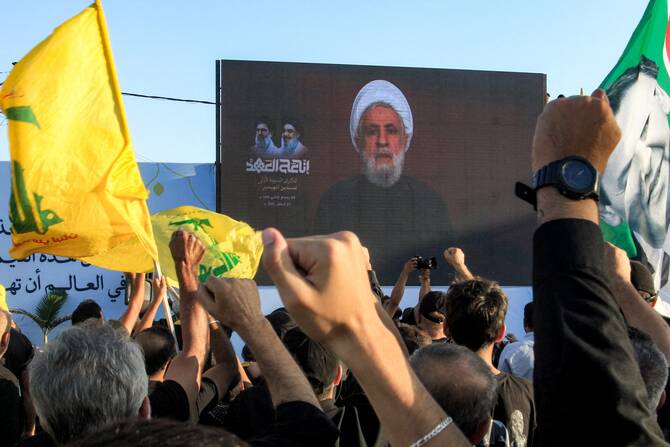

LONDON: For years, Hezbollah fighters propped up Syrian ruler Bashar Assad, who the men now governing in Damascus fought to overthrow. Both sides are now talking about sitting down together.
Any handshake between them would be built on that history.
Hezbollah leader Naim Qassem said on Tuesday that he had no objection to meeting openly with Syria’s leadership — the first time he has taken such a position since his Iran-backed group fought on behalf of Syria’s former government.
The signals have also come from Damascus.
Syria’s interim president, Ahmad Al-Sharaa, told Al-Mashhad TV in June that if sitting down with Hezbollah “serves Lebanon’s interests and safeguards Syria’s interests, why not?”
Foreign Minister Asaad Al-Shaibani echoed that during a visit to Beirut in July, saying Damascus was open to a meeting “if interests require it.”
Taken together, the remarks raise a question: What would Syria and Lebanon each stand to gain?

Israel's attacks in Lebanon have since early March displaced more than 1 million people, according to official figures. (AFP file photo)
Beirut-based policy expert Hussein Chokr said a rapprochement “would be a positive development with benefits for both countries on several levels.
“Lebanon and Syria are bound by such deep geographic, demographic, historical and civilizational entanglements that any rapprochement between key actors inside the two countries can reflect positively on social stability, just as the opposite can quickly produce instability,” Chokr told Arab News.
He pointed to history to make the case.
“The Christian-Muslim fighting of 1860 is one example,” he said. “It began in Mount Lebanon and rapidly spread to Damascus.
“How much more consequential, then, would rapprochement be between the ruling regime in Syria and the largest political and military actor in Lebanon?”
Both sides, he added, would benefit from reduced tensions between two actors “whose relationship has been marked by more than a decade of killing,” replacing “the tools of war and armed confrontation — tools they have already tested — with dialogue and diplomacy.”
Hezbollah entered Syria’s civil war in support of Assad after the conflict erupted in 2011, later publicly acknowledging its military role after initially denying direct involvement.

Syria's interim President Ahmad Al-Sharaa said in July his country did not intend to intervene militarily in Lebanon. (AFP file photo)
What has changed since is a shared predicament, said Joshua Landis, director of the Center for Middle East Studies at the University of Oklahoma.
“There is no hiding that Hezbollah and Damascus have terrible relations because of their long and bloody history of fighting on opposite sides in Syria’s civil war, all the same, they have many shared interests,” Landis told Arab News.
“Both have land occupied by Israel; both are fighting for sovereignty and to stabilize their countries; both must rebuild and come to grips with a transformed Middle East.”
For Lebanon, Chokr said, the calculation is also defensive. A calmer relationship with Damascus “could help prevent the implementation of what appears to be (US President Donald) Trump’s plan to drag the new Syrian government into a military confrontation inside Lebanon against Hezbollah.”
Trump suggested in June that Syria, rather than Israel, could take on Hezbollah in Lebanon — an idea that stirred alarm given Syria’s long history of interference in Lebanese affairs.
Al-Sharaa, however, publicly ruled out military intervention, saying Damascus wants to support regional stability through political, diplomatic and economic channels.
For Hezbollah, the pressure is more existential.
The group “has been terribly weakened and is cut off from its patron Iran,” Landis said, and so “it must find a modus vivendi with Syria even if relations remain tense.
“It must also repair relations with the government in Beirut,” he added. “Many Lebanese blame Hezbollah for Israel’s destruction of their country.”

Under a US-sponsored agreement signed in June, Lebanon's army is to disarm Hezbollah. (AFP file photo)
Hezbollah suffered heavy losses during Israel’s military campaign in late 2024, while the collapse of the Assad government severed its key overland supply route from Iran through Syria.
Those losses, Landis said, have forced a broader reckoning.
“Hezbollah is in a period of reshaping its regional identity,” he said. “The old axis of resistance may not be dead, but it is on life support. A new regional security system is slowly emerging.
“From Turkiye to Saudi Arabia, an alliance to contain Israel is taking shape. Hezbollah cannot afford to be left out of this new security architecture; at the very least, it cannot afford to ignore it.”
Landis said “Hezbollah clearly stands to gain more than Damascus by improved relations.
“Hezbollah is fighting for its life,” he explained. “Syria was its lifeline to its allies, particularly Iran and, to a much lesser extent, Russia."
Still, he said, the need may run both ways.

Lebanon's Prime Minister Nawaf Salam (R) and Syria's Foreign Minister Asaad Al-Shaibani holding a news conference in Beirut on July 2, 2026. (AFP file photo)
“Just as Al-Sharaa is discovering that he does not want to cut relations with Russia, he may also discover that he may need Hezbollah in the future,” Landis said.
“If the two cooperate in their efforts to get Israel to evacuate their occupied lands, they will each compound their leverage.”
Chokr agreed that Damascus has something to gain, chiefly “de-escalation with an actor that has long had strong regional reach.” Even if that reach has weakened, he said, “Hezbollah remains a powerful force with important regional alliances.”
Such de-escalation, he added, “could help the new Syrian leadership consolidate its rule that remains relatively new and fragile, and that faces many internal and external obstacles.
“Damascus may see wisdom in reducing some of these obstacles by addressing one important file: its relationship with Hezbollah and what Hezbollah represents as an extension of a regional axis with roots and presence across the region and Shiism presence inside Syria itself,” Chokr said.


