

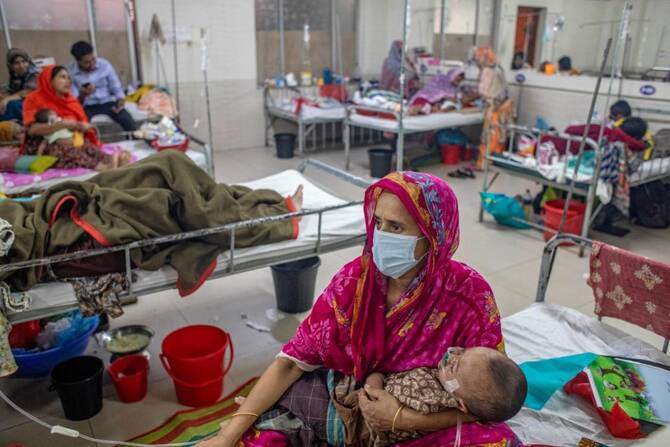

DHAKA: Nearly five months into Bangladesh’s unprecedented measles outbreak, doctors warn of long-term consequences, as daily child deaths and the infection rate remain close to the levels at its outset, despite an ongoing emergency vaccination campaign.
Hundreds of children have been admitted to hospitals and clinics with measles symptoms every day since the Directorate General of Health Services began to publish daily outbreak figures on March 15.
At least 840 of them have since then died and 145,000 have been hospitalized.
“It is unprecedented in Bangladesh that so many children have died from a single disease,” Dr. Be-Nazir Ahmed, former director of the disease control branch at the Directorate General of Health Services, told Arab News.
“It is a real concern for child health security because Bangladesh is a vaccine champion country, and it has long been able to control, prevent, and eliminate many childhood diseases and vaccine-preventable diseases. But with this measles outbreak, the country has actually been shocked.”
Since the 1990s, Bangladesh’s vaccination campaigns have been able to contain measles, but the mass immunization drive that should have taken place in 2024-25 was missed.
During that period, the country was ruled by a caretaker government led by Nobel laureate Muhammad Yunus, who took control after student-led protests that ousted the previous administration. The government was in charge for 18 months, until the general elections in late February.
The new government began emergency measles-rubella immunization in early April to vaccinate 20 million children, but the coverage is not complete as, with the scale of the effort, some received the vaccine twice and at least 3 million have been missed.
With measles, a highly contagious, airborne disease, which is especially dangerous to children under 5, transmission stops only when immunity reaches 95 percent.
The interrupted immunization under the caretaker administration is likely to compromise the future health of most of the children who were infected.
The main challenge will be lower immunity than that of their peers, exposing them to pneumonia, tuberculosis, parasites and both viral and bacterial infections.
“Also, some children will suffer from brain complications. There can be neurological sequelae following measles infection, which can cause delays in children’s development,” Ahmed said. “There are multifaceted complications that can occur following measles infection.”
The current outbreak is the deadliest and most widespread in Bangladesh’s recent history. Its broad transmission, also to groups that normally do contract it, raises concerns that it could become endemic in the country until herd immunity is reached again.
“We cannot rule it out,” Ahmed said. “The virus is transmitting … Very young children, who are not supposed to get the infection, including even a few-day-old children, have also been infected.”
Hospitals, too, have been increasingly reporting cases outside the usual infection groups.
“We are receiving children infected with measles despite having received the first dose or both doses of vaccine. This can happen as breakthrough infections occur sometimes after vaccination … however, we are also receiving some adult patients, which means the virus is still circulating,” Dr. Ariful Bashar from Mohakhali Contagious Diseases Hospital told Arab News.
“The vaccination campaign needs time to take full effect … It will take another two to three years to reach that 94 percent or 95 percent herd immunity level again. Because of the vaccination gap that had occurred, it will take a few years to cover it.”
A recent survey by the Bangladesh Red Crescent Society and the International Federation of Red Cross and Red Crescent Societies has shown that the measles crisis is already taking a socio-economic toll on the Bangladeshi population.
The assessment covering 2,700 families found that nearly 90 percent of them had to borrow money, as despite the treatment being free at government hospitals, many parents were not able to work for weeks, as they stayed at measles wards to take care of their ill children.
More than 60 percent of the surveyed families said they had used up their life savings.


