

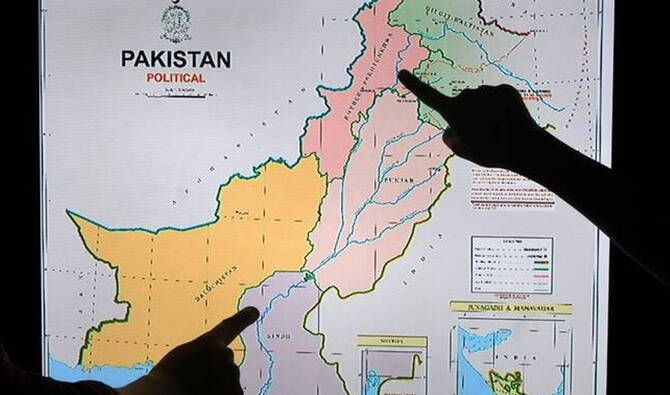

ISLAMABAD: Pakistan’s ruling Pakistan Muslim League-Nawaz (PML-N) has remained publicly silent after two of its coalition partners backed Interior Minister Mohsin Naqvi’s call last week to create new administrative units or provinces, reopening a long-running debate over how the country should be governed.
Naqvi, who is widely regarded as close to Pakistan’s military establishment, said last week the country’s decades-old governance system had “collapsed” and called for a national consensus on creating smaller administrative units, arguing that government needed to be brought closer to citizens.
Supporters of creating new provinces argue that Pakistan’s existing provinces have become too large and centralized to govern effectively, leaving many citizens far from provincial capitals where key administrative decisions are made. They say smaller provinces or administrative units would improve access to public services, strengthen local accountability and promote more balanced economic development. Critics, however, argue that redrawing provincial boundaries could inflame ethnic and regional tensions, trigger disputes over resources and political representation, and open a divisive constitutional debate in a country already grappling with political polarization.
The proposal is also politically sensitive because creating new provinces would require constitutional amendments and could reshape Pakistan’s political landscape. The PML-N and the Pakistan Peoples Party (PPP), the country’s two largest parties, derive much of their electoral strength from Punjab and Sindh respectively, and any change to provincial boundaries could alter political representation and administrative control.
It also remains unclear whether Naqvi was expressing a personal view or signaling broader thinking within the government or the establishment. Nor did he specify whether he was advocating entirely new constitutional provinces or some other form of administrative restructuring.
“This is not just our wish now. It has become a compulsion for this country, for this state to run,” Pakistan’s Health Minister Mustafa Kamal of the Muttahida Qaumi Movement-Pakistan (MQM-P), a key coalition partner, told Arab News, welcoming Naqvi’s proposal, saying restructuring had become a necessity rather than a political demand.
The MQM-P has long advocated creating another province in Sindh.
“We have been talking about this whole thing for many years,” Kamal said, adding that Naqvi’s statement was “music to our ears.”
Asked whether he expected support from PML-N ministers, Kamal said no formal discussion had taken place with the ruling party.
“At the end of the day, the people of Pakistan are the main stakeholders and people will decide what is to happen next,” he said.
Another coalition partner, the Istehkam-e-Pakistan Party (IPP), also endorsed the proposal. Privatization Minister Abdul Aleem Khan wrote on X that each of Pakistan’s four provinces should eventually be divided into three administrative regions, saying the move would spare citizens “long, exhausting, and humiliating journeys” to distant provincial capitals.
Many in Pakistan argue that Pakistan’s governance challenges stem less from the size of its provinces than from weak local government institutions. The country’s 18th Constitutional Amendment, passed in 2010, devolved significant powers from the federal government to the provinces and requires provinces to establish elected local governments. However, local bodies have often remained weak, underfunded or subject to long delays in elections, prompting many governance experts to argue that fully empowering municipal and district governments would bring decision-making closer to citizens without the need to redraw provincial boundaries.
The latest debate also recalls Pakistan’s “One Unit” policy, under which the provinces of West Pakistan were merged into a single administrative unit between 1955 and 1970. The arrangement was widely opposed by smaller provinces, which viewed it as undermining provincial autonomy, and later became one of several grievances in East Pakistan before the country’s breakup in 1971.
“SIMPLY NOT DOABLE“
Naqvi’s proposal faces significant constitutional and political hurdles.
“There is a procedure in the Constitution,” Sindh provincial minister Saeed Ghani of the PPP told Arab News by phone, noting that any change to provincial boundaries requires approval by a two-thirds majority in the affected provincial assembly.
“There is no benefit to this,” he added. “It will only cause harm.”
Some opposition figures also rejected the proposal. Sayed Zulfikar Bukhari of jailed former prime minister Imran Khan’s Pakistan Tehreek-e-Insaf (PTI) questioned whether the government had the mandate to pursue such sweeping constitutional changes.
“Foundations must be rock solid before cutting up the country further,” he said.
Several federal ministers from the ruling PML-N did not respond to requests for comment. However, former PML-N minister Khurram Dastgir Khan argued on X that creating smaller administrative units would not, by itself, solve Pakistan’s governance problems.
“The crisis of governance does not lie in the size of the administrative unit,” he said, arguing that the true solution lies in “empowered local governments.”
Independent analysts also questioned the feasibility of the proposal.
“It is simply not doable,” political commentator Suhail Waraich told Arab News. “Making new provinces is not only a deviation from history, geography, and experience, but in fact, it is the beginning of breaking Pakistan.”
Asked whether stronger local governments could offer an alternative to creating new provinces, health minister Kamal said both reforms were necessary.
“The local government’s constitutional amendment is compulsory whether you make the provinces or you don’t make the provinces,” he said.


