
OXFORD: Every new war in the Middle East is presented as an unprecedented crisis. Yet behind the headlines lies a pattern that stretches back more than a century — one in which unresolved disputes over borders, identity, statehood, foreign intervention and political legitimacy repeatedly erupt into fresh violence.
For Professor Eugene Rogan, one of the world’s leading historians of the modern Middle East, the region’s recurring instability cannot be understood by looking only at today’s conflicts. It requires tracing a line from the final decades of the Ottoman Empire through European colonial rule, military dictatorships, the Cold War and the upheavals unleashed by the 2011 uprisings.
Speaking to Arab News at the University of Oxford’s St. Antony’s College, the author of “The Arabs: A History” and “The Fall of the Ottomans” said the Middle East’s greatest handicap has been the absence of political systems that allow societies to determine their own futures.

“The challenge that countries in the Middle East and North Africa face is that they don’t have the kind of institutional consensus that allows their countries to have stable and continuous politics,” Rogan said.
In contrast with Western democracies, where constitutions evolved through public debate and political compromise, many Arab societies were denied that opportunity — and the effects show even to this day.
“I think this is where history’s legacy weighs on the Middle East,” he said, referring to Arab countries blighted by instability. “You’ve had a succession of repressive state systems that denied the people of the countries that chance to come and debate their political vision and realize it in their own terms.”

Prof. Eugene Rogan
Rogan traces that legacy back to Ottoman rule. “The Ottomans ... explicitly prevented people in the Arab world from organizing and talking about a different political future than being part of the Ottoman Empire,” he said.
European colonial powers simply replaced one form of repression with another. “The British and French alike clamped down on all nationalist societies and organizations. They imprisoned them, they intimidated them.”
After independence, hopes of representative politics were again frustrated as military coups swept across the region. “You have these military men coming to power, and they too oppose any political expression that’s not in line with their vision,” Rogan said.
The cumulative result, he argued, is a vast swath of the Middle East where people have rarely been allowed by strongmen to shape their political destinies. “It means that there’s not an investment in a political present that unites people in the Arab world.”
Few issues generate as much debate as the borders drawn after the First World War. Rogan argues they were never intended to create stable nation states. “Britain and France embarked on a kind of partition diplomacy,” he said. “Not with an aim to create a stable region, but rather to try and achieve an imperial balance of power.”

British soldiers enter the old city of Jerusalem to impose a curfew following Arab rioting against Jews during the British mandate in Palestine, 19 October 1938.
The colonial powers divided Ottoman territory according to imperial interests rather than local aspirations. “They didn’t see the Middle East as a region that would be exercising independence or autonomy. They saw it as territory that was going to come under their imperial umbrellas.”
Yet despite their artificial origins, today’s states have become political realities. “You can’t really wish away the existence of a Syria or an Iraq,” Rogan said. “Syrians and Iraqis, Lebanese, Jordanians, have all come to identify with the shape of the country that they were given.”
The greater instability, he argues, lies with peoples left without states. “So this leaves us really with the stateless, and that’s where the Palestinians and the Kurds come into the picture.”

A woman reacts by the grave of a loved one, a Kurdish fighter, at a cemetery in Syria's predominantly-Kurdish northeastern city of Qamishli on May 27, 2026. (AFP)
Kurdish communities divided between Iran, Iraq, Syria and Turkiye have endured decades of repression and repeated insurgencies.
But Rogan believes no issue has destabilized the region more than Israel and Palestine. “Israel-Palestine has got to be the most destabilizing of the conflicts in the region, and this very much a conflict with deep historic roots.”
The conflict, he noted, has driven repeated interstate wars before expanding since the Oct. 7, 2023, Hamas-led attack into wider regional confrontations.

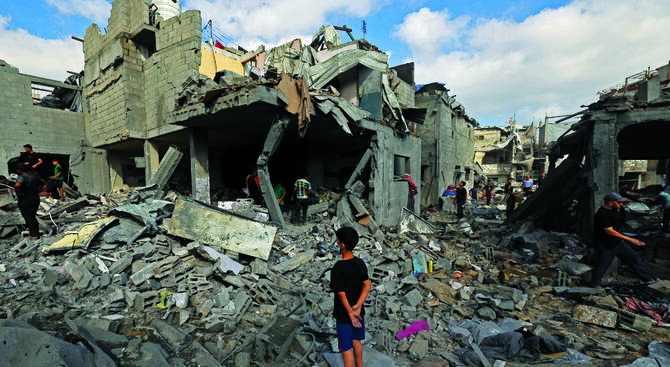
Palestinians walk past the destroyed buildings at the Al-Jalaa street following an Israeli strike in Gaza City on July 24, 2026. Gaza remains gripped by daily violence, with both the Israeli military and Hamas accusing one another of violating the truce in effect since October 10. (AFP)
While regional rivalries are significant, Rogan believes outside intervention has repeatedly intensified instability. “The instability in the Middle East is as much a feature of external pressures as of internal ones,” he said.
During the Cold War, Arab states became battlegrounds for Soviet-American competition. “The Arab-Israeli conflict almost became the proxy war of the Cold War itself.”
The end of the Cold War, he argues, made matters worse. “The Arab world found itself in a unipolar world of unbridled American domination.”
He points to the 2003 invasion of Iraq and the expansion of American military bases as turning points, arguing that more recent US support for Israel’s military campaigns in Gaza, Lebanon, and Iran has pushed the region to “the pinnacle of instability through outside intervention.”

US Army military police provide crowd control while Iraqi citizens line up for food and water being distributed to citizens in need 08 April 2003 near Al Najaf in Iraq. (AFP)
Yet Rogan is equally critical of the region’s own governments. “They have pretty consistently oppressed their people and have been very intolerant of dissent.”
Repression, he warns, often breeds violent alternatives. “Repressive states engender violent opposition,” he said. Militant organizations from Al-Qaeda to Daesh emerged partly from that environment.
The Arab uprisings of 2011 briefly appeared to offer another path. “It was peaceful civilian opposition ... saying: ‘Enough. Our governments are rotten and our opposition movements are rotten, and we the people demand a change.’”

Libyan rebel fighters attend the Friday noon prayer in Revolution square in the rebel stronghold city of Benghazi on July 22, 2011. Strongman Moammar Qaddafi was eventually toppled and killed in the uprising. (AFP file photo)
Instead, many uprisings descended into civil war. “They created power vacuums that would be filled by men with guns and more violence.”
For Rogan, no single explanation is sufficient. “There is a convergence of external and internal forces that play a very important role in explaining the conflicts of the region. There are no simple explanations to a region ... faced with deeply entrenched conflicts with no obvious sign of resolution.”
Despite the bleak picture, Rogan believes today’s upheavals mark more than another cycle of familiar crises. “I don’t think the old patterns of the past are surviving the violence of today,” he said. “I think something new is emerging.”
He sees the region entering “a moment of important transition,” although its eventual shape remains unclear. Among the greatest concerns, he said, is the perception that Israel, backed by the US, is reshaping the regional order through military power.
Rather than accepting another foreign-designed settlement, Rogan hopes regional powers will seize the initiative. “There is a deep consensus against succumbing to yet another vision of the Middle East as shaped by foreign actors.”

Arab leaders attend the opening session of the 34th Arab League summit in Baghdad on May 17, 2025. (AFP/file photo)
That could encourage “a core of Arab governments to work together to try and shape the architecture that they would like the region to live by.”
The challenge, however, is immense after years of conflict. The region has suffered, he said, “a period of unprecedented destruction and devastation, government failure, and humanitarian crisis.”
Still, he believes the opportunity exists. “There are a core of states that enjoy enough stability and have the material resources to take the lead here.”
His warning is stark.
“For those who fail to act in 2026 will be acted upon,” Rogan said. “And I think that governments in the region are conscious of that threat. And I hope that they act responsibly.”