
RIYADH: In a country where fresh water is manufactured rather than naturally abundant, every advance in desalination carries significant value.
Saudi Arabia’s vast desalination network supplies millions of homes, businesses and industries every day, transforming seawater into one of the Kingdom's most vital resources. But producing that water demands large amounts of energy, and maintaining efficient desalination systems remains a constant challenge.
Scientists believe an emerging class of materials known as zwitterionic hydrogels could help address that challenge.
FASTFACT
Did you know?
- Hydrogels create a water-rich barrier that keeps membrane surfaces cleaner.
- The technology could prolong membrane life and reduce energy and maintenance costs.
- Scientists are also testing it for wastewater treatment and atmospheric water harvesting.
Rather than replacing existing desalination technologies, researchers are developing zwitterionic hydrogels to enhance their performance. Applied as ultra-thin coatings on reverse osmosis membranes, these water-rich polymers form a highly hydrated protective layer that prevents bacteria, oil, proteins and organic matter from adhering to membrane surfaces while also reducing salt scaling — one of the leading causes of inefficiency in water treatment plants.
As Saudi Arabia accelerates investment in water security under Vision 2030, technologies that improve performance without requiring entirely new infrastructure are drawing growing attention. If successfully commercialized, zwitterionic hydrogel coatings could lower energy consumption, reduce maintenance costs and extend membrane lifespan, making one of the Kingdom's most essential industries more efficient and sustainable.
“Their most realistic role is not to replace commercial reverse osmosis membranes, but to improve them,” Noreddine Ghaffour, professor of environmental science and engineering at King Abdullah University of Science and Technology, told Arab News.
“The goal is to avoid oil, organic matter, proteins, bacteria and scale-forming species from accumulating on the membrane surface.”

Desalination plant. Jubail seawater reverse osmosis desalination plant in Saudi Arabia. (Lantania)
Membrane fouling remains one of the biggest operational challenges in desalination. As deposits accumulate, plants must operate at higher pressures to maintain water output, increasing electricity consumption, shortening membrane life and driving up maintenance costs.
“The realistic benefit is not a magic reduction in the thermodynamic energy of desalination,” Ghaffour said. “It is a reduction in the additional energy, cleaning and replacement costs caused by fouling, scaling and membrane aging.”
For Saudi Arabia, where desalination underpins national water security, even modest efficiency gains could deliver substantial environmental and economic benefits.
According to the Saudi Water Authority, the Kingdom’s desalination plants have a combined production capacity of about 11.1 million cubic meters of water per day, making Saudi Arabia the world’s largest producer of desalinated water. Operating in high-salinity waters and elevated temperatures, these facilities face particularly harsh conditions that accelerate membrane fouling and increase operating costs.
“I think Saudi Arabia is an ideal real-world proving ground for this technology, but also a very demanding one,” Ghaffour said.

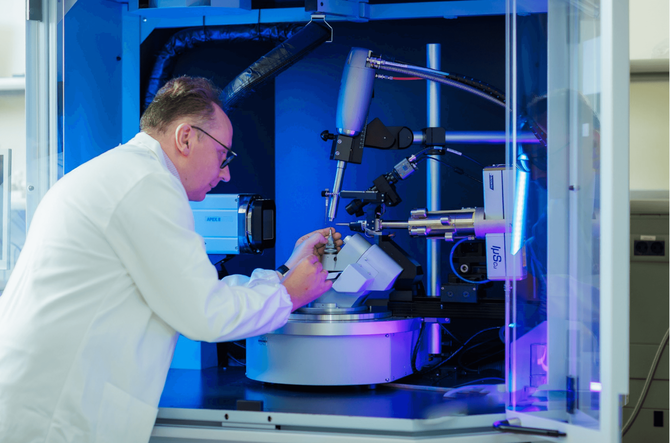
CaWater purification or desalination research in a laboratory. (KAUST)
Unlike conventional membranes, zwitterionic hydrogels act as protective surface coatings that create a stable hydrated barrier. This makes it more difficult for contaminants to adhere while allowing water to pass through efficiently. Researchers are also exploring their potential in wastewater treatment, industrial water reuse, atmospheric water harvesting and solar-driven water production.
Industry leaders see considerable promise in the technology but caution that its commercial success will depend on performance under real operating conditions rather than laboratory results alone.
Nizar Kammourie, CEO of SAWACO, said Saudi Arabia’s water sector is increasingly focused on producing water more efficiently and sustainably as demand rises from expanding cities and industrial projects.
“The main challenge today is not only producing more water, but producing it more efficiently, reliably and sustainably,” he told Arab News.

Nizar Kammourie, CEO of SAWACO
He said membrane fouling remains one of the industry’s most persistent operational challenges because it increases pressure requirements, raises energy consumption, shortens membrane life and necessitates more frequent chemical cleaning.
“Hydrogel materials are interesting because they are highly hydrophilic and can form strong hydration layers on membrane surfaces,” Kammourie said. “This helps resist the adhesion of organic matter, proteins, bacteria and other foulants.”
However, he cautioned that promising laboratory results alone are insufficient.
“In real plants, membranes must withstand pressure, cleaning chemicals, temperature variations, high salinity and long operating cycles," he said. "Mechanical robustness remains a key limitation for certain hydrogel systems.”
For water utilities, commercial adoption depends less on scientific novelty than on measurable operational gains.
“The first test is reliability,” Kammourie said. “Water infrastructure is critical infrastructure.”

Pipes, seawater intake or membrane filtration systems. (ACWA Power)
He said operators assess the total cost of ownership, including energy consumption, membrane lifespan, maintenance requirements, chemical use and downtime, before adopting new technologies.
Saudi Arabia’s broader investment in desalination innovation could help accelerate commercialization. The Kingdom is expanding energy-efficient reverse osmosis capacity while investing in local membrane manufacturing as part of its Vision 2030 strategy to strengthen water security and reduce environmental impact.
Ghaffour believes this growing industrial ecosystem positions Saudi Arabia to lead the next generation of membrane innovation.
“Saudi Arabia could become a strong validation and scale-up hub for next-generation membrane materials, particularly those designed for high-salinity seawater, brine, produced water, refinery wastewater and industrial wastewater reuse,” he said.
Kammourie said collaboration among research institutions, industry and government will be essential to move promising technologies from the laboratory into commercial desalination plants.
“It is essential,” he said. “No single party can move a technology from the laboratory to national-scale adoption alone.”
He said structured pilot projects with clearly defined performance indicators — including energy consumption, membrane lifespan, recovery rates and operating costs — will be crucial in determining whether advanced membrane technologies can deliver on their promise.
As Saudi Arabia continues to strengthen its water security, the future of desalination is likely to be shaped not by a single breakthrough but by a series of incremental innovations that make existing systems more efficient.
Alongside artificial intelligence, digital monitoring and expanded water reuse, advanced membrane materials such as zwitterionic hydrogels could become another important tool in helping the Kingdom produce more fresh water while consuming less energy, lowering operating costs and building a more sustainable water future.