

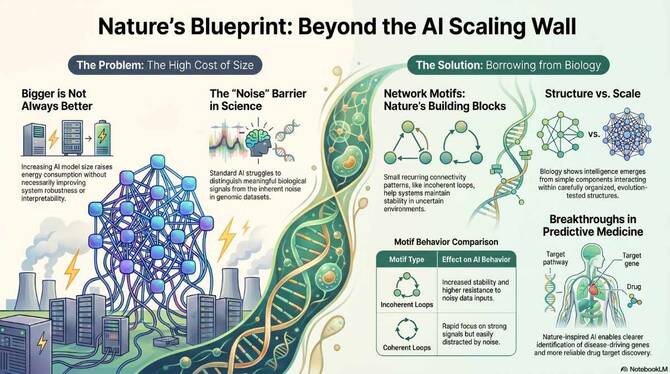

RIYADH: For years, the race in artificial intelligence has been driven by scale, with companies building ever-larger models trained on vast datasets. But researchers at King Abdullah University of Science and Technology believe the next leap forward may come not from making AI bigger, but from learning how nature processes information.
At KAUST, scientists are investigating how biological networks can help AI handle the rapidly expanding volume of life sciences data more efficiently.
“Nature has spent billions of years solving information-processing problems,” Jesper Tegner, professor of bioscience and associate dean of students in the Division for Biomedical Sciences at KAUST, told Arab News.
“The human brain, genetic regulatory networks, immune systems, and ecosystems are all examples of highly efficient, adaptive systems operating in noisy, uncertain environments.”
While recent advances in AI have largely come from increasing model size, data and computing power, Tegner argues that scale alone is not enough.
“Modern AI has largely focused on scaling, adding more parameters, data, and computing power, but biology suggests that structure matters as much as size,” he said.

KAUST scientists are investigating how biological networks can help AI handle the rapidly expanding volume of
life sciences data more efficiently. (Supplied)
“The question we asked was surprisingly simple: Could the way a network is wired be as important as its size?”
To illustrate the idea, Tegner compares AI to two cities with identical populations, roads and buildings. Their efficiency depends not on size, but on how those elements are connected.
“We wanted to understand whether the same principle applies to AI systems,” he said.
Studying recurring connection patterns found in biological networks, Tegner and his team discovered that intelligence depends not only on scale, but also on how simple components are organized.
“One striking lesson from biology is that intelligence often emerges from many simple components interacting within carefully organized structures,” he said.
“Biological systems do not simply maximize size; instead, they optimize their architecture.”
DID YOU KNOW?
• Nature has spent billions of years perfecting information-processing systems.
• A single cell contains thousands of interacting genes and proteins.
• Nature-inspired systems could improve disease detection and drug discovery.
The researchers examined two common biological network patterns and found that each affected AI differently. One made AI systems more resilient when processing noisy data, while the other responded faster but was more vulnerable to misleading signals.
The findings suggest that even subtle changes in an AI system's architecture can significantly influence how it learns and responds to uncertainty.
“Nature provides examples of architectures that have already been tested by evolution over vast timescales,” Tegner said.
The research could have particular significance for biology and medicine, where scientists increasingly depend on AI to interpret massive, highly complex datasets.
Modern biological research generates enormous volumes of information that are impossible to analyze manually. A single cell contains thousands of interacting genes, proteins and signaling pathways, producing data that are often noisy, incomplete and difficult to interpret.
“A single cell contains thousands of interacting genes, proteins, and signaling pathways,” Tegner said. “These systems are also noisy: Measurements are imperfect, biological processes are stochastic, and multiple mechanisms operate simultaneously.”

Researchers found that even subtle changes in an AI system's architecture can significantly influence
how it learns and responds to uncertainty. (Supplied)
Separating meaningful biological signals from background noise remains one of the field's biggest challenges.
“If AI systems become better at distinguishing genuine biological signals from background noise, researchers can gain more reliable insights into cellular states, disease mechanisms, and therapeutic responses,” he said.
More accurate AI could help identify disease-driving genes, uncover new drug targets, support biomarker discovery, detect diseases earlier, better predict patients' responses to treatment, and reveal biological pathways that might otherwise remain hidden.
Beyond the laboratory, such advances could improve diagnostics, enable more personalized treatments, accelerate drug discovery and support the shift toward predictive healthcare.
In the longer term, Tegner believes nature-inspired AI could help “move from reactive medicine toward predictive and preventive medicine.”
“By identifying subtle patterns earlier and more reliably, AI systems may enable interventions before diseases fully develop.”

Jesper Tegner, professor of bioscience and associate dean of students in the Division for Biomedical Sciences at KAUST. (Supplied)
Achieving that vision, he said, will require closer collaboration across scientific disciplines.
“Biology offers examples of highly effective information-processing systems, AI provides tools for modeling and learning from data, and computing supplies the infrastructure needed to test and scale those ideas,” he said.
“The future of scientific discovery will increasingly depend on integrating these perspectives rather than treating them as distinct domains.”
“The first generation of deep learning demonstrated that scale matters,” he said. “The next generation will likely show that structure matters as well.”
Nature, Tegner added, offers an immense repository of solutions refined over billions of years.
“Nature has spent billions of years learning to organize complex systems, and AI is only beginning to draw on those lessons,” Tegner said.


