

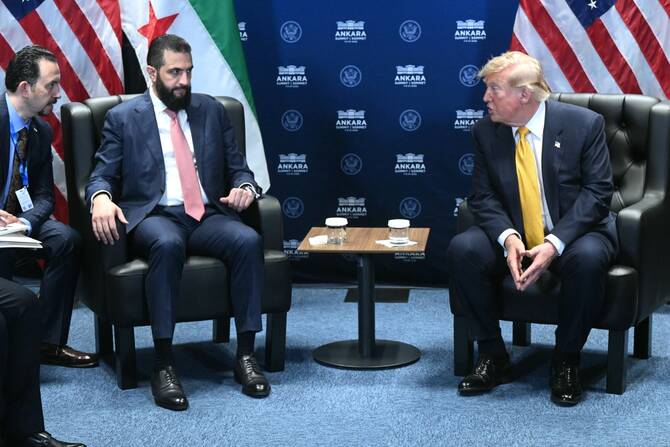

LONDON: US President Donald Trump on Wednesday appeared to soften his June suggestion that Syria could take on Hezbollah in Lebanon instead of Israel, but the idea continues to stir alarm because of Syria’s long history of interference in Lebanese affairs.
During a meeting with Syria’s interim president, Ahmad Al-Sharaa, on the sidelines of the NATO summit in Ankara, Trump was asked whether he still wanted Syria to help deal with Hezbollah in Lebanon.
“They could help, we’ll find out,” Trump told reporters. “I think we’re making a lot of progress.”
Even so, the proposal could revive one of Lebanon’s deepest anxieties: renewed Syrian involvement.
Al-Sharaa has publicly ruled out military intervention, saying in an interview with Al-Mashhad TV last month that Damascus wants to support regional stability through political, diplomatic and economic channels rather than armed involvement.
Trump’s remarks and Syria’s response were a central focus of a Middle East Institute online briefing on Wednesday.
David Hale, a distinguished diplomatic fellow at the institute, said relations between Syria and Lebanon carry “enormous baggage,” particularly under former presidents Hafez and Bashar Assad.
The Assads “never really reconciled themselves to Lebanon’s existence,” he said. “They viewed it as both a potential source of threats to them, as a landscape to battle Israel, (and) as a place to milk.”
By contrast, Hale said Lebanon is “probably more of a distraction than a focus” for Syria’s current leadership.
The shift reflects broader changes since Assad was ousted in December 2024, when a rebel offensive led by Al-Sharaa swept into Damascus. A transitional government was sworn in under Al-Sharaa in March 2025.
Since then, Damascus and Beirut have sought to rebuild relations, with the two countries last week establishing a committee to expand political, economic and security cooperation.

Syria's Foreign Minister Asaad Al-Shaibani (L) told Lebanese President Joseph Aoun his country does not want to intervene militarily in Lebanon. (AFP file photo)
Still, Hale said Trump’s comments should not be dismissed.
“I’m sure it’s taken seriously amongst his advisers,” he said. “But it does open a broader discussion about what is actually rational, what might be helpful, and what probably would not be.”
He said the proposal may appeal to Trump because it resembles the Nixon Doctrine, under which regional powers shoulder greater responsibility while the US reduces its direct role.
Hale also said Trump has been told the Lebanese Army is not yet capable of confronting Hezbollah and sees Al-Sharaa as a leader who also wants the Iran-backed group weakened.
“That’s the superficial appeal of the agreement,” Hale said.
But he warned that any Syrian military role in Lebanon would carry significant risks.
“When foreign countries occupy Lebanon, it’s very hard to extract them,” he said. Once Syrian forces entered, many Lebanese would immediately wonder how they could ever be removed.
Syria maintained a dominant military and political presence in Lebanon from 1976 until withdrawing in 2005, following years of influence over the country.
“That concern cuts against recent US policy,” Hale said. “American policy has had a remarkable breakthrough in the last 18 months, which is the effort to restore Lebanese sovereignty.
“So the last thing we need is to bring back Syria, which for so many decades actually was the agent of depriving Lebanon of that sovereignty.”
The debate comes as violence continues in Lebanon after Israel escalated military operations in the south following Hezbollah rocket fire. Lebanese officials say more than 4,200 people have been killed and about 1.2 million displaced, while Amnesty International said this week it had reasonable grounds to conclude Israeli forces violated international humanitarian law during the campaign.
Charles Lister, senior fellow and director of the Syria Initiative at the Middle East Institute, said relations between Lebanon and Syria have been transformed since Assad’s fall.
“We’ve gone from a position of de facto hostility to the Assad regime to a position of increasingly substantive engagement with the transitional government in Damascus,” he said.

President Trump on July 8 announced that he would remove Syria from the US list of state sponsors of terrorism. (AFP photo)
Even so, Trump’s proposal places Syria in a difficult position.
“The idea that Syria could or should militarily intervene in Lebanon is an absolute non-starter in Damascus,” Lister said, adding that Syria lacks both the political will and the resources for such an operation.
“This is still a country that can barely pay its own public sector salaries,” he said. “This is not a country that is prepared to go to war across a nation-state border, and particularly one with such complexity and sensitivity as Lebanon.”
Lister said Al-Sharaa has consistently argued that the era of Syrian tutelage in Lebanon is over, making any military intervention politically impossible.
“So the prospect of being coerced or encouraged to militarily intervene in a neighboring country, let alone Lebanon, is a poison cyanide pill that would kill everything that Al-Sharaa has sought to build over the last 18 months,” he said.
At the same time, Lister said Al-Sharaa does not want to alienate Trump.
He said the Syrian leader understands the proposal lacks broad support within the wider US government but is nevertheless trying to reinterpret Trump’s comments as referring to political rather than military assistance.
“Al-Sharaa is also aware that this is a pretty wild idea that doesn’t have a great deal of depth within the rest of the US government structures,” Lister said.
“But he knows very clearly that this is something he’s going to have to bridge, which is why I think he’s trying to kind of reinterpret or redefine President Trump’s words to suggest it doesn’t have to be a military intervention.”
He added that Syria could “play another positive role.”
Trump first floated the idea publicly on June 16 during the G7 summit in France, arguing that Israel’s campaign against Hezbollah had dragged on too long and become too indiscriminate. He said at the time that Syria could “take care of Hezbollah” because “they’d do a better job of doing it.”


