

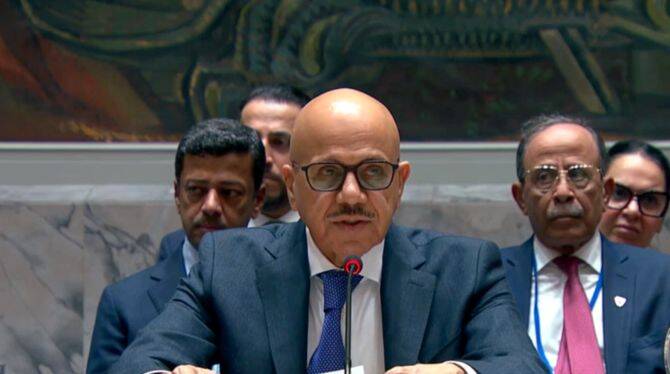

NEW YORK: Bahrain’s foreign minister flew to New York on Thursday to demand action from the UN Security Council after what he described as a “renewed and treacherous” Iranian attack on his country this week, as the US and Russia clashed sharply over responsibility for the escalation.
Foreign Minister Abdullatif bin Rashid Al-Zayani told the emergency session, called at Bahrain’s request, that his country had endured 808 attacks since Feb. 28, including 203 ballistic missiles and 605 armed drones, killing three civilians and wounding 465 others, including women and children. He said the latest strikes came despite Bahrain signing a memorandum of understanding with Washington on June 17.
“Bahrain requested this emergency meeting confident that this council will not remain a bystander in the face of such a blatant challenge to its authority,” Al-Zayani said, adding that the aggression extended beyond his country, with coinciding attacks on Kuwait International Airport and a drone strike on the UAE’s Barakah nuclear power plant that he said brought the region “to the brink of a nuclear safety disaster.”
He said the attacks violated the UN Charter and Security Council Resolution 2817, which was backed by 136 member states.
US Ambassador Mike Waltz delivered one of the sharpest rebukes of Iran, saying he had personally visited strike sites in Bahrain, including the Bahrain Petroleum Company, where he said Iranian forces deliberately targeted fire suppression lines and first responders before hitting fuel tanks and chemical storage areas in a manner designed to maximize casualties. He said a drone that failed to explode near a residential neighborhood could have killed two to three thousand people.
Waltz said Iran’s closure of the Strait of Hormuz had inflicted lasting damage on 61 developing economies, according to a UN Trade and Development report issued this week, and accused Tehran of using the waterway to “hold the world’s economy hostage” regardless of who signs onto its conflict with Israel and the US.
He said that 136 countries co-sponsored Resolution 2817 and that Gulf states had rallied a further 143 co-sponsors on a separate draft resolution circulated in May condemning Iranian mining of the strait.
Waltz also raised the case of two young men, Javad Zamani and Abolfazl Saedi, whom he said were executed in Iran 10 days ago on charges of “waging war against God,” and cited Amnesty International reporting on the detention and alleged torture of protesters. He warned that US President Donald Trump’s “patience is not unlimited” and that Iran must abide by its obligations under Resolution 2817.
Asked by Arab News what he believes should be the Security Council’s next step, Waltz pointed to the draft resolution condemning Iran over recent sea mine deployments and attacks on commercial shipping in the strait.
He said the council should let the measure move forward, or at minimum begin negotiating on it, framing this as the body’s necessary next move — one that would also open the door to humanitarian aid urgently needed for East Africa’s growing season.
Saeid Iravani, Iran’s ambassador, rejected the accusations, telling the council that Washington and Israel bore “full responsibility” for the wars afflicting the region.
He said the council itself had failed in its duty by not holding the US and Israel accountable, arguing that this inaction had “reinforced impunity and emboldened further unlawful acts.”
Iravani said Iran had exercised its “inherent right of self-defense” under the UN Charter by striking US military facilities and bases in the region, and warned Iran would continue defending its sovereignty if attacks persisted or the US continued violating the Islamabad agreement.
Anna Evstigneeva, Russia’s deputy permanent representative to the UN, backed Iran’s self-defense argument, saying US military sites in Bahrain and Kuwait were “logical targets” that did not enjoy immunity, though she said deliberate strikes on civilian infrastructure, wherever located, were unacceptable.
She said the “root cause” of the escalation was what she called US-Israeli aggression against Iran and voiced regret that Gulf states had been “held hostage” to the exchange between Washington and Tehran.
UK Ambassador James Kariuki condemned what he called Iran’s reckless attacks on Bahrain, Kuwait and shipping in Hormuz, saying they violated Resolution 2817, and called for the restoration of transit passage through the strait free of tolls or threats.
Pakistan’s Ambassador, Asim Iftikhar Ahmad, said Islamabad’s mediation, which produced the Islamabad MoU, reflected “a victory of robust and determined diplomacy,” noting talks between US and Iranian negotiators in Doha on Wednesday made “positive progress” and would continue.
UN Assistant Secretary-General for Peacebuilding Elizabeth Spehar gave the council a chronology of the past week, including drone strikes on the Singapore-flagged vessel Ever Lovely and the Panama-flagged tanker Kiku on June 25, followed by US strikes on Iranian coastal military infrastructure in Hormozgan province on June 26 and 27, and Iranian missile and drone strikes on Ali Al-Salem Air Base in Kuwait and the US Fifth Fleet headquarters in Bahrain overnight into June 28.
Spehar said the US and Iran agreed on June 28, following Qatari mediation, to cease attacks on each other, with indirect talks in Doha on implementing the agreement now underway.
She welcomed the deescalation but warned that “each new strike, each new interception, each new maritime incident increases the risk of miscalculation,” urging all parties to exercise maximum restraint and uphold the protection of civilians and freedom of navigation.


