

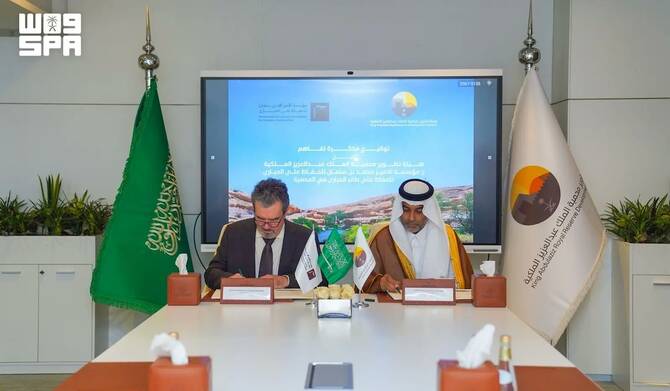

RIYADH: The King Abdulaziz Royal Reserve Development Authority has signed a memorandum of understanding with the Prince Mohammed bin Salman Foundation for Houbara Conservation to support national efforts to protect the endangered bird and reintroduce the houbara bustard into its natural habitats, contributing to the sustainability of ecosystems across the Kingdom.
The memorandum focuses on developing specialized programs to reintroduce the houbara bustard into the King Abdulaziz Royal Reserve, while leveraging scientific and technical expertise in breeding, release, monitoring, and tracking programs, reported the Saudi Press Agency.
The agreement also supports efforts to provide a safe and sustainable environment for the endangered bird by developing suitable movement corridors and reducing potential threats, including challenges associated with power lines.
In addition, it seeks to raise public awareness of the importance of wildlife conservation and the combating of illegal hunting.
The houbara bustard holds special environmental and cultural significance in the Kingdom and across the Arabian Peninsula due to its role in maintaining the natural balance of desert ecosystems.
Programs to restore its wild populations represent one of the Kingdom’s leading national initiatives to enhance biodiversity and protect native species.
As part of the Rewild Arabia initiative, the Prince Mohammed bin Salman Royal Reserve reintroduced the Asian houbara bustard in January 2026, after an absence of more than 35 years from the site.
The reintroduction formed part of a renewed, science-led approach to conserving a bird that has shaped cultural life in the Arabian Peninsula.
A total of 20 Asian houbara have been released into the Prince Mohammed bin Salman Royal Reserve, as part of a collaboration between the reserve, the National Center for Wildlife, and the Prince Mohammed bin Salman Foundation for Houbara Conservation, which aims to establish viable wild populations of the bird in the Kingdom.
The historic range of the Asian houbara (Chlamydotis macqueenii) extends from Egypt to China.
The Asian houbara is today classified by the International Union for Conservation of Nature as critically endangered across the Arabian Peninsula. Its population is in continued decline despite decades of conservation efforts and captive breeding programs.


