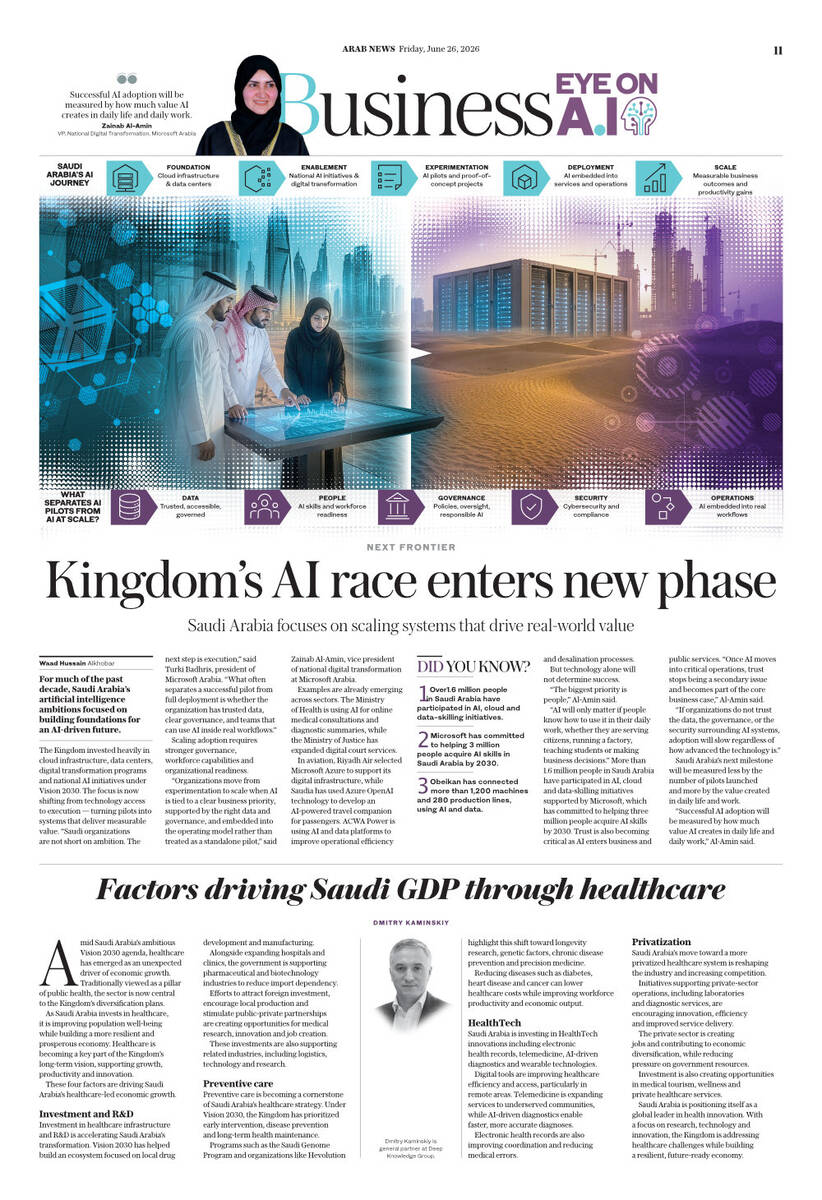
- The Kingdom focuses on scaling AI systems that drive real-world value
ALKHOBAR: For much of the past decade, Saudi Arabia’s artificial intelligence ambitions have been focused on building the foundations.
The Kingdom has invested heavily in cloud infrastructure, data centers, digital transformation programs and national AI initiatives under Vision 2030, as government entities and technology companies worked to expand digital capabilities across sectors.
Today, however, the conversation is evolving. As AI tools become increasingly accessible, industry leaders say the biggest challenge is no longer access to technology. Instead, the focus is shifting toward execution — transforming successful pilot projects into scalable systems that deliver measurable value across organizations and industries.
“Saudi organizations are not short on ambition. The next step is execution,” said Turki Badhris, president of Microsoft Arabia.
“What often separates a successful pilot from full deployment is whether the organization has trusted data, clear governance, and teams that can use AI inside real workflows.”

The challenge is becoming more pressing as organizations move beyond experimentation and begin embedding AI into everyday operations.
While many businesses have already tested AI applications, scaling these initiatives often requires broader changes in governance, workforce capabilities, cybersecurity practices and organizational culture.
“Organizations move from experimentation to scale when AI is tied to a clear business priority, supported by the right data and governance, and embedded into the operating model rather than treated as a standalone pilot,” said Zainab Al-Amin, vice president of national digital transformation at Microsoft Arabia.
Examples of large-scale AI deployment are already emerging across Saudi Arabia.
Manufacturing company Obeikan has connected more than 1,200 machines and 280 production lines, using data and AI to improve visibility, predict downtime and increase operational efficiency by up to 30 percent.

everyday operations rather than isolated pilot projects. (Microsoft Arabia)
In the public sector, the Ministry of Health is using AI to support online medical consultations and diagnostic summaries, while the Ministry of Justice has expanded digital court services through real-time dashboards and collaboration tools.
Other industries are beginning to see similar gains. In aviation, Riyadh Air selected Microsoft Azure to support its digital infrastructure, while Saudia has used Azure OpenAI technology to develop an AI-powered travel companion for passengers. In the energy sector, ACWA Power is using AI and data platforms to enhance operational efficiency and improve desalination processes.
Large-scale developments are also exploring how AI can reshape daily operations. Qiddiya, for example, is using Microsoft 365 Copilot and Power BI to improve visibility across contractors, assets and financial workflows.
Yet technology alone will not determine success.
Industry leaders increasingly argue that the next phase of AI adoption will depend on whether organizations can build the skills, governance frameworks and trust required to deploy AI responsibly.
“The biggest priority is people,” Al-Amin said.
“AI will only matter if people know how to use it in their daily work, whether they are serving citizens, running a factory, teaching students or making business decisions.”
Workforce readiness has therefore become a central pillar of Saudi Arabia’s AI strategy. More than 1.6 million people in Saudi Arabia have participated in AI, cloud and data-skilling initiatives supported by Microsoft, while the company has committed to helping three million people acquire AI skills by 2030.
At the same time, government-led programs are expanding efforts to strengthen digital literacy and AI capabilities across the workforce, as demand for technical and operational AI skills continues to rise.
Trust is emerging as another defining factor.

(Microsoft Arabia)
As AI becomes integrated into business processes and public services, organizations are placing greater emphasis on cybersecurity, data governance, transparency and responsible AI frameworks.
“Once AI moves into critical operations, trust stops being a secondary issue and becomes part of the core business case,” Al-Amin said.
“If organizations do not trust the data, the governance, or the security surrounding AI systems, adoption will slow regardless of how advanced the technology is.”
Looking ahead, experts believe Saudi Arabia’s AI progress will be measured less by the number of pilot projects launched and more by the real-world value those systems create.
“Successful AI adoption will be measured by how much value AI creates in daily life and daily work,” Al-Amin said.
As Saudi Arabia enters the next phase of its AI journey, the challenge is no longer simply building the technology. It is ensuring that institutions, workforces and governance systems are prepared to deploy it effectively at scale.