

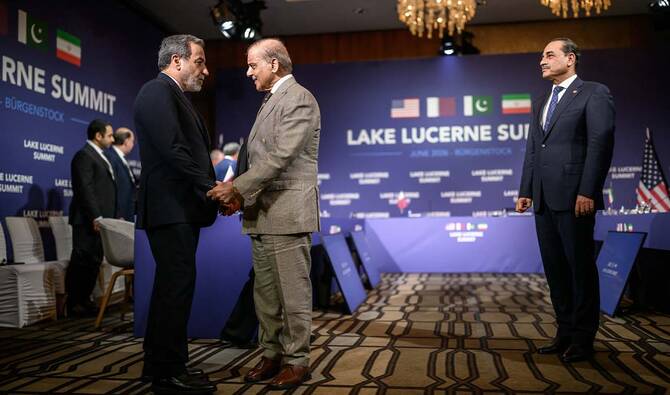

ISLAMABAD: Pakistan’s Deputy Prime Minister and Foreign Minister Ishaq Dar said on Thursday the country’s role in helping defuse the US-Iran conflict had transformed its international standing, arguing that Islamabad is now regarded as a “middle power and net security provider” whose next ambition should be to emerge as an economic power.
Dar’s remarks come after Pakistan helped broker diplomatic contacts between Washington and Tehran following the recent conflict, culminating in the two sides’ first high-level direct talks in more than four decades in April and an agreement on a framework for future negotiations.
The conflict, triggered by joint US-Israeli strikes on Iran in February, rattled global energy markets after Tehran closed the strategic Strait of Hormuz, through which about a fifth of the world’s oil supplies pass, and heightened fears of a wider regional war as Iran retaliated against US military bases and other targets in the Gulf.
Pakistan publicly condemned the initial attack on Iran, urged restraint on all sides and later helped facilitate a ceasefire between Washington and Tehran. The US and Iran are now holding technical-level talks in Switzerland, with Pakistani and Qatari officials facilitating the process as they seek to build on the framework agreement signed earlier this month.
“Pakistan was isolated for several years,” Dar said during a televised media interaction in Lahore. “Compare the number of countries that engaged with Pakistan two or three years ago with the situation today.”
“Pakistan’s image has improved considerably,” he added. “We are already a nuclear and missile power. Now our goal is to become an economic power.”
Dar said Pakistan was viewed internationally “as a peacemaker, a middle power and a net security provider,” crediting Islamabad’s sustained diplomatic efforts in recent months.
He maintained that much of Pakistan’s international engagements had been deliberately kept out of public view because mediators must preserve the confidence of both parties.
“We acted only as an honest facilitator,” he said, adding that Prime Minister Shehbaz Sharif, Field Marshal Asim Munir and the Foreign Office had engaged in extensive shuttle diplomacy and back-channel contacts throughout the process.
Dar said Pakistan also acknowledged the roles played by Qatar, Saudi Arabia, China, the United Arab Emirates, Türkiye and Egypt, describing the diplomatic outcome as the product of a collective effort.


