

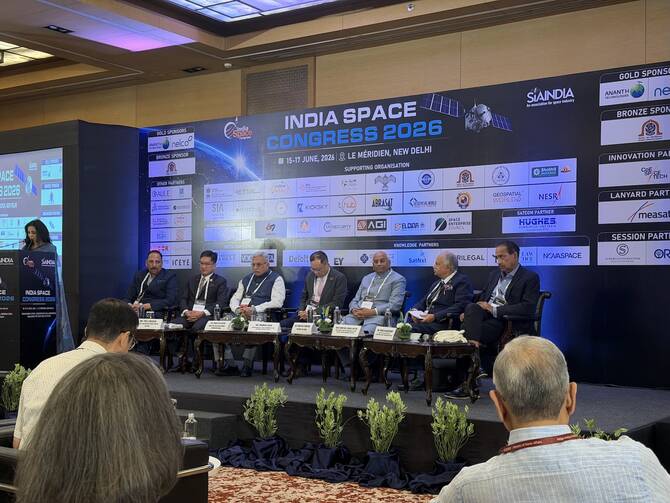

NEW DELHI: Policymakers, representatives of global space agencies and industry leaders gathered in New Delhi on Monday for the India Space Congress 2026 to discuss new partnerships, market creation and industrial scale-up.
Organized by the Space Industry Association of India, the congress is one of the largest gatherings of the space ecosystem in the region. It is taking place in the Indian capital for the fifth time, bringing together some 600 participants from over 20 countries.
Over three days, sessions and workshops will focus on satellite communications, direct-to-device connectivity, Earth observation, geospatial intelligence, launch systems, in-orbit servicing, navigation, cybersecurity, artificial intelligence, space sustainability, and space manufacturing.
“We bring in experts in space technology, space law, policies, new technologies … (It) is about re-imaging the entire space program more in the collaborative mode because India has a lot of expertise,” said Dr. Subba Rao Pavuluri, president of the Satcom Industry Association, which co-organized the event.
The event also serves as a platform for private sector cooperation, as India’s space economy seeks to expand to $44 billion by 2033.
Private companies have been a major driver in this effort since 2020, when the government opened the space sector more broadly to their participation by allowing them to build and operate satellites and offer private launch services.
This transformed the role of private firms from suppliers into independent space operators, with partnerships across the country and abroad.
“Government only looks after the exploration activities — on the moon, Mars, planetary positions — and the private sector is getting to manufacture the satellites, launch,” Pavuluri said.
“With countries in the Middle East, we also have collaborations … We can make satellites for them, we can have them launched in India, and from the education point of view, we can collaborate with them in order to bring their students to India, so they can be trained in making satellites. In other words, the satellites don’t need to be imported from the Western world.”
By participating in the congress, companies gain broader access to the space ecosystem.
“It’s a good and very ambitious place to be looking at all the companies and the ecosystem that is evolving in India with the support from the government,” said Shivam Singh, business development manager, VyomIC, a space-tech startup building India’s first private low-earth orbit positioning, navigation, and timing satellite constellation.
“It’s always great to collaborate and work with other companies to come up with fruitful results or to benefit the larger ecosystem and to benefit the country and the world as a whole.”
For Aveek Pal, chief of staff at ULOOK, a startup focused on space-based radio-frequency intelligence, it also offers the opportunity to present the company’s work and achievements.
“This is a platform that helps us showcase what we are building,” he said. “It brings in conversations which are extremely meaningful and valuable. We are able to connect to a lot of partners, exchange ideas and also demonstrate our capabilities to a larger audience.”


