

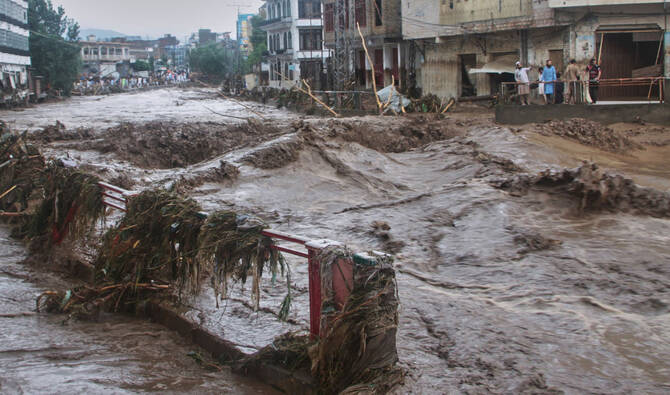

PESHAWAR: The Provincial Disaster Management Authority (PDMA) on Saturday warned of glacial lake outburst floods (GLOFs) and flash flooding in Pakistan’s northwestern Khyber Pakhtunkhwa province, amid untimely rains and rising temperatures in the country.
Pakistan, one of the countries most affected by climate change, has experienced heavy rainfall, flash floods, heatwaves, droughts, and GLOF events that have caused widespread destruction in recent years.
Parts of the country have experienced sweltering heat, with daytime temperatures soaring above 35 degrees Celsius in recent weeks. The rise in temperatures may increase snowmelt while rainfall in certain districts can lead to overflow of glacial lakes.
The PDMA has issued an alert for Upper and Lower Chitral, Upper and Lower Dir, Swat, Upper and Lower Kohistan, and Mansehra districts, warning of flood, landslide, rock and mudslide risks in these areas.
“Due to severe heat and rainfall, glaciers and snow in northern districts are melting rapidly,” the authority said. “The increased water flow caused by rainfall has raised the risk of GLOFs and flash floods.”
The PDMA said sudden flooding in streams and rivers could trigger flood situations in low-lying areas, adding that local administrations were directed to continuously monitor vulnerable locations.
It said district administrations were directed to issue timely warnings in high-risk areas, conduct evacuation drills, ensure essential supplies are available at safe locations, activate alert systems, and strengthen coordination with local disaster management committees.
The PDMA has advised the public to stay away from rivers, streams, fast-flowing water channels during the heatwave, and avoid unnecessary travel.
Five persons were killed and 23 injured in several rain-related incidents in Pakistan’s Punjab province this week, a rescue official said. At least 1,000 people were killed last year when intense monsoon rains, combined with excess water released from Indian dams, triggered flash floods across the country.


