

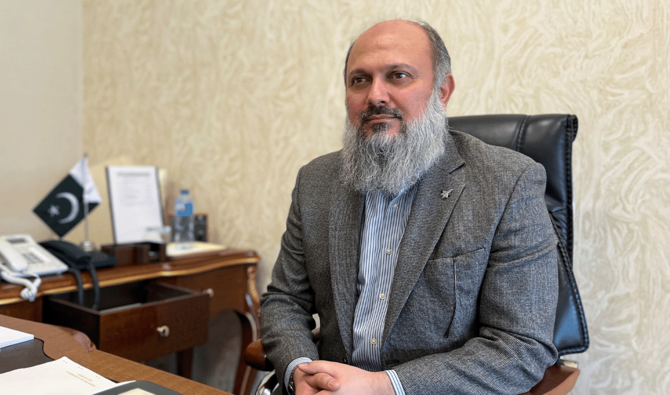

ISLAMABAD: Pakistan’s new federal budget and ongoing tariff reforms are aimed at attracting foreign investment and making the country a more competitive destination for business, Commerce Minister Jam Kamal Khan said on Friday, while warning that tensions around the Strait of Hormuz continue to weigh on regional trade and investor confidence.
Pakistan unveiled a Rs18.77 trillion ($67.49 billion) federal budget on Friday, targeting 4 percent economic growth in the next fiscal year starting July 1 as it seeks to move from economic stabilization under a $7 billion International Monetary Fund (IMF) program toward faster, investment-led expansion.
The budget includes tax relief measures for businesses and follows a broader government effort to gradually lower customs and regulatory duties.
“What we have tried to present in the current budget is a very friendly environment for investors,” Khan told Arab News after Finance Minister Muhammad Aurangzeb presented the fiscal plan.
The minister said the government’s economic strategy extends beyond the budget and includes a multi-year tariff reform program designed to lower the cost of doing business, improve competitiveness and encourage both domestic and foreign investment.
“For the last one year, the government of Pakistan has initiated a tariff policy where there is a constant reduction in all the custom duties, in the regulatory duties,” he said.
Khan said lower tariffs would make it easier for Pakistani businesses, particularly small and medium-sized enterprises, to import quality raw materials and intermediate goods while also making the country a more attractive market for international companies.
“So this constant depreciation of the tariff lines in the next three years is an indication that Pakistan is going to be a very open market where we are giving competitiveness, chance for people to come in, work in Pakistan, companies to come and do business in Pakistan.”
The minister said the government had also sought to address long-standing complaints from the business community about Pakistan’s tax structure, including through changes announced in the latest budget.
“That has been addressed in this budget for us, for the whole business community,” he said.
The budget includes reductions in the super tax for larger businesses, lower taxes on property transfers and cuts in some withholding taxes, measures the government hopes will encourage investment while maintaining fiscal discipline under the IMF program.
Khan said the reforms were being implemented at a time when regional instability remained one of the biggest obstacles to investment, pointing to tensions involving the United States and Iran and their impact on trade through the Strait of Hormuz, one of the world’s most important shipping and energy supply routes.
“We are expecting a lot of investment from many other countries in the region,” he said. “But as you know, the region is quite turmoil at this moment.”
The minister said countries across the region were hoping for a resolution of the crisis because the restoration of normal trade flows through Hormuz would improve investor confidence and unlock new economic opportunities.
“We are all hopeful that when the Strait of Hormuz is going to open up, that is the biggest thing which every country is now working on,” Khan said.
He said Pakistan was continuing to play a diplomatic role aimed at easing tensions and helping restore stability in the region.
“Pakistan has played its role, still is playing its role,” he said.
Pakistan has emerged as a key venue in recent diplomatic efforts between the US and Iran, hosting direct talks and facilitating communication between the two sides as negotiations aimed at ending months of conflict continue.


