


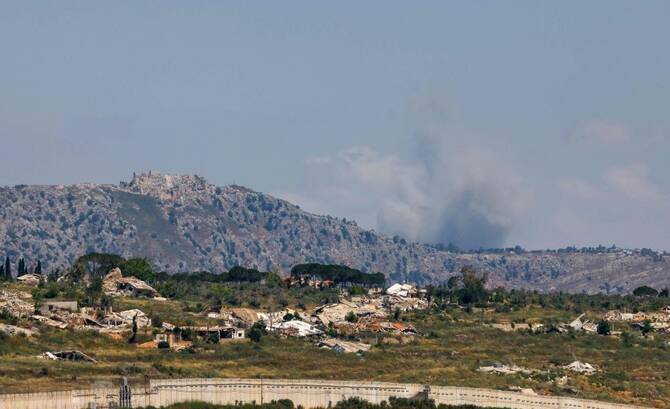
BEIRUT: Lebanese authorities said that the country’s archaeological heritage is increasingly at risk as military operations expand throughout the border region.
The warning came as Israel intensified its bombardment of Tyre on Sunday after ordering residents to leave districts that include the city's archaeological zone, a UNESCO World Heritage Site containing some of the best-preserved Roman ruins in the Mediterranean.
The developments coincided with growing concern over other heritage sites in southern Lebanon, including Beaufort Castle, after Israeli forces announced last month that they had taken control of the strategic UNESCO-listed hilltop fortress, known as Qalaat Al-Shaqif.
In a statement issued on Monday, the directorate dismissed a media campaign by Israeli outlets, which have circulated video clips and maps claiming the Beaufort Castle site harbors Hezbollah military infrastructure.
The ministry stressed that responsibility for Beaufort Castle has rested entirely with the Directorate General of Antiquities since Israel withdrew from southern Lebanon in 2000.
As for the allegations of tunnels or military installations beneath the fortress, it said a closer look at the maps and footage now in circulation makes clear that they lie far from the castle and its immediate vicinity, with no link to the heritage site whatsoever.
“Any strike on the site, or any effort to justify exposing it to destruction or damage, amounts to a flagrant breach of international agreements and of the legal protections afforded to cultural property in times of armed conflict,” the culture ministry said.
Sarkis Khoury, director general of Lebanon’s Directorate General of Antiquities, told Arab News that Israel has shown no regard for the international conventions that Lebanon has signed on protecting heritage sites.
“We raised blue shields over every site classified by UNESCO, yet they failed to keep Israeli warplanes and artillery at bay,” he said.
Of the 73 sites on Lebanon’s lists, he noted, most lie in the south, stretching from Sidon to Naqoura and deep into the border villages, including the ruins of Tyre and the castles of Tibnin, Beaufort and Chamaa.
As the Israeli incursion into southern Lebanon advanced, Prime Minister Nawaf Salam said in a statement issued at the end of May: “Nothing justifies the continued attacks on the Tyre and Nabatieh regions and the destruction of their historic landmarks, or the persistent threats against their residents. These actions amount to collective punishment, which is condemned by all international norms and laws.”
In Nov. 2024, during the previous war between Israel and Hezbollah, UNESCO granted 34 heritage sites in Lebanon “provisional enhanced protection.”
The organization warned that “non-compliance with these clauses would constitute “serious violations” of the 1954 Hague Convention and its Second Protocol for the Protection of Cultural Property in the event of armed conflict, drawn up in 1999, which would constitute potential grounds for prosecution.”
Five months later, UNESCO added 39 more Lebanese sites to the list.
The city of Tyre, a UNESCO World Heritage Site, is home to some of the most significant Phoenician, Roman and Byzantine archaeological remains.
Culture Minister Ghassan Salameh told Arab News that the ministry has urged the international community to take immediate action to ensure the protection of Beaufort Castle and prevent it from becoming part of any military operations.
His media office added that he has contacted relevant international organizations to draw attention to the extensive damage inflicted on archaeological sites and historic neighborhoods in southern Lebanon, particularly in Tyre, Beaufort Castle and other heritage sites that benefit from UNESCO’s enhanced protection status.
While the ministry of culture continues to monitor damage to archaeological and historical sites on a daily basis, Khoury accused Israel of not respecting the maps submitted to UNESCO in its attacks.
He confirmed that on Sunday, the Tyre maritime archaeological site was bombed, and land sites were being targeted the following day.
“This is a cultural war aimed at erasing Lebanon’s connection to its roots,” Khoury told Arab News.
Khoury said the danger extends beyond direct strikes on archaeological sites. The explosive power of rockets and artillery shells can cause significant structural damage even when they land nearby.
“We have observed the shifting of capitals on Roman columns from their original positions,” he said, noting that preliminary scientific assessments suggest vulnerable structures could suffer gradual deterioration that may eventually lead to partial collapses.
According to Khoury, the threats facing heritage sites during the current conflict differ markedly from those in previous wars in southern Lebanon. In the past, risks largely stemmed from military occupation, the use of sites for military purposes, neglect, unregulated urban expansion and limited funding for preservation.
Today, he said, the danger comes from sustained airstrikes, drone attacks, artillery bombardment, mass displacement and the expansion of military operations. Archaeological sites are being affected not only by direct hits, but also by shockwaves, shrapnel, fires, damaged access roads and restrictions preventing inspection and restoration teams from reaching them.
“An archaeological site does not always need a direct hit to be damaged,” Khoury said. “Sometimes a nearby strike is enough to weaken its ancient stone structure” and accelerate deterioration that would otherwise have taken years to occur.
Khoury said Lebanon has submitted reports documenting the damage and that UNESCO could take further steps, including treating attacks on protected heritage sites as potential war crimes before international judicial bodies.
He said Lebanon had complied with international procedures designed to protect cultural property. Blue shields were placed on designated heritage sites, and the ministry of defense formally certified that the Lebanese army does not use those locations for military purposes.
The ministry of culture’s move was an attempt to place heritage within the international protection agenda, not within the cultural margins of war.
Jaafar Fadlallah, an academic archaeologist, said the South, which is now paying the price of military escalation, is itself a repository of diverse and rich heritage comprising fortresses, tombs, ancient roads, religious sites, and accumulated historical layers from the Phoenicians to the Romans to the Crusaders, the Middle Ages, and the Islamic era.
“The more hostile operations expand and intensify, the more archaeological areas find themselves at the heart of danger, even if they are not declared targets,” he told Arab News.
“This is what makes Lebanese action necessary on more than one level.”
He called the attacks as targeting Lebanon’s “history, geography, culture, and the environment; in short, it is the erasure of memory.”
The Israeli aggression, he said, is destroying public squares to markets, old houses, and road networks.
Regarding Israel’s claim of a Hezbollah tunnel near Beaufort Castle and the possibility of the castle being destroyed amid the hit-and-run attacks between the Israeli army and Hezbollah, Fadlallah said the Israeli army had previously occupied the historic castle during the 1982 invasion and remained there for years.
“Today, it has returned to it, and we do not know if it is equipped with maps of the crypts within the castle, crypts that Lebanon had not previously discovered,” he said.
“The lower layers of the castle may contain additional archaeological remains, and we do not know what will become of them.”
Israeli forces had used Beaufort Castle as a base during their occupation of southern Lebanon between 1982 and 2000.
Fadlallah said the current war is more destructive than previous wars on the South “because it is wiping entire villages off the map, turning the South into a scorched land with neither monuments nor memory.”
Israeli airstrikes during the previous war in 2023 on the South targeted the Phoenician city of Tyre, causing significant damage to the Roman Hippodrome and some surrounding sites, as well as the Crusader castle of Tebnine, Mays Castle in Ansar, the historic mosque of Blida, the shrine of Prophet Benjamin in Mhaibib, the shrine of Prophet Shimon in Shamaa, and mosques in Blida, Shebaa, Yaroun, Al-Dhahira, Tayr Debba, Kfar Tibnit, Majdel Selem, and the church of Derdghaya.
The strikes were not limited to archaeological sites but included the destruction of the historic Nabatieh commercial market, which is part of the city’s social and cultural identity.




