


ISLAMABAD: Pakistan on Monday rejected criticism by some members of British parliament over the deteriorating law and order situation in Azad Jammu and Kashmir (AJK) following widespread protests, saying the regional government respects constitutional rights of citizens but it cannot allow violence under any circumstances.
At least seven people, including four law enforcement personnel and three protesters, have been killed in clashes that began last week as a political dispute between the government and a recently proscribed rights group over reserved legislative seats deepened ahead of regional elections.
British MP Imran Hussain and others on Saturday wrote a letter to UK Foreign Secretary Yvette Cooper over the deteriorating situation in the region and urged him to address communications blackouts, arrests and rising tensions in Azad Kashmir.
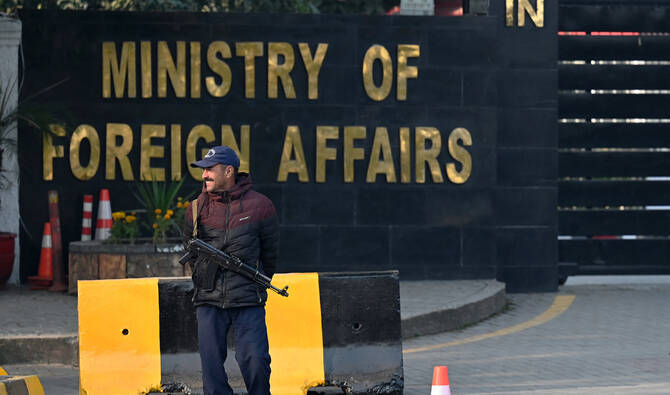
In a statement issued on Monday, Pakistan’s foreign ministry said it has noted the “unwarranted remarks and queries” raised by the British parliamentarians, which reflected a “lack of awareness and disregard for the historical background of the issue.”
“The Governments of Pakistan and Azad Jammu and Kashmir fully recognize and respect the constitutional rights of citizens to peaceful assembly, freedom of expression, and democratic participation. However, vandalism, the destruction of public services, including hospitals, and the murder of innocent civilians and law enforcement officials cannot be permitted under any circumstances,” the Pakistani ministry said.
“We urge the British Government to educate and caution those supporting proscribed organizations to refrain from such actions and to respect the democratic process, judicial decisions, and the rule of law as enshrined in the Constitutions of Azad Jammu and Kashmir and Pakistan.”
The unrest marks the most serious escalation yet in a months-long confrontation between the AJK government and the Joint Awami Action Committee (JAAC), a civil rights alliance that has campaigned on economic and governance issues in the past but has recently focused on a demand to abolish 12 seats in the regional assembly reserved for refugees from Indian-administered Kashmir who settled in Pakistan after 1947.
The dispute comes ahead of legislative elections scheduled for July 27 in the mountainous region, which lies within the broader Kashmir territory claimed in full by both India and Pakistan but administered in parts by each. The AJK government banned the rights alliance on June 5, citing reports about its involvement in “potential violence, acquisition of weapons, attacks on law-enforcement personnel, and plans to disrupt normal life.” JAAC denies the allegations and says its struggle for rights is peaceful.
JAAC called for protests across AJK on June 9 after talks with Pakistan’s federal government failed to resolve the dispute over the refugee seats. The group argues that the reserved seats allow Pakistan’s mainstream political parties to influence government formation in AJK and has demanded their immediate abolition.
However, JAAC’s campaign suffered a setback on Sunday when the AJK Supreme Court observed that the seats enjoy constitutional protection and cannot be abolished through executive or administrative action.
The Pakistani foreign ministry also raised concern about the “irresponsible and ill-informed insinuations” made regarding AJK by certain members of the diaspora in the UK.
“These individuals are advised to refrain from interfering in the internal affairs of Pakistan and Azad Jammu and Kashmir. They would do well to contribute positively to their country of residence,” it said.


