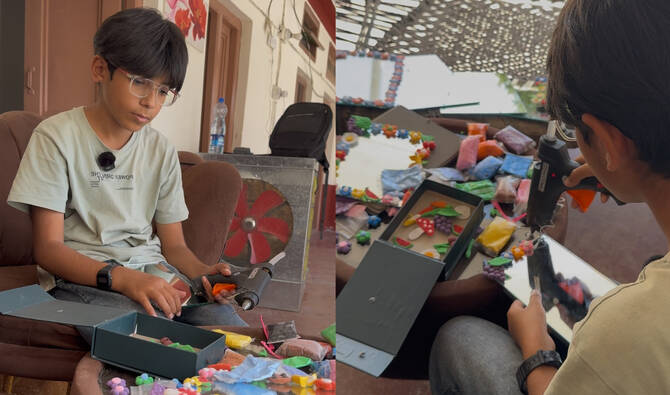

ISLAMABAD: With his glasses slipping down his nose and bits of colored clay pressed beneath his fingernails, nine-year-old Muhammad Ibrahim spends hours shaping tiny flowers, leaves and fruit by hand around cracked mirrors salvaged from his family home on the outskirts of Islamabad.
What began as a child’s attempt to repair a broken household mirror has unexpectedly turned into a source of income for a family struggling to cope with the mounting costs of his mother’s cancer treatment.
Earlier this month, Ibrahim uploaded a short Instagram video showing himself transforming an old mirror into a brightly decorated frame using play-dough and glue. The video, posted on May 16 on an account managed by his father, has since been viewed more than 5.1 million times, attracting over 500,000 comments and hundreds of thousands of likes.
But the attention did not emerge in isolation.
In recent months, Ibrahim’s family had begun posting videos documenting the breast cancer diagnosis of his mother, Nausheen, whose own social media following once centered on special effects makeup tutorials before illness reshaped both her life and the family’s finances.
“I got the idea of starting a business [via social media] to help my mother with her treatment,” Ibrahim told Arab News while carefully pressing a clay rose onto the edge of a mirror frame.
“I was wondering what to do when I got the idea of decorating my mirror. I always wanted to start a business. And when people commented on my video to make a mirror for their mother or for themselves, I got inspired.”
The family lives in a modest two-bedroom home surrounded by open fields on Islamabad’s rural fringes, where much of daily life now revolves around hospital visits, medicine schedules and fulfilling online orders one mirror at a time.
Each piece takes between five and six hours to complete, according to Nausheen, who works alongside her son to shape, varnish and package the handcrafted mirrors.
“When I was diagnosed, I felt maybe I was doing something wrong,” she said, explaining how she moved away from more sensational online content after learning she had cancer and instead began making awareness videos.
As treatment costs grew, the family gradually shifted from content creation to selling handmade crafts through social media.
“Now my treatment has become very complicated. Medication has become very expensive. Life has become very tough,” Nausheen said.
“So now everyone has to work.”
The mirrors, priced between Rs1,800 and Rs2,500 ($6.40 and $8.90), are intentionally kept affordable, she said, because many customers buy them as gifts for parents or family members.
“We don’t ask for financial support,” she added. “We request that people support us. Watch our videos.”
The sudden online popularity has created both opportunity and pressure for Ibrahim, who says he is trying to balance schoolwork with the growing number of orders arriving through Instagram.
“I have 10 days off for Eid, so I want to make as many orders as possible,” he said.
“I have received a lot of orders, but I can’t make it that fast.”
Despite the growing business, his mother insists education remains the priority.
“He is a position holder,” she said proudly. “God has willed it, my son is a business-minded child… He will study and move forward in life.”
“I WANT TO BE A BUSINESSMAN”
Behind the family’s story also lies a broader reality faced by many digital creators in Pakistan, where monetization options on global platforms remain limited.
Ibrahim’s father, Ali Haider, who previously worked as a rider for a bike-hailing service, said the family turned seriously toward social media after medical expenses became overwhelming.
“Cancer is a kind of disease that even if a person has treasures, it can drain them,” he said.
“So, I made a decision that I should turn to social media and start earning from here.”
While Haider quickly built audiences on TikTok and Facebook, he said creators in Pakistan continue to face structural barriers, including the absence of Instagram monetization and limited access to international payment systems such as PayPal.
Without direct payment infrastructure, many small creators rely on intermediaries who take commissions from earnings and customer payments.
“Now Instagram is an app from which the world is earning,” Haider said.
“But there is no monetization [of Instagram] in Pakistan.”
“Our government can do something about it. So that creators at a low level can be helped.”
For now, the family hopes to expand the small business beyond mirrors into keychains and other handmade items they can eventually sell at exhibitions and local fairs.
For Ibrahim, however, the work still carries the quiet concentration of childhood craft, even as it has become tied to responsibilities far beyond his years.
“I don’t want to do a job,” he said softly while smoothing the edge of another tiny mirror.
“I want to be a businessman.”