

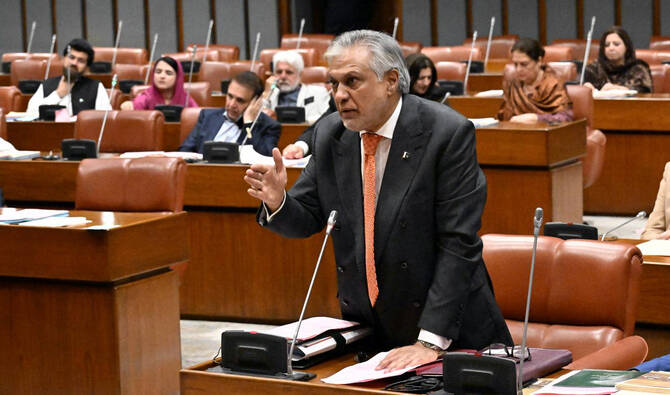

ISLAMABAD: Pakistan’s Deputy Prime Minister and Foreign Minister Ishaq Dar said on Wednesday Islamabad remained in close coordination with China throughout the recent US-Iran-Israel conflict, highlighting deep strategic ties between the two countries amid efforts to promote regional peace and stability.
Dar made the remarks while addressing Pakistan’s Senate in the presence of a visiting Chinese parliamentary delegation as Islamabad and Beijing mark 75 years of diplomatic relations.
Pakistan and China have maintained close strategic cooperation across diplomacy, defense, infrastructure and regional connectivity, particularly under the China-Pakistan Economic Corridor (CPEC), a flagship project of China’s Belt and Road Initiative.
During the recent Middle East conflict, the two countries also jointly promoted a five-point peace initiative calling for a ceasefire, dialogue, protection of civilian and nuclear infrastructure, safe navigation through the Strait of Hormuz and adherence to the United Nations Charter.
“Throughout the conflict between US and Iran and Israel, we have been in constant touch with my counterpart, Foreign Minister His Excellency Mr. Wang Yi, as well as the other colleagues from the region,” Dar told lawmakers.
He said he visited Beijing on Mar. 31 at the invitation of Chinese Foreign Minister Wang Yi, where the two sides developed the five-point peace proposal, which he said reflected the shared sense of responsibility toward regional stability between the two countries.
“We came up with a five-point initiative for peace plan in the conflict, and this has been accepted and endorsed by dozens of countries on the globe,” he added.
The deputy prime minister said coordination between Pakistan and China at the United Nations, the Shanghai Cooperation Organization and other international forums had been “vital in defending the interests of developing countries and promoting global peace.”
He also said Prime Minister Shehbaz Sharif would visit China from May 23-26, during which the two sides would hold meetings on CPEC and broader bilateral cooperation.
Dar said Sharif would meet Chinese President Xi Jinping, Premier Li Qiang and Chinese business leaders during the visit.
He described CPEC as central to Pakistan’s economic development and said the next phase of the corridor, known as CPEC 2.0, would focus on industrialization, agriculture, information technology and socio-economic development.


