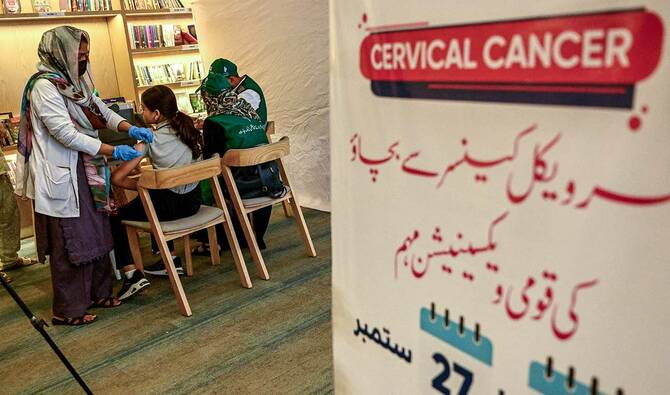

ISLAMABAD: Health Minister Syed Mustafa Kamal said on Tuesday that Pakistan must achieve self-sufficiency in producing vaccines by 2030, warning that it would otherwise have to pay a costly $1.2 billion to import them.
Pakistan currently imports almost all of its finished vaccines, data from the World Health Organization and UNICEF states. Public health experts say heavy dependence on imported vaccines leaves Pakistan vulnerable to global supply disruptions and contributes to an annual vaccine import bill exceeding $250 million.
Pakistan has made attempts to produce vaccines locally in the past couple of months, with the federal cabinet approving the country’s first-ever National Vaccine Policy. In February, Pakistani health authorities held discussions with a visiting Saudi delegation to explore partnership in the production of vaccines in Pakistan. Kamal had said Islamabad was “very close” to reaching an agreement with Riyadh that would enable it to produce vaccines locally.
Pakistan bears 49 percent of vaccine financing itself while the remaining 51 percent is supported by global donors. However, global vaccine assistance is expected to end by 2030, which would increase Pakistan’s vaccine expenditure from $400 million to approximately $1.2 billion, Kamal said at a conference in Islamabad.
“Pakistan will have to pay $1.2 billion in 2030,” Kamal said. “Just imagine, in this fragile economy, in this weak economy of ours today, will we have so much money that we can take out $1.2 billion from our economy and import?“
The minister noted that Pakistan imports 13 types of vaccines to boost its population’s immunization. He warned that if the country compromises on the vaccines it imports, then it would create a horrific situation for millions of patients across Pakistan.
He stressed the need for Pakistan to produce vaccines indigenously, saying the process itself will take time before results appear.
“Because this will not happen in a day, in a week. It takes at least one-and-a-half year to three years,” Kamal said. “If you start today, you will be able to do it in 3 years.”
Pakistan, a country of over 240 million people, regularly holds national immunization campaigns against diseases such as polio, measles, rubella and hepatitis. It plans to hold an anti-polio nationwide vaccination campaign on May 18 to vaccinate 19 million children against the disease.
Officials say local production of vaccines could enable Pakistan to become a regional supplier once its facilities meet WHO prequalification standards.