

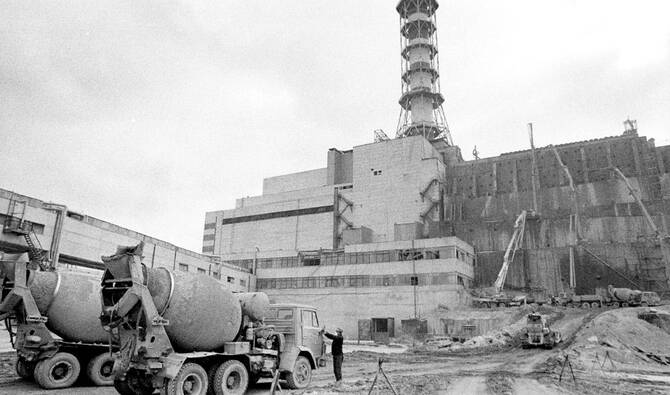

ISLAMABAD: President Asif Ali Zardari said on Sunday that Islamabad remains committed to maintaining the highest standards of nuclear safety and security, as the international community observes the 40th anniversary of the Chernobyl disaster that exposed millions to radiation.
On Apr. 26, 1986, an explosion at the Chernobyl Nuclear Power Plant spread a radioactive cloud over large parts of the Soviet Union, which are now the territories of Belarus, Ukraine and the Russian Federation. Nearly 8.4 million people in the three countries were exposed to the radiation.
Since the accidental explosion, thousands have succumbed to radiation-related illnesses such as cancer, although the total death toll and long-term health effects remain a subject of intense debate.
“As president, I reaffirm Pakistan’s commitment to maintaining the highest standards of nuclear safety and security,” a statement from the Pakistani president’s office said.
“We support international efforts that promote responsible conduct, strengthen safeguards and reduce the risk of such disasters.”
Zardari noted that the disaster’s anniversary compels the world to recognize “the long reach of radiation,” adding that exposure does not end at the boundaries of a facility nor within a single generation.
“It spreads across regions and persists over time, affecting public health, the environment and economic life in ways that are often irreversible,” he said.
The Pakistani president said that the UN, along with partner organizations, supported affected communities through research, health interventions and recovery programs. He said this effort reflects the scale of the challenge and the need for continued vigilance.
Zardari said the incident points to the lesson that nuclear safety cannot be treated as a technical matter only.
“It requires consistent discipline and strong oversight with a clear understanding of the risks involved,” he said. “Any negligence or hostile action involving nuclear installations can have consequences that extend far beyond the immediate target.”
He said Pakistan supports international efforts to promote responsible conduct, strengthen nuclear safeguards and reduce the risk of such disasters.
“The experience of Chernobyl remains a serious reminder that the margin for error in this domain is extremely narrow and the cost of failure is borne by generations,” Zardari warned.


