


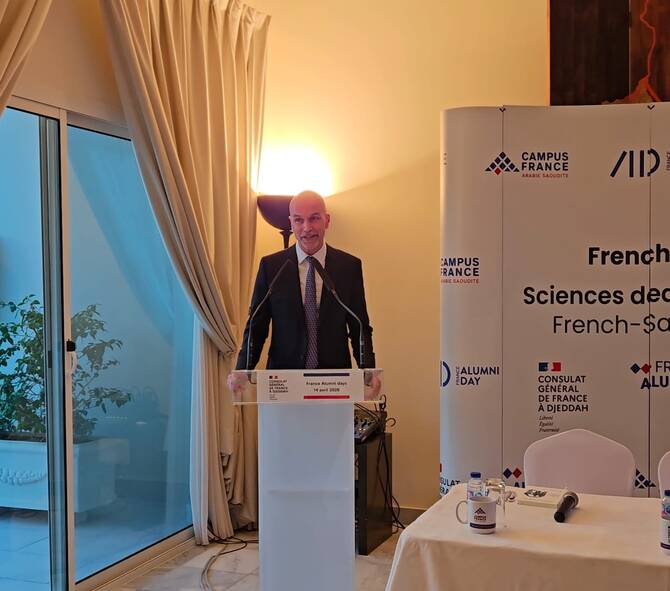

Jeddah: The role of science in addressing environmental challenges and strengthening Franco–Saudi academic cooperation was highlighted at a recent roundtable organized by the Consulate General of France in Jeddah, bringing together researchers, academics, and students from both countries.
Held as a part of France Alumni Day, the discussion titled “Science in the Service of the Environment: Franco–Saudi Crossed Perspectives” focused on environmental innovation, research mobility, and academic collaboration.
France’s Consul General Mohammed Nehad told Arab News: “This initiative is part of our ongoing efforts to reinforce scientific dialogue between France and Saudi Arabia.
“It also highlights the role of French higher education in supporting academic excellence and research. France is not only a cultural and tourist destination, but also a major actor in science and innovation.”
He stressed that a key objective was to make academic pathways clearer and more accessible to students and researchers. “Many people want to collaborate or study abroad, but they do not always know where to start.
“We try to show them the programs available, the institutions they can contact, and the funding mechanisms that exist. The goal is to give them practical entry points.”
He added that interdisciplinary research was central to addressing current environmental challenges and said academic exchange benefits both countries’ long-term development goals.
Gilles Lubineau, mechanical engineering professor at the King Abdullah University of Science and Technology and director of the ENERCOMP program between KAUST and Saudi Aramco, moderated the roundtable and described the platform as a means to connect scientific communities.
“We were really acting as a bridge between the French and Saudi academic communities. The idea was to show what opportunities exist, what programs are available, and how students and researchers can collaborate, even for short-term exchanges.”
He added that the discussion helped clarify practical steps for cooperation. “The point was to give people the keys to start — who to contact, what funding mechanisms exist, and which institutions are involved.
“We had colleagues from King Abdulaziz University, Jeddah University and others across chemical engineering, health sciences, mechanical engineering and water engineering. There is real interest in how to ignite collaborations and send students abroad.”
He also highlighted the value of multidisciplinary training.
“France is very strong in multidisciplinary (efforts). You work with teams combining mathematics, biology, mechanics and that is exactly what is needed to tackle modern problems. Moreover, these students gain a first international experience, and that is very important.
“We already see students who went to France now returning as postdoctoral researchers. They bring back their experience, and it benefits both countries.”
From the Saudi side, KAUST doctoral scholar and future postdoctoral researcher at the Institute of Supramolecular Science and Engineering in Strasbourg, Osamah Al-Harbi, who spent three months conducting research in France, said the experience had a strong impact on his academic development.
“I explored my idea in an institute that is very deep in science. It was a very interesting opportunity for a young scientist starting his career.”
He added that the program helped connect research with real-world environmental challenges.
“We were reflecting on our research and how it relates to important environmental issues that need to be investigated scientifically. We also discussed how scientific mobility influences careers and improves research outcomes.
“There are many potential avenues for cooperation between Saudi and French institutes in climate change, renewable energy and materials science.”
“I encourage everyone who is interested in research to try. You may not be sure you will get selected, but you should still apply. Even the process itself is valuable. If we want to build an economy based on innovation, we need to focus on science,” he added.
KAUST doctoral candidate in plant sciences, Ibrahim Tarbiyyah, also emphasized the importance of scientific exchange and exposure to different research environments.
“When I was in France, I was learning. Great science exists here at KAUST, but there you meet scientists with different ideas and approaches. Science does not come from books alone; it comes from experience and when you work with different people, you learn more.”
He said the roundtable highlighted the importance of openness in research. “Science should not stay in one place with the same information. If you stay isolated, you will not learn something new. It is a very good opportunity for French and Saudi cultures to come together through science.”
The panel discussion included French speakers Emmeric Frejafon, deputy head of the Environment, Earth and Universe Department at the French Ministry of Higher Education and Research.
Philippe Maitre, vice president of the Ecole normale superieure Paris-Saclay, and Saudi speaker Meshal Al-Malki, a doctoral candidate at the Micalis Institute, Universite Paris-Saclay, also participated.


