

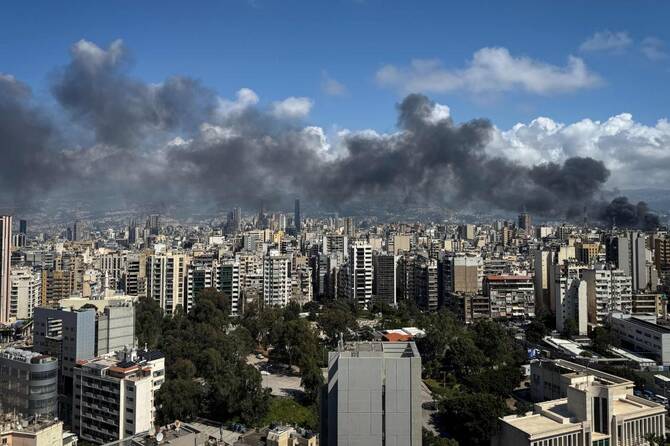

DUBAI/BEIRUT: Israel bombed more targets in Lebanon on Thursday, putting the Middle East ceasefire in further jeopardy after its biggest attacks of the war on its neighbor killed more than 250 people and threatened to torpedo Donald Trump’s truce from the outset.
Prime Minister Benjamin Netanyahu said Israel would keep hitting Hezbollah “wherever necessary,” the day after deadly Israeli strikes pummelled Lebanon.
“We are continuing to strike Hezbollah with force, precision, and determination,” Netanyahu said on his personal X account.
“Our message is clear: anyone who acts against Israeli civilians — we will strike them. We will continue to hit Hezbollah wherever necessary, until we fully restore security to the residents of the north” of Israel, he added.
Meanwhile, Israel’s military said it was continuing ground operations in southern Lebanon, where troops have been fighting Hezbollah and holding positions since early March.
In a separate statement, it said it had struck overnight “two key crossings used by Hezbollah terrorists and commanders for movement from north to south of the Litani River in Lebanon to transfer thousands of weapons, rockets, and launchers.”
It added that it had struck “approximately 10 weapons storage facilities, launchers, and command centers” belonging to the Lebanese armed group.
Ceasefire breach
Iran's President Pezeshkian condemned Israel’s actions, saying attacks on Lebanon would deem ceasefire negotiations meaningless
Both Netanyahu and Trump have said that Lebanon was not included in the ceasefire agreement, contradicting with the original statement by Pakistan when it was first announced.
And Iran’s parliament speaker Qalibaf also said the ceasefire proposal included Lebanon and the entire ‘axis of resistance’.
Death toll mounts
Lebanon’s health ministry said at least 203 people were killed and more than 1,000 wounded in widespread Israeli strikes in central Beirut and other areas of Lebanon on Wednesday, when Israel intensified its attacks on the Iran-backed Hezbollah militant group, which joined the war in support of Tehran.
The death toll was the highest for a single day in Lebanon during more than five weeks of renewed war between Israel and Hezbollah.
Lebanese cabniet bans Hezbollah activities
Lebanon’s cabinet on Thursday instructed security forces to restrict weapons in Beirut exclusively to state institutions, a day after Israeli strikes across the country including in the heart of the capital.
“The army and security forces are requested to immediately begin reinforcing the full imposition of state authority over Beirut Governorate and to monopolize weapons in the hands of legitimate authorities alone,” Prime Minister Nawaf Salam said at the end of a cabinet meeting.
The Lebanese government banned Hezbollah’s military activities at the beginning of March, shortly after the start of war with Israel, but the decision has not stopped the group from conducting military operations.
Iran warns against continued attacks on Hezbollah in Lebanon
Iran warned continued Israeli attacks on Hezbollah in Lebanon will bring ‘explicit costs and STRONG responses.’
The warning came as Iranian negotiators were expected to set off later on Thursday for Pakistan for the first peace talks of the war, where they are due to meet a delegation led by US Vice President JD Vance on Saturday. But there was no sign Iran had lifted its blockade of the Strait of Hormuz, which has caused the worst disruption to global energy supplies in history, and Tehran said there would be no deal as long as Israel was striking Lebanon.
The supply shortage drove the price that European and Asian refineries were paying for a physical barrel of oil to record levels near $150 a barrel, with even higher prices for some products such as jet fuel.
Israel, which invaded Lebanon last month in parallel with the war on Iran to root out the armed group Hezbollah, Tehran’s ally, says its actions there are not covered by the ceasefire announced late on Tuesday by US President Donald Trump.
Washington has also said Lebanon is not covered by the truce, but Iran and Pakistan, which acted as mediator, say it was explicitly part of the deal.
A host of countries, including prominent US allies Britain and France, said the truce should extend to Lebanon and condemned Israel’s attacks on the country.
Hezbollah chief’s newphew killed
The Israeli military said on Thursday it had killed the nephew of Hezbollah’s Secretary-General Naim Qassem, who had served as his personal secretary, and had struck river crossings used by the group overnight.
Israel struck Beirut’s southern suburbs just before midnight and at dawn, and hit towns across the south on Thursday morning, Lebanese state media said.
For its part, Hezbollah, which had initially said it would pause attacks on Israel in line with the ceasefire, said it was resuming them on Thursday morning and had fired once across the border into Israel and twice at Israeli forces in southern Lebanon.
Rescuers across Lebanon were working through the night to try to save wounded people trapped under rubble of destroyed buildings after the Israeli attacks, which hit heavily populated areas without customary warnings for civilians to flee.
“This is my place, this is my house, I’ve been living here like more than 51 years. So, everything destroyed. See?” said Naim Chebbo, sweeping shattered glass and debris from his home in Beirut after strikes destroyed the building next door.
(With agencies)


