


DUBAI/WASHINGTON: US President Donald Trump once again exhorted Iran to make a deal by his Tuesday deadline, saying a “whole civilization will die tonight” if an agreement is not reached to end the conflict.
“A whole civilization will die tonight, never to be brought back again. I don’t want that to happen, but it probably will,” Trump said in a post on Truth Social.
“We will find out tonight, one of the most important moments in the long and complex history of the World.”
Following Trump's statement, Vice President JD Vance said the US had largely accomplished its military objectives in Iran.
Meanwhile, Iran’s ambassador to Pakistan, which is mediating between Iran and the United States, said that efforts to end the war were approaching a “critical” stage.
“Positive and productive endeavours in Good Will and Good Office to stop the war is approaching a critical, sensitive stage,” Ambassador Reza Amiri Moghadam wrote on X, without giving details.
The message came hours before a deadline set by US President Donald Trump for Iran to open the Strait of Hormuz to shipping or face attacks on key infrastructure.
Later on Tuesday, a senior Iranian source told Reuters that Iran had rejected any temporary ceasefire with the US, demanding any negotiations be based on a permanent peace deal.
Iran’s ambassador to Kuwait urged Gulf states on Tuesday to find a way to avert a “tragedy”, as US President Donald Trump’s evening deadline loomed for Iran to agree a deal or face strikes on civilian infrastructure.
“We hope that the countries in the region will use all their diplomatic and political capabilities to prevent such a tragedy from befalling the region,” Mohammad Toutounji said.
Meanwhile Iran and Israel traded attacks on Tuesday as Tehran defiantly refused to reopen the Strait of Hormuz and accept a ceasefire deal on the eve of a deadline set by US President Donald Trump to agree to his demands or get “taken out.”
Iran previously rejected a US proposal brokered by Pakistan for an immediate ceasefire and the lifting of its effective blockade of the strait, followed by talks on a broader peace settlement within 15 to 20 days, according to a source aware of the plan.
The Iranian response consisted of 10 clauses, including an end to conflicts in the region, a protocol for safe passage through the Strait of Hormuz, lifting of sanctions, and reconstruction, official IRNA news agency reported.
On Monday, Trump said “the entire country can be taken out in one night, and that night might be tomorrow night.” He vowed to destroy Iranian power plants and infrastructure if Tehran refused to agree before the deadline.
Without a deal, Trump said “every bridge in Iran will be decimated” by midnight EDT (0400 GMT) on Wednesday and “every power plant in Iran will be out of business, burning, exploding, and never to be used again.”
Iran sets preconditions
Iran set preconditions for talks on a lasting peace with the United States, a senior official told Reuters on Tuesday, including an immediate halt to strikes, guarantees that attacks will not be repeated, and compensation for damage.
The official said Tehran rejects any ceasefire with the U.S. that is only temporary.
He added that a permanent peace deal should allow Iran to demand fees for ships passing through the Strait of Hormuz, which would vary depending on the type of ship, its cargo, and prevailing conditions.
Qatar warns region ‘close’ to point where war escalation cannot be controlled
Qatar on Tuesday warned thw war in the Middle East was close to a threshold where it cannot be controlled after US President Donald Trump set a deadline for Iran to reopen the Strait of Hormuz.
“We have been warning since 2023 that escalation left unchecked will get us into a situation where it cannot be controlled and we are very close to that point and this is why we have been urging all parties to find a resolution to find a way of ending this war before it’s too late,” Qatar’s foreign ministry spokesman Majed Al-Ansari said.
Fighting unabated
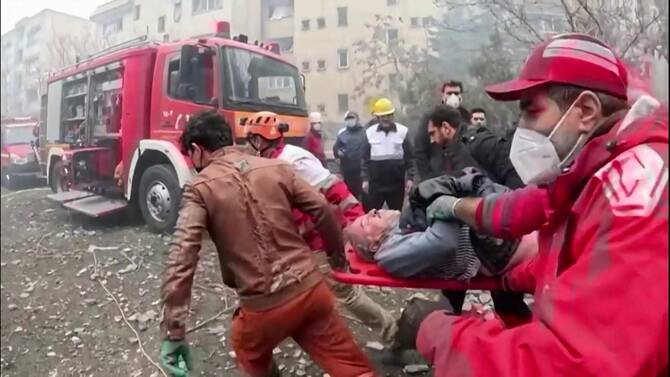
Early on Tuesday, the Israeli military said it had completed a wave of airstrikes targeting Iranian government infrastructure in Tehran and other areas. It was operating air defense systems to intercept missiles launched from Iran.
Saudi Arabia intercepted ballistic missiles toward its eastern region with debris falling near energy facilities, its defense ministry said without specifying who launched the projectiles. Saudi Arabia has come under attack from hundreds of Iranian missiles and drones since the US and Israel launched the war on Iran on February 28, most of which were intercepted, authorities have said. Saudi Arabia, the United Arab Emirates and Bahrain issued simultaneous public safety alerts on Tuesday.
Trump has brushed off questions that his vow to wipe out Iranian power plants would constitute war crimes, saying he was “not at all” concerned about the prospect.
“I hope I don’t have to do it,” he said.
Iran’s envoy to the United Nations said on Monday Trump’s threat to strike was “direct incitement to terrorism and provide clear evidence of intent to commit war crimes under international law.”
Iran’s deputy sports minister, Alireza Rahimi, called on artists and athletes to form human chains at power plants across the country on Tuesday, and its top military command said Trump was “delusional.”
A synagogue in the center of Iran’s capital was heavily damaged by a US-Israeli projectile on Tuesday, according to the semi-official news agency Mehr.
Chokehold
Oil prices hovered around $110 per barrel on Tuesday as Trump’s deadline loomed and little visible prospect of the reopening of the Strait of Hormuz, a key global oil transit chokepoint that has spurred inflation worries around the world.
Iran effectively closed Hormuz, a conduit for about a fifth of the world’s oil and natural gas supply that has proved a powerful bargaining chip for Tehran which it is reluctant to relinquish.
Brent crude futures rose 0.4 percent to $110.19 a barrel while US West Texas Intermediate crude futures climbed 0.8 percent to $113.31.
Trump was on the verge of a political crisis as Iran proved a tougher adversary than he predicted at the start of the conflict, which he said was aimed at stopping the country from building nuclear weapons and developing missiles to deliver them.
With 13 US service members killed since the conflict began, he found himself on an even more perilous ground when a US F-15E fighter jet was downed on Friday and one of the two airmen was left stranded deep inside Iranian territory.
A rescue mission by US commandos to extract the stranded weapons specialist officer to safety helped avert a disastrous escalation of a political crisis for Trump. Thousands of people have been killed across the Middle East in the war, including 3,546 in Iran, US-based rights group HRANA said, and nearly 1,500 in Lebanon where Israel has targeted the Iran-backed Hezbollah militia.
– with agencies


