LONDON: A post on Saturday by US Secretary of State Marco Rubio ignited a social media firestorm with the announcement that two women with ties to the Iranian regime were in the custody of US Immigration and Customs Enforcement, awaiting deportation.
The State Department later confirmed that Hamideh Soleimani Afshar, 47, and Sarinasadat Hosseiny, 25 — the niece and grandniece of slain Islamic Revolutionary Guard Corps commander Qassem Soleimani — had lost their lawful permanent resident status and faced arrest.
Rubio’s post on X described the pair as “green card holders living lavishly” in the US, a characterization quickly reinforced by images drawn from Hosseiny’s since-deleted Instagram account.
The photos showed nightclub visits in Miami, a trip to Alaska and Las Vegas celebrations — a portrait of excess that stood in sharp contrast to the severe restrictions placed on women back home in Iran.
The juxtaposition grew starker still when set against the events of Sept. 13, 2022. That day, photos showed Hosseiny and her mother browsing Rodeo Drive and the luxury boutiques of Beverly Hills.

Hamide Afshar's posts on Instagram has been criticized as a proof that she was living a lavish lifestyle while other Iranian women were being repressed by the regime at home. (Instagram)
Thousands of miles away in Tehran, morality police stopped 22-year-old Kurdish woman Mahsa Amini near a metro station for allegedly wearing her headscarf, or hijab, improperly.
Officers forced her into a van for what authorities called dress code “re-education.” Witnesses said she was assaulted but officials denied it.
Amini collapsed in custody, fell into a coma at Kasra Hospital and died three days later, igniting nationwide protests over her treatment at the hands of the state.

Demonstrators attend a protest against the Iranian regime at Place de la Bastille in Paris on September 16, 2023, on the first anniversary of the death of Mahsa Amini — show in the cardboard image — in Iran. (AFP)
That history gave Rubio’s post a raw edge when it resurfaced Hosseiny’s images. The contrast — elite Iranian relatives living freely abroad while women at home face brutality for minor dress infractions — drew immediate and widespread condemnation online.
“They curse the West for its decadence, then send their kids — and even relatives like the daughter or sister of Qassem Soleimani — to London and Los Angeles to indulge in every forbidden pleasure,” Rabyaah Althaibani, a Yemeni American community organizer, said in a post on X.
“They stone women for showing a single strand of hair, while their own kin strut through Europe and America in designer clothes, free from the chains they forge for others.”
Video footage sharpened the backlash. One clip showed Soleimani Afshar praising the death of US soldiers in battle, another showed her in a black leather bodysuit astride a motorcycle, an American flag visible behind her.

Hamide Afshar's posts on Instagram hailing the Iranian regime and criticizing the country where she was enjoying a lavish life. (Instagram)
“As identified by both press reporting and her own social media commentary, Soleimani Afshar is an outspoken supporter of the totalitarian, terrorist regime in Iran,” the US State Department said.
It also said she had “praised the new Iranian Supreme Leader,” Mojtaba Khamenei and “denounced America as the ‘Great Satan.’”
Iranian state media pushed back swiftly, quoting Zeinab Soleimani, the youngest daughter of the late IRGC general, denying any family connection to the detained women.
“The individuals arrested in the United States have no relation whatsoever to the family of Martyr Soleimani, and the claim by the US State Department is a lie,” she wrote in a social media post cited by Iranian state media.
“They have become so weak and helpless that, by fabricating lies against a great figure like Haj Qassem, they seek to divert global public opinion from their defeat against the Iranian nation.”

While women in Iran risk arrest — and even death, as in the case of Mahsa Amini in 2022 — for ‘improper’ hijab, the niece and grandniece, of slain IRGC commander Soleimani were green card holders ‘living lavishly’ in the US until this week. (AFP)
Qassem Soleimani led Iran’s Quds Force, the IRGC’s external operations arm that orchestrates regional proxy wars. US forces killed him in a January 2020 drone strike near Baghdad International Airport in Iraq.
Still, bikini-clad photos of Hosseiny fueled comments about Iranian women assaulted and jailed for less.
Those reactions carried the weight of recent history. Amini’s 2022 death had sparked the “Women, Life, Freedom” movement — a sweeping uprising that IRGC forces ultimately crushed, killing hundreds of protesters in the process.
The regime’s repression has since surged. Late last year saw widespread economic protests that left thousands dead and resulted in mass arrests.

Women share a meal as they sit at a table in Vanak Square in central Tehran on September 4, 2023.
While women in Iran risk arrest for ‘improper’ hijab, the niece and grandniece, of slain IRGC commander Soleimani were green card holders ‘living lavishly’ in the US until this week. (AFP)
After joint US-Israeli strikes on Iran on Feb. 28, which marked the start of open hostilities among the three nations, Iranian authorities detained more than 20,000 people, including activists, journalists, ethnic minorities and those accused of collaboration, with calls for executions rising sharply.
The crackdown on women’s rights has continued throughout. Although no firm count exists for activists detained on immorality charges, the arrest last week of prominent human rights lawyer Nasrin Sotoudeh underscored the reach of the state’s enforcement apparatus.
Human Rights Watch has described the overall situation as a “tsunami” of detentions, disappearances and hijab enforcement.

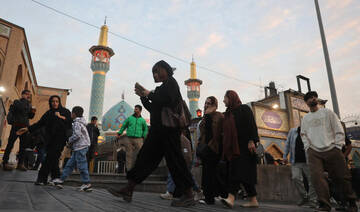
People walk outside the Grand Bazaar in Tehran on September 5, 2023. A year after the death of Mahsa Amini sparked unrest across Iran, the issue of the hijab remains a sore spot -- but a crippling economic crisis has left many preoccupied with making ends meet. (AFP)
On Saturday, the Department of Homeland Security shared on X the immigration timeline of Soleimani Afshar and Hosseiny.
According to the post, Soleimani Afshar entered the US in June 2015 on a tourist visa, later claimed asylum and received that status in 2019. She was issued a green card in 2021 under the Biden administration. In July last year she filed a naturalization application in which she disclosed she had traveled to Iran at least four times since receiving the green card.
“Her trips to Iran illustrate her asylum claims were fraudulent,” the post said.
Hosseiny followed a similar trajectory. She arrived in the US on a student visa in July 2015, was granted asylum by an immigration judge in 2019 and became a green card holder in 2023.
The cases fit a pattern that extends well beyond the Soleimani family. The New York Post has documented multiple instances of senior Iranian officials’ children who moved to the US to study or work.
The State Department has already revoked legal status for the daughter and son-in-law of Ali Larijani, a senior Iranian security official killed in a March 17 Israeli strike. Both are barred from reentering the US. Fatemeh Ardeshir-Larijani taught at Emory University’s Winship Cancer Institute until her visa was canceled.
The others are Leila Khatami, daughter of former Iranian President Mohammad Khatami, who lectured in mathematics at Union College; and Zeinab Hajjarian, daughter of security veteran Saeed Hajjarian, who held a position at the University of Massachusetts Lowell.
“The Trump Administration will not allow our country to become a home for foreign nationals who support anti-American terrorist regimes,” Rubio wrote.