


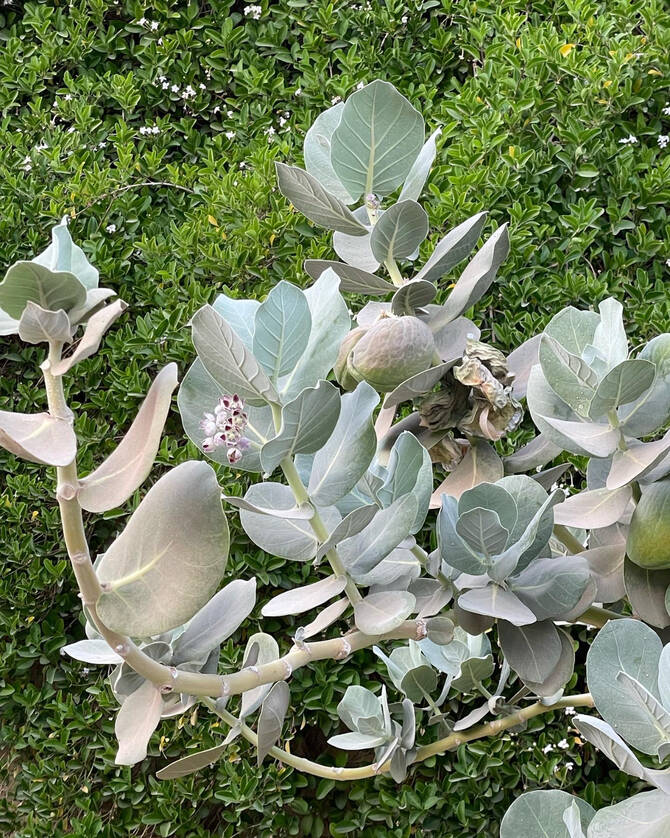


JEDDAH: Calotropis procera, commonly known in Arabic as ushar, is a resilient shrub widely distributed across Saudi Arabia.
It grows in deserts, open landscapes, roadsides, and disturbed areas, where it is often characterized as poisonous. Native to the Arabian Peninsula and the broader Afro-Asian arid belt — spanning tropical and northern Africa through the Middle East to South Asia — the species is well adapted to extreme environmental conditions. It thrives under intense heat, prolonged drought, strong sunlight, and frequent soil disturbance.
The plant is typically found in warm lowlands, plains, wadi systems, and agricultural margins, where water runoff and exposed soils create favorable conditions. Its thick, felt-like leaves — earning it the nickname “felt plant”— protect against wind damage and ultraviolet radiation while aiding moisture retention.
An evergreen shrub, Calotropis procera demonstrates exceptional persistence. Its vigorous root system enables it to resprout following disturbance, supporting long-term establishment in harsh environments.

The plant produces inflated pods containing numerous silky-tufted seeds that are easily dispersed by wind; historically, this floss has been used as a soft stuffing material.
Joshua Van Alstine, co-founder of the Saudi Arabian Botanical Society, noted that native species can still exhibit invasive-like behavior at a local scale. In parts of Saudi Arabia, including the Taif region, researchers have documented C. procera forming dense, dominant stands that shape surrounding plant communities, particularly in disturbed environments.
Outside its native range, the species is widely recognized as problematic, classified as noxious in Hawaii and a serious weed in Australia.
Although native, C. procera can reach ecologically disruptive densities. Dense stand formation—often described informally as “swarming”— is typically driven by disturbance. Reduced competition, combined with the plant’s ability to rapidly recolonize, allows it to expand aggressively.
This dynamic is often intensified by grazing pressure. Livestock tend to avoid C. procera due to its toxicity and latex, enabling it to persist while more palatable species are depleted. As a result, it can proliferate in overgrazed landscapes.
DID YOU KNOW?
• This resilient shrub thrives in deserts, roadsides, and disturbed lands where few plants can survive.
• Its thick, felt-like leaves protect against wind and UV radiation while conserving moisture.
• Traditionally, it has been used in folk medicine and veterinary practices.
Van Alstine explained: “Although we have noticed that Calotropis procera, Rhazya stricta, and Peganum harmala often appear together, this matches a common field pattern in harsh, disturbed desert-edge vegetation where chemically defended, drought-tolerant species persist as others decline. This pattern is real, but it is not a rigid rule and varies by site and grazing history.”
He added that the shrub’s ecological role is complex. “It can stabilize soil simply by establishing as a persistent shrub with a strong root system in exposed ground. Some applied references note that the species can function as a soil binder and even as a ‘nurse’ plant in degraded landscapes. However, soil stabilization alone does not automatically make it desirable: in grazing and rangeland contexts, dense stands can reduce pasture value and complicate land use.”
“Its abundance can act as a strong indicator of disturbance and grazing pressure. Because it is chemically defended and often avoided by livestock, it can expand where other, more palatable species are removed over time. So, when C. procera appears in unusually high numbers, it can indicate landscapes shaped by overgrazing, soil exposure, and ecological imbalance, rather than simply healthy desert vegetation,” he added.
Ecologically, the species can function as a pioneer in disturbed terrain. However, when dominant, it may suppress biodiversity and slow the recovery of more diverse plant communities — an issue that has prompted multiple Saudi studies on its ecological impact.
Opinion
This section contains relevant reference points, placed in (Opinion field)
A defining feature of C. procera is its milky latex, a key survival mechanism. “It is a chemical defense, and many weed and botanical references emphasize that its sap is toxic/irritant, discouraging grazing and deterring damage,” Van Alstine said.
Biologically, the latex also serves as a wound-sealing system, flowing from damaged tissues to protect and stabilize the plant.
The species has been referenced in scientific literature on traditional medicine in Saudi Arabia, including the use of aerial parts in decoctions. However, such applications require caution due to its pharmacological potency and inherent toxicity.
Van Alstine explained the plant’s frequent presence along roadsides and abandoned land: “Because it is a disturbance-adapted species. It readily establishes where soil is exposed and competition is reduced, especially roadsides, abandoned plots, overgrazed pastures, and poorly managed agricultural margins. It is very good at avoiding grazing pressure, extremely hardy, and not picky about growing conditions so disturbed corridors become natural launch points for spread.”
He emphasized the need for balanced management. “We need to control and monitor Calotropis procera in Saudi Arabia. Although we have the utmost respect for all it has done and still can do, if we want to reestablish diverse ecological areas, Calotropis procera can get in the way and prove to be a hindrance especially in overgrazed or repeatedly disturbed landscapes where it forms dominant stands.”

The shrub's inflated pods release silky, wind-dispersed seeds, allowing the plant to spread rapidly across open terrain. (Courtesy of the Saudi Arabian Botanical Society)
A targeted approach is therefore essential — monitoring the species where it coexists within native vegetation, while actively managing it in areas where dense growth inhibits ecological recovery and reduces rangeland value.
Saudi Arabia has established a national framework to address vegetation cover, desertification, and invasive species management, led by the National Center for Vegetation Cover Development and Combating Desertification. The organization has launched initiatives to assess invasive species and develop sustainable monitoring and control strategies, reflecting a balanced approach of observation and intervention.
Under broader environmental regulations, provisions exist for compiling invasive species lists and implementing measures to prevent their spread.
In traditional knowledge, Calotropis procera is viewed ambivalently: as a plant with notable medicinal potential, yet one that carries real risks. This dual perception aligns with modern research highlighting both its bioactive compounds and toxicity. Folklore attributes additional properties to the plant—for example, claims that its latex can cause blindness — though such assertions lack scientific confirmation.
Historically, it has also been used in folk veterinary practices. Bedouin accounts suggest that applying its latex to ticks and other visible parasites on camels or sheep could eliminate them.


