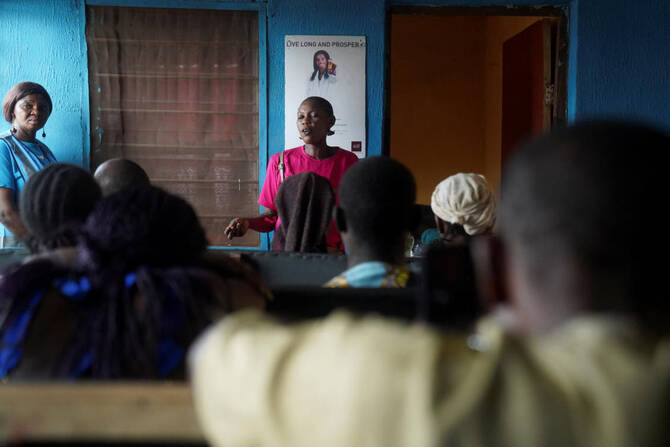
MAKURDI, Nigeria: For several months last year, Josephine Angev walked the dusty village paths of Nigeria’s Benue State with a mission — to help people living with HIV stay on their life-saving medication, after a US aid freeze left thousands scrambling for supplies. The 40-year-old is one of dozens of volunteer “HIV champions” who went door-to-door to bring patients back into care when their access to antiretroviral drugs was disrupted, tending to those whose condition can still bring shame and stigma.
Some patients didn’t realize the risks if they stopped.
“They don’t understand the implications,” Angev said. If people living with HIV stop taking antiretroviral drugs, which suppress the virus, it rebounds. This puts them at risk of HIV-related illnesses within months, and also means they can transmit the virus to others.
Angev made multiple visits to a 65-year-old woman who had stopped taking medication once her supplies ran out. Then she became ill.
Today, thanks to Angev’s interventions, she is back on her drugs, and doing well. Her story is just one example of how people fared in the wake of aid cuts that upended the global HIV response in 2025.
Other rich states joined the US in cutting aid, forcing a reckoning for countries that had relied on it heavily. Nigeria responded with a $200 million health funding package within six weeks that included HIV.
The US government also issued a waiver for “life-saving” aid in February 2025, including antiretrovirals. But crucially, volunteers also bridged the gaps.
“My future depends on these drugs”
Dinah Adaga coordinates the volunteers in Benue State.
“If we couldn’t reach someone by phone, we went to their house — we traced the address and knocked on their door,” she said.
A 41-year-old mother said she had despaired on learning of the aid cuts, fearing the drugs would become unaffordable. Volunteers helped her back into treatment last November.
“These drugs mean a lot to me. My future depends on them. I have three daughters, and they’re all doing well … They are all (HIV) negative. I’m the only one who is positive. So I believe the drugs were truly made for people like me,” she said.
Abrupt end to US aid brought months of disruption
US President Donald Trump’s 90-day pause on foreign aid on January 20 last year had immediate repercussions in Nigeria. The US had paid for around 90 percent of Nigeria’s HIV treatment costs and funded health workers.
In the following months, patients and aid groups said the dispensing of drugs collapsed. Patients were only able to get supplies lasting a week or two, instead of six months, from major clinics.
In Benue’s capital Makurdi, all 10 treatment centers closed for a month, and the World Health Organization warned medication may run out. A small army of volunteers stepped in, part of the continent-wide Afrocab community support network, a non-profit.
They connected people to care centers once they reopened with new funding, and countered misinformation that had spread on prayer ‘cures’, for example. They coaxed mothers-to-be back into antenatal care to protect their babies.
The volunteers brought more than 1,000 people in Benue, including 95 children under five, back into care between June and December 2025 — everyone, they estimate, who had stopped treatment in February and March.
“We have not received reports of people dying from not accessing antiretrovirals… that’s, for us, a good sign,” said Krittayawan Boonto, UNAIDS country director in Nigeria.
More people now in treatment
In Nigeria, about two million people live with HIV, one of the highest numbers in the world. Benue, a state of 4.25 million, has just over 200,000 people on treatment, Afrocab estimates. Immediately after the aid freeze, a UNAIDS tracker suggested 200,000 fewer Nigerians were receiving treatment. But by the end of 2025, data showed 1.7 million people on treatment, a slight increase from 2024’s 1.6 million.
A US State Department spokesperson said the number of those receiving drugs was “very similar” at the end of 2025 as in 2024.
“The narrative suggesting widespread HIV treatment loss … is inaccurate, misleading and irresponsible,” they added.
Nigeria’s government did not respond to requests for comment.
Prevention has been harder hit
Global health agencies and the Nigerian government have warned HIV prevention services were hit harder and for longer.
Bright Oniovokukor, a coordinator of the Civil Society for HIV/AIDS in Nigeria said the number of people accessing drugs to prevent HIV infection dropped from 43,000 in November 2024 to below 6,000 in April 2025, and condom distribution fell by 55 percent.
Things have improved since, but any gap in prevention will lead to more cases, said Dr. Oluwafunke Odunlade, HIV unit head at WHO Nigeria.
Testing was hit too, meaning cases may have been missed: early figures showed that more than a million fewer people were tested for HIV in 2025 than 2024.
Today, the US and Nigeria are working out the details of a health agreement for 2026-2030 signed in December, under which the US will contribute $2.1 billion and Nigeria $3 billion.
The deal prioritizes the HIV response and commits to putting more patients on treatment programs, with Nigeria taking over funding in full over the next five years.
The US has said only workers “formally recognized within government structures” will be funded, and the agreement places “a strong emphasis on Christian faith-based health care providers,” part of a wider US drive to support Nigeria’s Christian population, that has come under threat from Islamist violence.
In Benue, Angev will keep volunteering. “It can be exhausting, but we do it so lives that might have been lost are instead restored. And when you see them living better lives and truly changed, that’s when you feel happy,” she said.


![]()

With US aid slashed, Nigerian HIV volunteers go door‑to‑door to keep patients alive
Short Url
https://arab.news/zct6w
With US aid slashed, Nigerian HIV volunteers go door‑to‑door to keep patients alive
- Other rich states joined the US in cutting aid, forcing a reckoning for countries that had relied on it heavily
- Nigeria responded with a $200 million health funding package within six weeks that included HIV


Latest updates


© 2026 SAUDI RESEARCH & PUBLISHING COMPANY, All Rights Reserved And subject to Terms of Use Agreement.