
KARACHI: Pakistan is considering shifting to more frequent fuel price adjustments as the International Monetary Fund has shared the Memorandum of Economic and Financial Policies (MEFP) with the government, a finance ministry official said on Friday.
The country currently revises fuel prices weekly, a shift it made from the earlier fortnightly mechanism after the outbreak of the war in Iran, which triggered sharp volatility in global oil markets.
Officials are now weighing a further move to daily pricing to better reflect international fluctuations.
“A week or a day: they [the IMF officials] have been talking about it for quite some time,” the official privy to the negotiations between the government and the international lender told Arab News on condition of anonymity.
The IMF mission led by Iva Petrova started its third review of Pakistan’s economic performance on Feb. 25 under the $7 billion Extended Fund Facility (EFF) and the second review under the $1.4 billion Resilience and Sustainability Facility (RSF).
Successful reviews would help Pakistan secure about $1 billion in a fresh tranche.
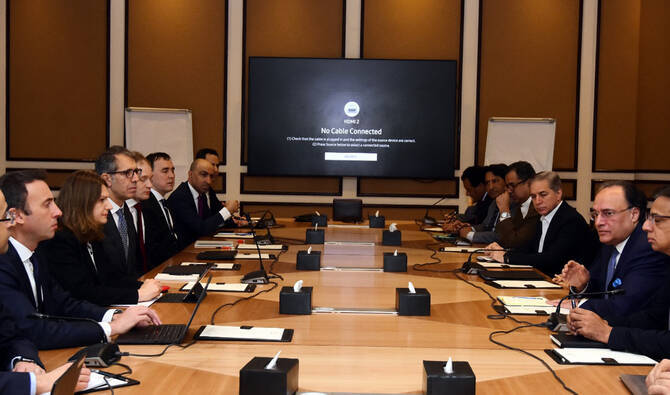
The two sides are expected to conclude the review talks, with the IMF sharing the MEFP — a key policy document that outlines the government’s economic reform commitments, including fiscal, monetary and structural measures — with authorities in Islamabad.
“The MEFP document comes after 10 days [once the review talks begin],” the official added. “It has come.”
IMF’s resident representative in Pakistan Mahir Binici and Pakistan’s finance adviser Khurram Schehzad did not respond to requests for comment on the issue.
Asked about price adjustments, the official said the government wanted to do it more frequently, though there were issues that needed to be addressed.
“Our plan is also to adjust fuel prices daily. But it is not easy to govern how much petrol pumps are charging on a daily basis.”
Both the EFF, secured in Sept. 2024, and the RSF, approved in May 2025, are critical to Pakistan’s economic recovery, particularly at a time when the ongoing Middle East conflict involving the United States, Israel and Iran has disrupted global markets and supply chains.
The war led to the closure of the Strait of Hormuz by Iran, through which around 70-80 percent of Pakistan’s imports, especially fuel, are transported.
The disruption forced the government to raise petrol and diesel prices by Rs55 (about $0.20) per liter earlier this month.
Prime Minister Shehbaz Sharif said in a televised address on Friday the government had tried to shield consumers from further hikes in fuel prices despite receiving recommendations to raise petrol and diesel rates.
He also called for “revolutionary” behavioral changes in fuel consumption and urged public cooperation, saying a comprehensive conservation plan would be unveiled in the coming days.
The ongoing IMF engagement is seen as vital for Pakistan as geopolitical tensions and rising global oil prices pose renewed risks for its economic recovery.
The IMF mission reported “considerable progress” in talks with the Pakistani authorities at the beginning of this month, saying Islamabad’s program implementation under the EFF was broadly aligned with the government’s commitments through end-Feb.