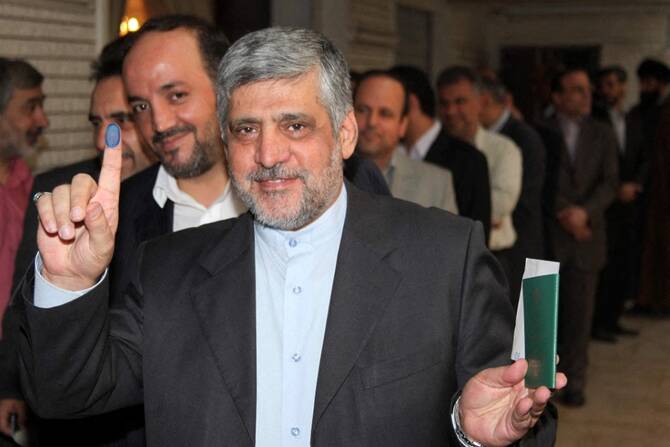
BEIRUT: Lebanon’s decision to withdraw accreditation from the Iranian Ambassador Mohammad Reza Raouf Sheibani was a measure taken against him and does not amount to a severing of diplomatic relations with Iran, a source from Lebanon’s Ministry of Foreign Affairs told Arab News on Tuesday.
“The measure taken against Sheibani does not require a Cabinet decision as it does not involve severing diplomatic relations,” the source said. “The decision was made in coordination with the president.”
The ministry on Tuesday declared Sheibani persona non grata and demanded his departure from Lebanon by Sunday in a move that highlighted an escalating diplomatic crisis between Lebanon and Iran, amid Tehran’s backing of Hezbollah’s recent attacks on Israel earlier this month. Tehran must now assign a new ambassador.
The ministry said it summoned Tawfiq Samadi Khoshkho, Iran’s charge d’affaires in Beirut, and informed him of the government’s decision.
In a related development, the ministry also summoned the Lebanese Ambassador to Iran Ahmad Sweidan for “consultations,” following what the Lebanese state described as Tehran’s violation of diplomatic norms and established practices between the two countries.
Sheibani, 66, served as Iran’s ambassador to Lebanon from 2005 to 2009, during which his tenure coincided with the July 2006 war. He later served as his country’s ambassador to Syria from 2011 to 2016, during the early and most intense years of the war in Syria.
Iran had reappointed him to the post as replacement for Mojtaba Amani, who was injured in the September 2024 pager explosions in Lebanon.
Sheibani was described as “one of the most prominent diplomats, deeply knowledgeable about the details of political issues in Lebanon, Syria, and the region.”
During his time in Lebanon, Sheibani consistently emphasized his support for “the resistance as an option in confronting Israel.”
Early signs of the Lebanese-Iranian diplomatic crisis emerged through statements by Iranian officials that indicated interference in Lebanese affairs.
The crisis began with the well-known statement by Ali Velayati, the Iranian Supreme Leader’s international affairs adviser, who said in April 2020 that “Iran controls four Arab capitals, including Beirut.”
Last August, following the Lebanese government’s decision to disarm Hezbollah, Ali Larijani, who was then head of Iran’s Supreme National Security Council, reaffirmed Tehran’s support to Hezbollah on his arrival at Beirut–Rafic Hariri International Airport.
In talks with Larijani, Lebanon’s President Joseph Aoun stressed that “it is forbidden for anyone ... to bear arms and to use foreign backing as leverage,” reaffirming the country’s rejection of foreign interference and its commitment to sovereignty and state authority.
One of the most notable public interventions came in October 2024 when Iran’s Foreign Minister Abbas Araghchi commented on Hezbollah’s military operations in southern Lebanon, launched in support of Palestinians in Gaza.
He said: “We do not believe in halting the war in the face of aggression, and we support Hezbollah’s full right to respond. Iran will not stand idly by in the event of a comprehensive war in Lebanon.”
Samir Geagea, the head of the Lebanese Forces Party, described the measure taken against the Iranian ambassador as “one that should have been implemented long ago due to Iran’s interference in Lebanon.”
He said recent events in Lebanon had demonstrated “beyond a shadow of a doubt” that members of Iran’s Islamic Revolutionary Guard Corps were present in the country, numbering at least in the hundreds and directly managing operations.
Geagea added that all losses incurred by Lebanon during the war must be submitted by the Lebanese government to Iran for reimbursement.
The crisis has deepened as Lebanon has been dragged into the broader regional conflict after Hezbollah fired rockets at Israel on March 2.
Lebanese Prime Minister Nawaf Salam confirmed in a televised address on Sunday that the IRGC was present in Lebanon and was leading military operations, adding that its members were behind drones launched from Lebanese territory toward Cyprus.
Salam said: “The Revolutionary Guard are residing in Lebanon illegally using forged passports. The government has begun implementing a decision to expel them.”
He added: “Those who dragged Lebanon into the current war sought to avenge Iran’s former Supreme Leader Ali Khamenei. It is not Lebanon’s responsibility to pursue such retaliation.”
Aoun on Tuesday reiterated that Lebanon “cannot fight other countries’ wars on its own soil,” and stressed that government decisions on the state’s monopoly over arms and on war and peace are “irreversible” and aligned with the constitution, the Taif Agreement, his oath of office, and ministerial statement.
Hezbollah MP Hussein Hajj Hassan described the withdrawal of the ambassador’s credentials as “a new misstep by the government, an inappropriate measure, and a grave transgression.”
Hezbollah MP Ibrahim Al-Moussawi said that the decision “does not reflect the country’s true interests.”
He described Iran as “an ally of Lebanon (that) has stood by its side through numerous crises” and that current developments “do not serve national unity.”
Arrest warrants were issued on Tuesday by Ghada Abu Alwan, the first military investigative judge, against two Hezbollah members following their interrogation about a case involving the possession of military weapons. The action followed the seizure of 21 rockets at an army checkpoint in the Jezzine district of southern Lebanon.
George Mezher, also serving as a military investigative judge, issued an arrest warrant against another Hezbollah member, who was charged with possession of military weapons.