

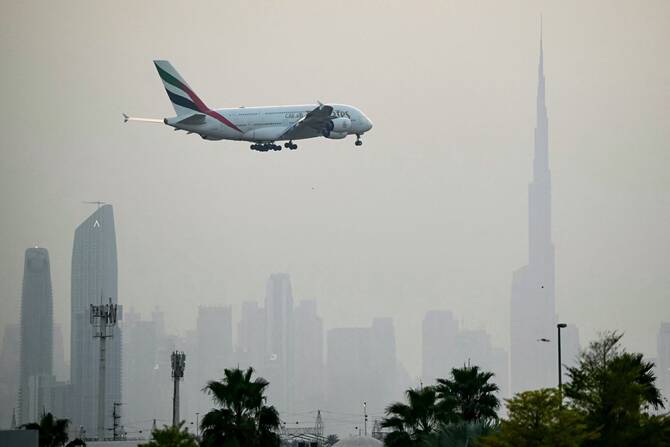

DUBAI: Four people were injured when two drones fell near Dubai International Airport on Wednesday as Iranian attacks continued on transport and energy sites across the Gulf.
Oil storage facilities at Oman’s Salalah port were also hit by drones, and interceptions by the UAE’s air defenses led to a fire at Abu Dhabi’s old airport.
The attacks marked the twelfth day in a row of Iranian attacks on Arab Gulf countries in response to the US and Israeli war with Iran.
There were also more attacks on commercial shipping in the Strait of Hormuz - the narrow waterway at the entrance to the Gulf through which one-fifth of the world’s traded oil passes.
The attack at Dubai’s main airport caused moderate injuries to one Indian national and minor injuries to two Ghanaians and a Bangladeshi, Dubai Media Office said in a statement.
Authorities confirm that two drones fell in the vicinity of Dubai International Airport (DXB) a short while ago, resulting in minor injuries to two Ghanaian nationals and one Bangladeshi national, and moderate injuries to one Indian national. Air traffic is operating as normal.
— Dubai Media Office (@DXBMediaOffice) March 11, 2026
The statement said air traffic continued to operate normally.
Later in the day, the UAE's Ministry of Defense said it was intercepting a barrage of missiles and drones, reassuring residents that sounds heard were from active air defense systems.
Authorities said they had controlled a fire that broke out at Abu Dhabi’s old airport, following another successful interception by air defense systems. The incident resulted in no injuries.
UAE presidential advisor Anwar Gargash said Iran’s attacks were hitting civilian infrastructure in the Gulf “with no regard for civilians and innocent people.”
He accused Iran of lying “when they claim to be targeting US bases in the Gulf,” saying on X that the numbers of missiles and drones revealed a different truth.
Some Iranian leaders, including the president, have insisted their country is only attacking US military facilities in Gulf countries, despite hundreds of drones and missiles being intercepted in the skies over Gulf cities.
Oman's civil defense was working to control a fire in fuel tanks at Salalah Port late on Wednesday after they were struck by drones earlier in the day, Oman's state news agency reported.
"Controlling the fire might take some time," the report said.
There were no injuries reported.
An energy ministry official said later that there had been no disruption to oil supplies or petroleum derivatives in the country.
Several drones targeting the sultanate were also successfully intercepted and brought down, the reports said.
*With AFP, Reuters and AP


