Iraq welcomes the appointment of Iran’s new supreme leader

1 / 2
Iraqi Prime Minister Mohammed Shia al-Sudani attends the first session of negotiations between Iraq and the United States to wind down the International Coalition mission in Baghdad, Iraq, January 27, 2024. (REUTERS)
2 / 2
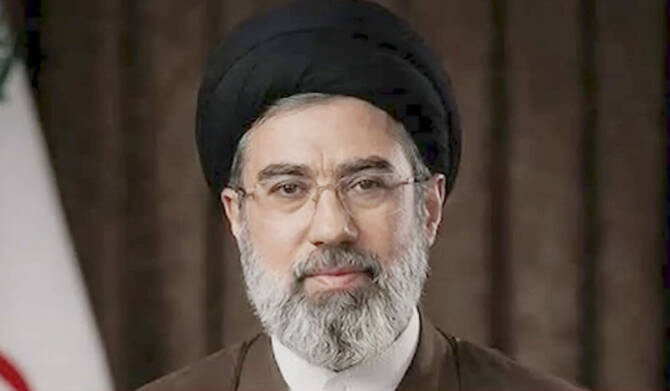
Mojtaba Khamenei, a son of Iran's slain supreme leader, who has been named as the Islamic Republic's next ruler, authorities announced Monday, March 9, 2026. (AP)
Short Url
Updated 10 March 2026
Follow

Iraq welcomes the appointment of Iran’s new supreme leader

  • Armed faction Kataeb Hezbollah said it reflects a profound understanding “of the existential challenges confronting the nation”

BAGHDAD: Iraq’s Prime Minister Mohammed Shia Al-Sudani welcomed on Monday the appointment of Mojtaba Khamenei as Iran’s new supreme leader after his predecessor and father was killed in US and Israeli strikes.
“We express our confidence in the ability of the new leadership in the Islamic Republic of Iran to manage this critical stage,” and to further strengthen “the unity of the Iranian people” amid the current challenges, Sudani said in a statement.
He stressed that Iraq stands in solidarity with Iran and supports “all steps aimed at ending the conflict.”
Iran wields significant influence in Iraqi politics, and also backs armed groups whose power has grown both politically and financially.
Iraq has for decades been a proxy battleground between the US and Iran.
Pro-Tehran Iraqi groups were among the first to welcome the new supreme leader.
The powerful Badr organization said the new leadership represents a “blessed continuity of the path of the Islamic revolution.”
The Asaib Ahl Al-Haq faction said choosing Mojtaba Khamenei shows continuity and “reinforcement of the Islamic republic’s role as a central pillar in the axis of resistance.”
Armed faction Kataeb Hezbollah said it reflects a profound understanding “of the existential challenges confronting the nation.”
“The best successor to the best predecessor,” said Kataeb Hezbollah, which is part of the Islamic Resistance of Iraq — a pro-Iran alliance that has been claiming attacks on US bases since the start of the war in the Middle East.
Senior Iraqi politician and moderate cleric Ammar Al-Hakim wished the new supreme leader “success in following the path of his martyred father... in upholding the word of truth.”


The art of war: fears for masterpieces on loan to Louvre Abu Dhabi

Updated 13 March 2026
Follow

The art of war: fears for masterpieces on loan to Louvre Abu Dhabi

  • UAE paid more than €1 billion to borrow priceless works, but experts in France want them back

PARIS: The Middle East war has raised fears for the safety of priceless masterpieces on loan from France to the Louvre Abu Dhabi, the museum’s only foreign branch.
The Abu Dhabi museum, which opened in 2017, has so far escaped damage from nearly 1,800 Iranian drone and missile strikes launched since the conflict erupted on Feb. 28.
However, concerns are mounting in France. “The works must be removed,” said Didier Selles, who helped broker the original agreement between France and the UAE.
French journal La Tribune de l’Art echoed that alarm. “The Louvre’s works in Abu Dhabi must be secured!” it said.
France’s culture ministry said French authorities were “in close and regular contact with the authorities of the UAE to ensure the protection of the works loaned by France.”
Under the agreement with the UAE, France agreed to provide expertise, lend works of art and organize exhibitions, in return for €1 billion, including €400 million for licensing the use of the Louvre name. The deal was extended in 2021 to 2047 for an additional €165 million.
Works on loan include paintings by Rembrandt and Chardin, Classical statues of Isis, Roman sarcophagi and Islamic masterpieces: such as the Pyxis of Al-Mughira.

A Louvre Abu Dhabi source said the museum was designed to protect collections from both security threats and natural disasters.