

Pakistan to auction 5G spectrum tomorrow ahead of phased rollout in major cities

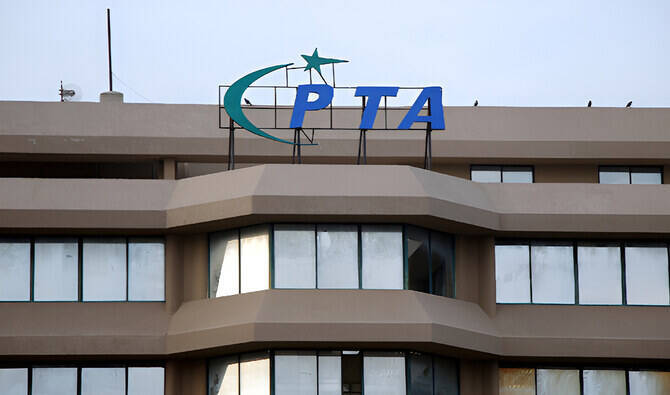
A logo of the Pakistan Telecommunication Authority (PTA) is seen on its headquarters building in Islamabad on January 22, 2020. (AN/File)
Short Url
Updated 09 March 2026
Follow

Pakistan to auction 5G spectrum tomorrow ahead of phased rollout in major cities

  • 5G services will initially begin in Islamabad, Lahore, Karachi, Peshawar and Quetta
  • Regulator will auction 11 bands to Ufone, Zong and Jazz via electronic bidding system

ISLAMABAD: Pakistan will hold an auction for 5G spectrum tomorrow, Tuesday, as the government prepares to launch next-generation mobile services in five major cities in bid to improve Internet speeds and connectivity, top officials said on Monday.

The development comes at a time of mounting pressure on Pakistan’s telecommunication networks and Internet service providers, with users and businesses frequently complaining of slow speeds and disruptions as a limited spectrum struggles to serve the South Asian nation of over 240 million.

Pakistan has more than 130 million broadband connections but access remains uneven, though its IT exports reached a record $3.8 billion in Fiscal Year 2024–25, up from $3.2 billion the previous year, marking an 18 percent year-on-year increase, according to the Pakistan Software Export Board.

The 5G spectrum auction will begin at 10am on Tuesday through an electronic system at the Pakistan Television headquarters, according to Pakistan Telecommunication Authority’s (PTA) Director-General for Licensing Aamir Shahzad.

“In the first phase, six spectrum bands will be auctioned among mobile network operators Ufone, Zong and Jazz, followed by bidding for five additional bands until 4pm,” he said at a briefing in Islamabad.

PTA Chairman Hafeez-ur-Rehman said a mock trial had already been conducted and all three telecom operators had been briefed on the bidding process.

The auction will not follow an open bidding format as each spectrum band would be auctioned separately, according to officials. The government expects the launch of 5G services to improve digital connectivity without increasing costs for consumers.

“The introduction of 5G will not raise data prices and there will be no additional burden on consumers,” the PTA chairman said.

IT Minister Shaza Fatima Khawaja said the government was encouraging wider adoption of 5G-compatible devices in Pakistan.

“Our aim is that as many people as possible use 5G mobile phones,” she said, adding that about 95 percent of mobile phones in Pakistan are locally manufactured.

According to officials, 5G services will initially be rolled out in Islamabad, Lahore, Karachi, Peshawar and Quetta, before expanding nationwide as the infrastructure develops.

Khawaja said Pakistan currently uses 274-megahertz spectrum which has been in use since 1987, and the upcoming auction will make a 600-megahertz spectrum available.

She said the auction would be conducted through specialized software and streamed live to ensure transparency.

PTA DG Licensing Shahzad said Pakistan currently has one of the lowest spectrum allocations in the region, and the government has prepared a nine-year plan for complete 5G rollout.

Under the plan, telecom operators will add around 3,000 new network sites each year, with initial 5G speeds expected to reach 50 megabits per second (Mbps).

PTA officials also said Pakistan currently offers some of the world’s cheapest mobile data services and assured that consumer protection would remain a priority.

Around 500,000 5G-enabled mobile phones have been produced in Pakistan in recent months, while five local manufacturers have already started producing more such devices, they added.


From classrooms to screens: Pakistan schools go online amid Middle East war-driven oil crisis

Updated 4 sec ago
Follow

From classrooms to screens: Pakistan schools go online amid Middle East war-driven oil crisis

  • Government orders school closures, remote work and fuel cuts to conserve energy
  • Measures follow oil price surge linked to US-Israeli strikes on Iran and regional tensions

RAWALPINDI: Some schools in Pakistan shifted to online learning this week as authorities introduced emergency fuel-saving measures after global oil prices surged due to the escalating conflict involving the United States, Israel and Iran.

The government has ordered a series of austerity steps aimed at reducing fuel consumption, including temporary school closures, remote work arrangements for a portion of government and private sector employees, and sharp cuts in fuel allocations for official vehicles. The measures were introduced after international oil prices jumped amid fears the widening Middle East conflict could disrupt supplies passing through the Strait of Hormuz, a vital global energy shipping route, raising costs for import-dependent economies such as Pakistan.

Parents in cities including Rawalpindi said many educational institutions had already informed families through social media that classes would be conducted online while campuses remained closed.

“Hopefully, all the schools will remain closed today because many of the institutions have already shared the message on social media that we will be taking classes online for the students,” said Misam Abbas, a 30-year-old father of schoolchildren.

Pakistan’s education system is still recovering from severe disruptions during the COVID-19 pandemic, when schools across the country remained closed for extended periods and millions of students shifted to remote learning. 

The closures lasted around 10.5 months in some areas, affecting nearly 40 million school-age children, while limited Internet access and digital devices meant many students could not fully participate in online classes. Education experts say the prolonged shutdowns caused significant learning losses and pushed some children permanently out of the school system. 

Even after the pandemic, schooling in Pakistan has faced repeated interruptions due to environmental and health emergencies. In recent years, dense winter smog, extreme heatwaves and cold spells have frequently forced authorities to suspend classes, sometimes for 10 to 12 days at a time, shortening the academic year and disrupting teaching schedules. 

Analysts warn that repeated closures and the shift to online learning, often difficult for students without reliable Internet access, continue to strain an already fragile education system. 

For many families, the sudden switch to remote learning has also raised concerns about prolonged disruptions to education if the austerity measures remain in place.

“They [the government] should not close [schools] for a long time because it suffers a lot. The students… should think that they are to close the school for two to three days, not for all the weeks, not for two to three weeks because that can suffer the studies of these small kids,” Abbas said.

Pakistan imports most of its crude oil and refined petroleum products, making domestic energy costs highly sensitive to global price swings during geopolitical crises.

“Our situation should not be affected by the world’s situation. The world is already in a bad situation. But in our country, we should have some good system so that people cannot be affected by those circumstances,” Abbas said.