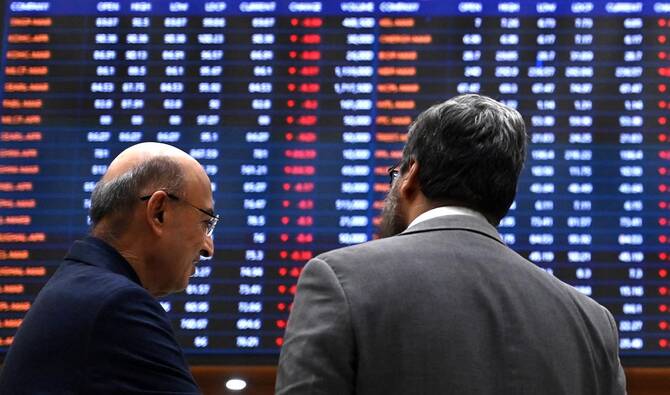

ISLAMABAD: Pakistan’s benchmark KSE-100 Index recorded its second-largest drop ever on Monday, plunging by over 11,015 points or 6.99 percent as surging oil prices due to the intensifying Middle East conflict weighs heavily on investor confidence, financial analysts said.
Trading at the Pakistan Stock Exchange was temporarily suspended after the benchmark KSE-30 Index declined by more than 5 percent from the previous day’s close. The KSE-100 Index ended the trading session by closing at 146,480.14 points.
Coordinated strikes by the US and Israel against Iran on Feb. 28 have rattled global oil markets, causing a sharp increase in the prices of petroleum products worldwide. Pakistan increased the price of petrol and diesel on Friday by Rs55 per liter each, with analysts fearing the move could trigger inflation in the coming days.
This was the second-largest drop ever recorded by Pakistani stocks. The PSX recorded its largest-ever single-day decline on Mar. 2 when it plunged by 16,089 points or 9.57 percent to close at 151,973 points, according to data shared by the PSX.
“Stocks witnessed record selloff amid the escalation in the Israel -US led Iran war,” Ahsan Mehanti, chief executive officer of Arif Habib Commodities, said in a statement.
He said the sell-off was due to heightened investor fears over inflation and prevailing economic uncertainty after brent crude reached the price of $119 per barrel during the early trading session of the PSX.
Pakistan’s central bank will also announce its monetary policy on Monday. Mehanti noted that uncertainty over the State Bank of Pakistan’s policy announcement amid surging inflation and weak earnings’ projections played a “catalyst role” in the bearish activity at the stock market.
Meanwhile, leading brokerage house Topline Securities also said that investor sentiment remained “fragile” as global crude oil prices surged above $110 per barrel.
“The development triggered strong reactions across international energy and financial markets, further weighing on investor confidence,” Topline Securities said in a statement.
The firm said market participation remained “active” on Monday, with the total traded volume of stocks reaching 621 million shares and turnover amounting to Rs37 billion [$132 million].
Pakistan’s fragile economy is heavily dependent on global energy prices as it comprises a large chunk of the country’s import bill.
Last year Pakistan imported petroleum products worth $16 billion, accounting for the most on Islamabad’s $58.4 billion import bill, according to official data.