

Safety of Jordanians a priority during regional conflict, says country’s crown prince

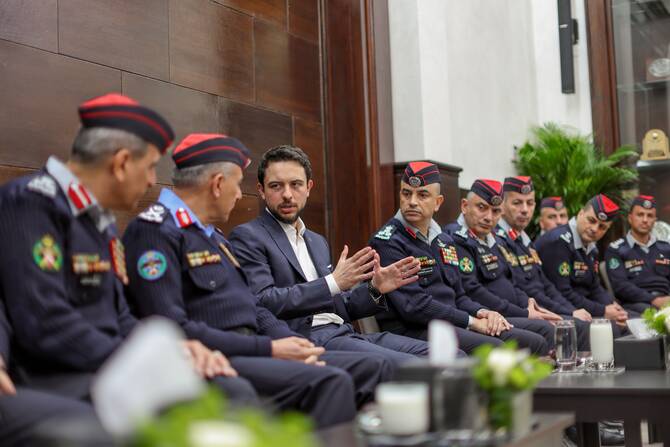
Jordanian crown prince Hussein visited the Civil Defense Department for a briefing and iftar event on Wednesday. (Petra) 
Short Url
Updated 05 March 2026
Follow

Safety of Jordanians a priority during regional conflict, says country’s crown prince

  • He visits Civil Defense Department and is briefed on the work it is doing to manage emergencies and protect lives and property amid attacks by Iran

LONDON: The safety of citizens is a priority for authorities in Jordan amid regional tensions, the country’s Crown Prince Hussein bin Abdullah Al-Hashimi said on Wednesday as he visited the Civil Defense Department for a briefing and iftar event.

He stressed the importance of keeping pace with the latest developments in civil protection systems and taking every opportunity to enhance the skills of Civil Defense personnel, the royal court said.

The department, which operates under the Ministry of Interior, has been working to manage emergencies and protect lives and property amid a barrage of missiles and drones launched by Tehran in recent days in response to attacks on Iran by the US and Israel. The strikes have targeted civilian and military areas in Jordan and other countries in the region.

During his visit the crown prince was greeted by Maj. Gen. Obeidallah Maaytah, director of the Public Security Directorate, and Brig. Gen. Nasser Sweilmeen, the Civil Defense director, and briefed on the work of the Civil Defense Department, the systems it uses, and the ways in which it is responding to the regional conflict.

In addition to firing missiles into Israel, Iran has targeted US forces at Muwaffaq Salti Air Base in Jordan and other American military sites in Gulf countries. Military personnel and civilians in several countries have been killed or injured by missiles or falling debris.


Delivery drivers dodge debris to keep Gulf fed under Iranian attacks

Updated 7 sec ago
Follow

Delivery drivers dodge debris to keep Gulf fed under Iranian attacks

  • Thousands of couriers on motorcycles have been working full throttle to ensure food, home supplies and whatever else a customer might need is available
  • UAE President Mohamed bin Zayed Al-Nahyan walked with his massive entourage through Dubai Mall pausing for an occasional selfie

DUBAI: As air raid sirens wail and explosions echo off glass skyscrapers, Gulf delivery drivers have emerged as unlikely heroes, providing a lifeline to frightened residents sheltering from Iranian attacks.
Airports, embassies, residential areas and military installations across the region have come under fire from daily salvos of Iranian missiles and drones since the war between the Islamic republic, Israel and the US broke out on Saturday.
While weaving through Gulf metropolizes’ traffic was never entirely safe, delivery drivers now face danger from the skies with the risk of falling debris from drones and interceptors.
Nonetheless, thousands of couriers on motorcycles have been working full throttle to ensure food, home supplies and whatever else a customer might need is available with the tap of an app.
During the war’s first hours, Agyemang Ata was in a mall in Dubai, waiting for an order when the first explosions rang out, but the 27-year-old has no plans to leave.
“My mom, sister and family have been calling me but I told them I am OK, they don’t need to worry about me,” Ata told AFP.
“I will stay here and work. Dubai is a safe place for me.”
To most residents, drivers like Ata were just an anonymous army keeping the hassles of daily life at bay — and to some, another traffic hazard on already busy streets.
Now, however, people are heralding their vital role, with many on social media describing them as “heroes” risking their lives to keep the Gulf running.
Further north in Kuwait, driver Walid Rabie said the fear was constant.
“We carry our lives along with the orders,” he told AFP
At least seven civilians have been killed in the Gulf since Iran began its attacks — many of them foreign laborers, who make up a large part of the region’s workforce.
Washington said six US service members have also been killed, four of them in Kuwait.

‘I have struggled’

The UAE has seen a disproportionate number of attacks, with the Ministry of Defense saying authorities have worked to intercept more than 900 drones and about 200 missiles fired at their territory.
“I’m afraid, I won’t lie,” said Franklin, a delivery driver in Dubai.
The need to earn a living outweighs other anxieties over the war, but maintaining his regular pace has been difficult under the new circumstances, and the number of orders has dropped.
“Before, I used to complete between 10 and 15 orders a day,” he explained. “But since this started, I have struggled to get even eight.”
The life of the drivers cuts a stark contrast to the region’s numerous influencers on social media, who have continued to party during the war, or to the city’s well-heeled expats, some of whom have dropped six figures on chartered flights out of neighboring countries to escape.
In Bahrain, where the sounds of explosions have continued for a sixth day, a foreign worker at a food delivery company said the situation was worrying at first but he has begun to get used to it — especially since he needs the job.
“I go out to work almost every day. I follow the news and hope the crisis will end,” said Ajit Arun, 32.
“We take precautions while driving, especially when the sirens sound.”
Across the Gulf, governments have implored their citizens and residents to avoid posting misinformation about the war and rely on official channels for news.
Others have sought to present an image of normality.
UAE President Mohamed bin Zayed Al-Nahyan walked with his massive entourage through Dubai Mall pausing for an occasional selfie.
But on the city’s streets, the reality of war weighed heavily, casting questions for some over future plans to stay in the Gulf.
“If things continue like this, I cannot risk my life,” said Franklin. “It would be better for me to return to my country.”