Afghan military attacks Pakistan after deadly strikes

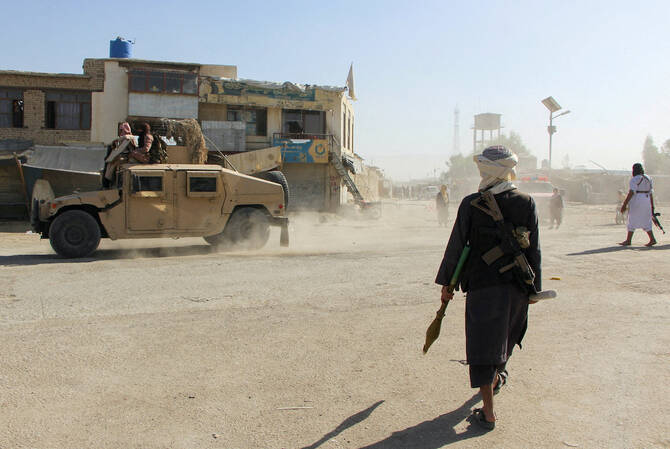
Afghan Taliban fighters patrol near the Afghanistan-Pakistan border in Spin Boldak, Kandahar Province. (Reuters/File)
Short Url
Updated 27 February 2026
Follow

Afghan military attacks Pakistan after deadly strikes

  • Pakistan says it has taken 'immediate' action against Afghanistan in response to the 'unprovoked' strikes

KABUL: Afghanistan attacked Pakistani forces on Thursday and claimed to have killed and captured dozens of soldiers in retaliation for deadly air strikes days earlier.
The offensive at multiple points along the frontier follows a series of border clashes and Pakistani strikes on Afghanistan in recent months.
“In response to repeated violations by the Pakistani military, large-scale offensive operations were launched against Pakistani military bases and military installations,” Taliban government spokesman Zabihullah Mujahid said.
The governor’s office and residents in the province of Kunar told AFP that military action was under way, while Afghan officials said armed forces were operating in multiple other provinces.
Pakistan said the attack was “being met with immediate, and effective response.”
Afghanistan “opened unprovoked fire on multiple locations” across the border in Pakistan’s Khyber Pakhtunkhwa province, Islamabad’s information ministry said.
The Taliban government spokesman told AFP that Afghan forces had captured more than 15 Pakistani outposts in two hours.
“Dozens of (Pakistani) soldiers have been killed and we have transferred 10 dead bodies to Kunar and other areas. There are also several wounded and caught alive,” Mujahid said.
There were no immediate reports of Afghan casualties.

Months of border violence 

The military operation follows Pakistani strikes on Nangarhar and Paktika provinces overnight into Sunday, which the UN mission in Afghanistan said killed at least 13 civilians.
The Taliban government said at least 18 people were killed and denied Pakistan’s announcement that the military operation left more than 80 militants dead.
Both sides also reported cross-border fire on Tuesday, but without casualties.
Relations between the neighbors have plunged in recent months, with land border crossings largely shut since deadly fighting in October that killed more than 70 people on both sides.
Several rounds of negotiations followed an initial ceasefire brokered by Qatar and Turkiye, but the efforts have failed to produce a lasting agreement.
Saudi Arabia intervened this month, mediating the release of three Pakistani soldiers captured by Afghanistan in October.
Islamabad accuses Afghanistan of failing to act against militant groups that carry out attacks in Pakistan, which the Taliban government denies.
Pakistan’s military launched its air strikes on Afghanistan days ago following a series of deadly suicide blasts.
They included an attack on a Shiite mosque in Islamabad that killed at least 40 people and was claimed by the Daesh group.
The militant group’s regional chapter, Islamic State-Khorasan, also claimed a deadly suicide bombing at a restaurant in Kabul last month.


26 Doctors without Borders workers remain unaccounted for in South Sudan a month after attacks

Updated 4 sec ago
Follow

26 Doctors without Borders workers remain unaccounted for in South Sudan a month after attacks

  • A hospital in the town of Lankien was bombed by government forces, MSF said
  • “We have lost contact with them amid ongoing insecurity”

NAIROBI: More than two dozen Doctors Without Borders workers remain unaccounted for a month after attacks in South Sudan, the medical charity said.
Two facilities belonging to the group, known by French acronym MSF, were attacked on Feb. 3 in Jonglei State, northeast of the capital, Juba, where violence has displaced an estimated 280,000 people since December.
A hospital in the town of Lankien was bombed by government forces, MSF said, while another medical facility in the town of Pieri was raided by “unknown assailants.” Both were located in opposition-held areas.
Staff working at the two facilities fled alongside much of the local population into deeply rural areas where armed clashes and aerial bombardments were ongoing.
MSF said in a statement on Monday that “26 of 291 of our colleagues working in Lankien and Pieri remain unaccounted for.
“We have lost contact with them amid ongoing insecurity,” it said.
The lack of communication with its staff could be linked to the limited network connectivity in much of the state. Staff members who had been contacted described “destruction, violence and extreme hardships.”
Fighting escalated sharply in December, when opposition forces captured a string of government outposts in north central Jonglei. In January, the government responded with a counteroffensive that recaptured most of the area it had lost.
Displaced people in Akobo, an opposition-held town near the Ethiopian border, described horrific violence by government fighters. Many described not being able to find food or water as they walked for days to reach safety.
The attacks on MSF facilities in Lankien and Pieri are part of an uptick in violence on humanitarian staff, supplies and infrastructure, aid groups say. MSF facilities have been attacked 10 times in the last 12 months.
“This violence has taken an unbearable toll not only on health care services, but on the very people who kept them running,” said Yashovardhan, MSF head of mission in South Sudan, who only uses one name.
“Medical workers must never be targets,” he said. “We are deeply concerned about what has happened to our colleagues and the communities we serve.”