South Africa says 2 of its nationals died fighting for Russia in Ukraine after recruitment scheme

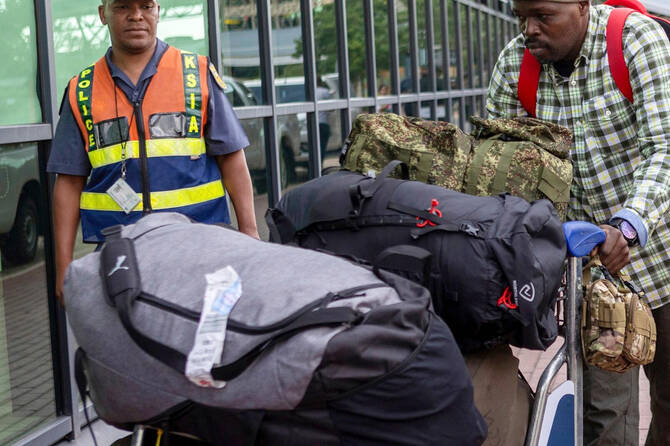
South African men who were allegedly tricked into fighting for Russia in the war in Ukraine arrive at King Shaka International Airport in Durban, Feb. 25, 2026. (AP)
Short Url
Updated 26 February 2026
Follow

South Africa says 2 of its nationals died fighting for Russia in Ukraine after recruitment scheme

  • Foreign Minister Ronald Lamola didn’t name the two people who died or say when or where they had died
  • Duduzile Zuma-Sambudla, ex-President Jacob Zuma’s daughter, is being investigated by police for alleged involvement in luring those 17 men to Russia

CAPE TOWN: At least two South Africans have died fighting for Russia in the war in Ukraine after being tricked into traveling there by a recruitment scheme, South Africa’s foreign minister said Thursday.
It was the first time South African authorities had confirmed any of their citizens who were allegedly lured to Russia with false promises of employment or training opportunities had been killed in the war.
Foreign Minister Ronald Lamola didn’t name the two people who died or say when or where they had died.
His announcement came while he visited the families of 11 South Africans who returned home on Wednesday after they were allegedly recruited last year in a scheme promising them security training in Russia and ended up involved in the conflict in Ukraine. Four men caught up in the same scheme had previously been repatriated, while two remained in Russia with “severe injuries,” Lamola said.
Duduzile Zuma-Sambudla, a daughter of former South African President Jacob Zuma, is being investigated by police for alleged involvement in luring those 17 men to Russia. She denied any wrongdoing but resigned as a lawmaker in November over the allegations.
Lamola said the two people who died were not connected to the group allegedly recruited by Zuma-Sambudla, but they were “part of another recruitment drive or another scheme that took them there.”
“The law must take its course,” Lamola said regarding the cases of the 17 men who were allowed to leave the front lines in Ukraine after diplomatic negotiations between South Africa and Russia. “Everyone who is involved in this scheme must be held accountable and there must be consequences.”
Ukraine has said it believes more than 1,700 Africans have been recruited to fight for Russia and several African nations have said some of their citizens have been tricked into fighting for Russia by offers of lucrative jobs or skills training.
An intelligence report presented to parliament in Kenya last week said that 1,000 Kenyans were recruited to fight for Russia after being misled with false promises of jobs in Russia before being sent to the front lines.
The Kenyan government said that at least 89 Kenyans were still on the front line in Ukraine, 39 were hospitalized, 28 were missing in action, and others had returned home. It has confirmed one death.
A man in Kenya was arrested and charged on Thursday with trafficking 25 Kenyans to Russia last year in an alleged scheme that duped them into fighting for Russia.
Russia’s recruitment network has spread to other continents. An Associated Press investigation in January found that workers in Bangladesh were lured to Russia under the false promise of civilian work, only to be thrust into the chaos of combat in Ukraine. Many were threatened with violence, imprisonment or death.
The Russia-Ukraine war marked its four-year anniversary this week and Russia has been seeking to replenish its forces, partly by recruiting fighters from other countries.


Trump takes unconventional approach to communicating to the public about war in Iran

Updated 03 March 2026
Follow

Trump takes unconventional approach to communicating to the public about war in Iran

  • The communications strategy opened Trump to criticism that he hadn’t done enough to explain the rationale and objectives of the war

Typical of an unconventional presidency, the Trump administration waited more than 48 hours to make any live, public communication to the American people about why it had decided to go to war with Iran.
President Donald Trump discussed why he launched the attack prior to a White House ceremony honoring military heroes on Monday but took no questions from reporters. Earlier in the day, Defense Secretary Pete Hegseth and Joint Chiefs of Staff Chairman Dan Caine briefed journalists at the Pentagon.
The two days previous, Trump delivered two pretaped statements that were released on Truth Social, the social media site owned by the president’s media company, and granted telephone interviews to more than a dozen journalists — several of which produced fragmented responses that, to some, clouded as much as they cleared up.
The communications strategy opened Trump to criticism that he hadn’t done enough to explain the rationale and objectives of the war, even as the American military suffered its first casualties. By contrast, Israeli Prime Minister Benjamin Netanyahu, who has teamed with the US against Iran, delivered two statements the day the war began and addressed reporters Monday at the site of a missile attack that killed nine people. The Israeli military has held multiple press briefings each day.
“The American people need a commander in chief, and he has been absent in that role,” Rahm Emanuel, White House chief of staff under President Barack Obama, said on CNN Monday. Emanuel, a Democrat, is contemplating a run for the presidency in 2028.
An unconventional strategy leads to criticism
Peter Baker, chief White House correspondent for The New York Times, wrote on social media that “after Trump launched a new war on Iran, he did not rush back to the White House to make an Oval Office address to rally the nation as other presidents have done. He stayed at Mar-a-Lago to attend a glitzy political fundraiser.”
That post provoked a response from Steven Cheung, White House communications director. “Imagine being a reporter so consumed with Trump Derangement Syndrome that he wants President Trump to mimic the failed policies of the past. The truth is that President Trump spent the majority of his time monitoring the situation in a secure facility, in constant contact with world leaders, and made multiple addresses to the nation that garnered hundreds of millions of views. He also took dozens of calls with reporters.”
The calls included one with Baker’s colleague at The Times, Zolan Kanno-Youngs. Trump’s mobile phone number is known to many of the reporters who cover him, and the president often takes their calls for on-the-spot interviews. Besides The Times, he spoke in the aftermath of the attack to journalists for ABC, CBS, NBC, CNN, CNBC, Fox News Channel, The Atlantic, The Washington Post, Axios, Politico and an Israeli television station.
Most of the calls were brief and marginally illuminating; Politico’s Dasha Burns said Trump answered but said he was too busy to talk. The public couldn’t hear what Trump said in the interviews and was dependent upon what the journalists chose to report on the conversations.
“I spoke to President Trump today and he told me that the operation in Iran is going to go very fast,” Libby Alon, a reporter for Channel 14 News in Israel, wrote about her interview on X. “It’s doing very well, and (will) make the people of Israel very happy, and the people of the world very happy.”
The Times reported that in its six-minute chat, Trump “offered several seemingly contradictory visions of how power might be transferred to a new government — or even whether the existing Iranian power structure would run that government or be overthrown.”
In one of his two conversations with Trump, ABC News’ Jonathan Karl said when he asked about the death of Iranian Ayatollah Ali Khamenei, the president said: “I got him before he got me. They tried twice. Well I got him first.” CNN’s Jake Tapper went on the air minutes after his conversation Monday, saying Trump told him “the big one is coming soon,” an apparent reference to a future attack.
Asked for comment, White House spokeswoman Anna Kelly said: “President Trump is the most transparent and accessible president in American history. The American people have never had a more direct and authentic relationship with a president of the United States than they have with President Trump.”
Hegseth briefing concentrates on friendly reporters
Pentagon reporters learned late Sunday about Hegseth’s briefing. Reporters from The Associated Press, Reuters, ABC, CBS, NBC, CNN, Fox News Channel and Stars & Stripes were permitted into the briefing room, but Hegseth did not call on them. Instead, he took questions from NewsNation and Trump-friendly outlets like the Daily Caller, Daily Wire, One America News and the Christian Broadcasting Network. Most mainstream news outlets left their regular stations at the Pentagon last fall rather than agree to Hegseth’s rules restricting their work.
Hegseth denounced the “foolishness” of people wanting to know details of the operation in advance, such as whether Americans would commit to more than air power, and said the operation would continue as long as it took to achieve objections. He initially ignored NBC News’ Courtney Kube when she called out a question: “President Trump put a four-week time limit on it. Are you saying he’s wrong?”
Later, Hegseth denounced Kube for asking “the typical NBC sort of gotcha-type question. President Trump has all the latitude in the world to talk about how long it might take — four weeks, two weeks, six weeks, it could move up, it could move back. We’re going to execute at his command the objectives he set out to achieve.”
Unlike Pentagon briefings in past administrations, reporters were given assigned seats, with the Trump-friendly outlets seated in front. Jennifer Griffin, Hegseth’s former colleague at Fox News Channel who left the Pentagon with other reporters after not accepting his new rules, was seated in the last row.