

US imposes preliminary 126% tariffs on solar imports from India

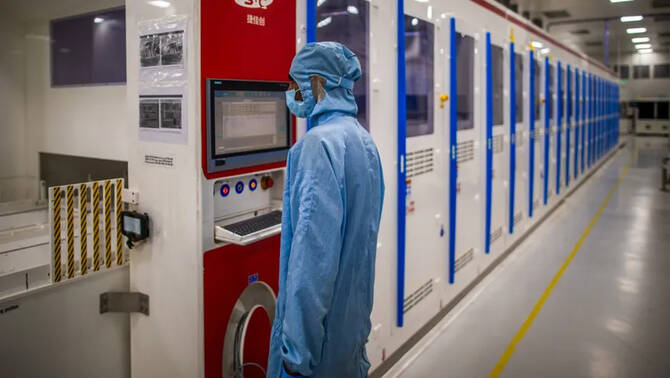
An employee inside a solar cell and module manufacturing facility in Mundra, Gujarat, India. Bloomberg.
Short Url
Updated 25 February 2026
Follow

US imposes preliminary 126% tariffs on solar imports from India

RIYADH: The administration of US President Donald Trump has imposed preliminary tariffs of up to 146 percent on solar panels imported from India, Indonesia, and Laos, after concluding that these countries provided unfair support to their manufacturing sectors.

The move is expected to benefit US producers, but in turn, could raise costs for consumers, according to Bloomberg.

The US Department of Commerce said on Feb. 24 that the tariff rates reflect the level of support provided, at 126 percent on imports from India, between 86 percent and 143 percent on Indonesia, and 81 percent on Laos.

The US claims that this support allows foreign producers to sell their exports in the US market at prices below production costs, harming the competitiveness of domestic manufacturers.

While these tariffs are expected to favor domestic manufacturers, they will negatively affect US renewable energy project developers, who have long relied on low-cost foreign supplies, exacerbating uncertainty in a sector already influenced by fluctuating policies and regulatory decisions in Washington.

A different customs path for solar tariffs

These duties are separate from the broader global tariffs previously imposed by Trump, which the US Supreme Court overturned last week. Following the ruling, Trump introduced new tariffs of 10 percent, with a warning that they could rise to 15 percent.

Earlier this month, the president reached a bilateral trade agreement with India aimed at easing economic tensions between the two countries.

According to Bloomberg NEF data, India, Indonesia, and Laos accounted for 57 percent of US solar panel imports in the first half of 2025, with some project developers shifting to importing panels from these countries after Washington imposed high tariffs on four Southeast Asian countries that had once represented the largest share of imports.

Pressure on Indian manufacturers

Vikram Bagri, an analyst at Citi, wrote in a research note on Feb. 24 that the relatively high tariff levels will make the US market almost closed to solar panel manufacturers in India.

The US solar industry group, the Alliance for American Solar Manufacturing and Trade, had requested the Department of Commerce to open an investigation into the support, arguing that the step was necessary to protect the domestic industry.

Tim Brightbill, co-chair of the international trade practice at Wiley Rein and the alliance’s lead attorney, said: “The results announced today represent a pivotal step toward restoring fair competition in the US solar market.”

He added: “US manufacturers are investing billions of dollars to rebuild production capacity domestically and create well-paying jobs. These investments cannot succeed if unfairly traded imports continue to distort the market.”

The Department of Commerce is expected to issue a final decision on the investigation on July 6, while a parallel probe is underway to impose anti-dumping duties on solar cell imports from India, Indonesia, and Laos.


UAE non-oil business growth at 1-year high in February: PMI report

Updated 6 sec ago
Follow

UAE non-oil business growth at 1-year high in February: PMI report

RIYADH: The growth of the non-oil private sector in the UAE ticked up to a 12-month high in February, driven by rapid increases in business activity and new work orders, an economic tracker showed.

In its latest Purchasing Managers’ Index report, S&P Global revealed that the UAE’s PMI rose to 55 in February from 54.9 in January.

Any PMI reading above 50 indicates expansion, while a reading below 50 reflects contraction.

The upturn of the non-oil private sector in the UAE aligns with the broader trend observed in the Gulf Cooperation Council region, where countries, including Saudi Arabia, are pursuing economic diversification efforts to reduce reliance on crude revenues.

In January, the Kingdom’s PMI stood at 56.3, the highest in the region, while Kuwait recorded a reading of 54.5.

“The UAE PMI signalled the strongest growth in non-oil business conditions for a year in February, with output increasing rapidly in response to strong inflows of new work. So far, the data points to an encouraging picture for the domestic economy in the first quarter of this year,” said David Owen, senior economist at S&P Global Market Intelligence.

According to the report, stronger output among non-oil sectors was driven by higher demand, successful contract wins, and growth in key sectors including construction, real estate, logistics, and technology.

Additional factors that contributed to this growth include rising tourist arrivals, the expansion of e-commerce channels, and growing demand for AI-related products.

While international orders also contributed to the expansion of the non-oil sector, the increase in export sales remained modest, suggesting that sales growth was mainly driven by domestic demand.

The analysis highlighted that employment numbers rose modestly in February, marking the largest uplift since last November.

UAE non-oil businesses successfully increased their inventories of purchased inputs for the second month running, supported by another rapid improvement in supplier delivery times.

Regarding the future outlook, non-oil firms in the UAE expressed optimism, although the level of confidence declined from the recent high in January.

“The outlook is positive, as demand has continued to pressure business capacity, suggesting additional expansions in output and employment may be necessary,” added Owen.

In the same report, S&P Global revealed that Dubai’s PMI slipped to 54.6 in February from 55.9 observed in January.

Rates of output and new order growth lost momentum, but remained sharp overall, with firms highlighting increased opportunities and new projects.

The release highlighted that demand was also lifted by various factors, including marketing activities, AI adoption, population growth and increased tourism.