

Islamabad hospital says Imran Khan receives second eye injection, party demands independent access

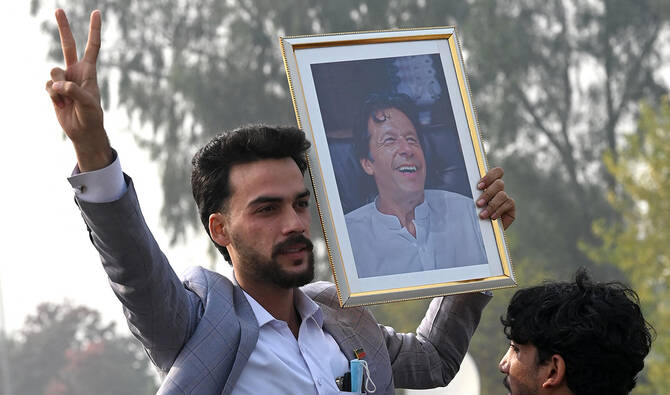
Pakistan Tehreek-e-Insaf (PTI) party supporters protest to demand release of their jailed leader and Pakistan's former Prime Minister Imran Khan, in Peshawar on December 2, 2025. (AFP/File)
Short Url
Updated 24 February 2026
Follow

Islamabad hospital says Imran Khan receives second eye injection, party demands independent access

  • PIMS hospital says jailed former premier stable after day-care procedure on Tuesday
  • PTI demands access for personal doctors, questions adequacy of medical disclosure

ISLAMABAD: The Pakistan Institute of Medical Sciences (PIMS) has said jailed former prime minister Imran Khan was brought to the government hospital for a second eye injection procedure and discharged in stable condition on Tuesday, while his party challenged the transparency of the medical update and demanded independent medical access.

Khan, 74, has been imprisoned at Adiala Jail since August 2023 in cases he and his Pakistan Tehreek-e-Insaf (PTI) party say are politically motivated. His detention has triggered sustained political confrontation between PTI and the federal government, with repeated protests demanding his release, several of which have turned violent.

Khan’s health has become an increasingly sensitive political issue in recent weeks, particularly after a lawyer told Pakistan’s Supreme Court vision in one eye had significantly deteriorated while in custody. Khan has been reported to be undergoing treatment for retinal vein occlusion, a condition caused by blockage of veins draining blood from the retina that can lead to vision loss.

In a press release issued by Dr. Aneeza Jalil, a spokesperson for PIMS, the hospital confirmed that Khan was brought for follow-up treatment on Tuesday.

“After obtaining informed consent, and under standard monitoring, precautionary measures and protocols in the operation theater, he was injected with second dose of intra-vitreal injection of Anti VEGF under guidance of microscopy by Consultant Ophthalmologist, and Consultant Vitreo-Retinal Surgeon of PIMS and Al Shifa Eye Hospital,” the PIMS statement said.

Anti-VEGF injections are commonly used to treat retinal vein occlusion and other retinal vascular disorders by reducing swelling and abnormal blood vessel growth inside the eye. 

The hospital said the procedure was performed as a day-care surgery and that Khan was examined prior to the injection by a consultant cardiologist and physician, with ECG and echocardiography reported as normal. The ex-PM remained clinically and vitally stable before, during and after the procedure before being discharged with follow-up instructions, the statement added. 

The PTI rejected the hospital’s brief statement as insufficient.

“PTI strongly maintains that a perfunctory two-line procedural note cannot conceivably substitute for a comprehensive, independently verified medical report,” the party said.

It added that given Khan’s custodial status, access should be granted to his personal physician and family, saying continued opacity “serves only to intensify public disquiet and further undermine confidence in the integrity of the process.”

Zulfi Bukhari, a close aide and spokesman for Khan, also dismissed the official account.

“Everything the authorities or the hospital says is irrelevant and only conjecture, until access is granted from confirmation to his personal doctors or family,” he said.

Khan was removed from office in April 2022 through a parliamentary vote of no confidence that he says was orchestrated by his political rivals with backing from the military, allegations both the government and armed forces deny. 

Since his imprisonment, Khan has faced multiple convictions and ongoing legal proceedings that authorities say follow due process, while his party describes them as efforts to sideline him from politics.


Pakistan raises fuel prices by Rs55 per liter as Middle East conflict drives oil surge

Updated 06 March 2026
Follow

Pakistan raises fuel prices by Rs55 per liter as Middle East conflict drives oil surge

  • Government says adequate fuel stocks in place despite global energy shock
  • Oil prices jump from about $78 to over $106 per barrel amid regional conflict

ISLAMABAD: Pakistan on Friday increased petrol and diesel prices by Rs55 ($0.20) per liter each as escalating conflict in the Middle East sent global oil prices sharply higher and disrupted energy supply routes, officials said.

Global oil markets have been rattled since coordinated strikes by the United States and Israel against Iran began last week, triggering retaliatory attacks across the region, raising fears of disruption to key energy shipping routes and pushing petroleum prices sharply upward.

The price adjustment in Pakistan was announced after a joint press conference by Finance Minister Muhammad Aurangzeb, Deputy Prime Minister and Foreign Minister Ishaq Dar and Petroleum Minister Ali Pervaiz Malik, who said the government was monitoring international energy markets and domestic supply conditions amid the crisis.

“So, the decision we have made by changing the levy a little bit is that we are going ahead with increasing the price of both fuels, petrol and diesel, by Rs55 ($0.20),” Malik told reporters. 

“And as soon as this matter settles, we will revise the prices downward with the same speed and take steps on how to increase people’s income and purchasing power.”

He said Pakistan entered the crisis with “comfortable energy reserves” due to earlier planning but rising global prices had forced the government to adjust domestic fuel rates to maintain supply continuity.

He said international petrol prices had climbed from roughly $78 per barrel on March 1 to around $106.8 per barrel, while diesel prices had risen to about $150 per barrel.

Malik added that the government had taken steps to minimize the burden on consumers, noting diesel plays a critical role in agriculture, transportation and public mobility.

Malik also warned that authorities would take strict action against anyone attempting to hoard fuel or manipulate supply for profiteering.

The minister said Pakistan was working with international partners to secure additional energy supplies, including arrangements with Saudi Aramco and the use of Pakistan National Shipping Corporation vessels to transport crude oil imports.

Finance Minister Aurangzeb said a high-level government committee formed by Prime Minister Shehbaz Sharif had been meeting daily to review developments in global petroleum markets and their potential impact on Pakistan’s economy.

“Pakistan currently maintains adequate energy stocks and macroeconomic stability,” Aurangzeb said, adding that the government’s response was based on preparedness rather than panic.

He said the committee, which includes senior ministers, the governor of the State Bank of Pakistan and other officials, was assessing short-, medium- and long-term implications of the crisis for inflation, foreign exchange reserves and broader economic indicators.

Deputy PM Dar said the regional conflict had significantly disrupted global energy markets, with international petroleum prices rising by as much as 50–70 percent in recent days.

The deputy prime minister added that Pakistan was also engaged in diplomatic efforts aimed at de-escalating tensions and restoring stability in the region.

Petroleum prices will now be reviewed more frequently, potentially on a weekly basis, and any reduction in global oil prices would be passed on to consumers.

Pakistan, which relies heavily on imported fuel to meet its energy needs, is particularly vulnerable to global oil price shocks that can quickly feed into inflation and pressure the country’s external accounts.