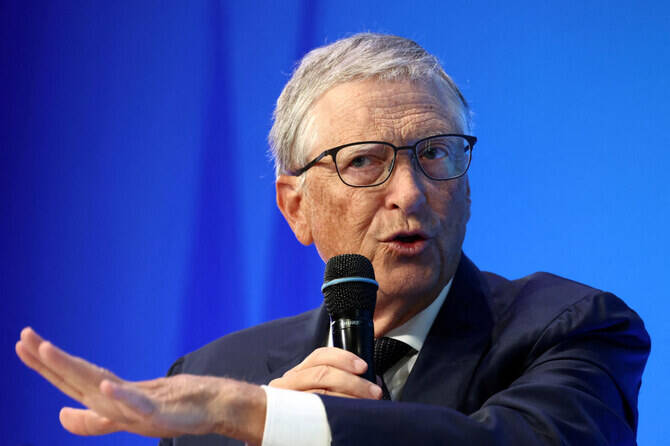
Bill Gates pulls out of India AI summit amid Epstein scrutiny

Bill Gates pulled out of India’s AI Impact Summit hours before his scheduled keynote on Thursday, as scrutiny over his ties to late financier and sex offender Jeffrey Epstein intensified following the release of US Justice Department emails. (Reuters/File)
Short Url
Updated 19 February 2026
Follow

Bill Gates pulls out of India AI summit amid Epstein scrutiny

  • The abrupt withdrawal of Microsoft’s co-founder dealt a fresh blow to a flagship event already marred by organizational lapses
  • The foundation said the billionaire will not deliver his address “to ensure the focus remains on the AI Summit’s key priorities“

NEW DELHI: Bill Gates pulled out of India’s AI Impact Summit hours before his scheduled keynote on Thursday, as scrutiny over his ties to late financier and sex offender Jeffrey Epstein intensified following the release of US Justice Department emails.
The abrupt withdrawal of Microsoft’s co-founder dealt a fresh blow to a flagship event already marred by organizational lapses, a robot row and complaints of traffic chaos.
The six-day event still notched more than $200 billion in investment pledges for AI infrastructure in India, including a $110 billion plan announced by Reliance Industries on Thursday.
India’s Tata Group also signed a partnership deal with OpenAI. Gates’ cancelation follows the release of emails last month by the DOJ that included communication between late financier and convicted sex offender Epstein and the Gates Foundation’s staff.
The foundation said the billionaire will not deliver his address “to ensure the focus remains on the AI Summit’s key priorities.” Only days ago, the foundation had dismissed rumors of his absence and insisted he ⁠was on track ⁠to attend.
The foundation’s chief strategy officer and Africa and India chief Ankur Vora spoke instead of Gates.
A representative for the philanthropic organization, started by Gates and his then-wife in 2000, did not respond to a Reuters query on whether the withdrawal was linked to scrutiny over the Epstein files.
Gates has said the relationship was confined to philanthropy-related discussions and that it was a mistake for him to meet the sex offender. He was among the top tech leaders due to attend the event among the likes of Google CEO Sundar Pichai, OpenAI CEO Sam Altman and Anthropic CEO Dario Amodei.
Gates’ absence followed another high-profile cancelation by Nvidia’s Jensen Huang earlier on Saturday, which added to a difficult opening ⁠for a summit billed as the first major AI forum in the Global South, where India has sought to position itself as a leading voice in worldwide AI governance.


Poland slow to counter Russia’s ‘existential threat’: general

Updated 4 sec ago
Follow

Poland slow to counter Russia’s ‘existential threat’: general

  • The general highlighted a low “pace of technical modernization,” compared to increases in the army’s size
  • Kukula said the Polish army should reach 500,000 soldiers by 2039

WARSAW: Russia poses an “existential threat” to Poland and its military is lagging, the country’s armed forces chief warned senior officials on Wednesday.
Poland, the largest country on NATO’s eastern flank and a neighbor of Russia, Belarus, and Ukraine, is the western alliance’s largest spender in relative terms.
This year, the country is allocating 4.8 percent of its GDP to defense, just shy of the alliance’s five percent target to be met by 2035.
However, that record defense spending was not enough to “make up for nearly three decades of chronic underfunding of the armed forces,” General Wieslaw Kukula, chief of the general staff, argued at the meeting, which included top officers, the defense minister and Poland’s president.
The general highlighted a low “pace of technical modernization,” compared to increases in the army’s size.
Kukula said the Polish army should reach 500,000 soldiers by 2039, compared with around 210,000 at present.
As a result of a lack of updates, some new Polish units “are not achieving combat readiness,” due to insufficient equipment, rather than a personnel shortage, the general argued.
Meanwhile, he added, “the Russian Federation remains an existential threat to Poland.”
Russia “is constantly reorganizing its forces, drawing on the lessons from its aggression in Ukraine, and building up the capacity for a conventional conflict with NATO countries,” he stressed.
Poland is to receive 43.7 billion euros ($51,5 billion) in loans under the European Union’s Security Action For Europe (SAFE) scheme, designed to strengthen Europe’s defensive capabilities.
Warsaw plans to use these funds to boost domestic arms production.
The Polish government claims that Poland will be able to access SAFE finance even if President Karol Nawrocki — backed by Poland’s conservative-nationalist opposition — vetos a law setting out domestic arrangements for its implementation.
Law and Justice (PiS) — the main opposition party — argues that SAFE could become a new tool for Brussels to place undue pressure on Poland, thanks to a planned mechanism for monitoring the funds, which they claim risks undermining Polish sovereignty.