

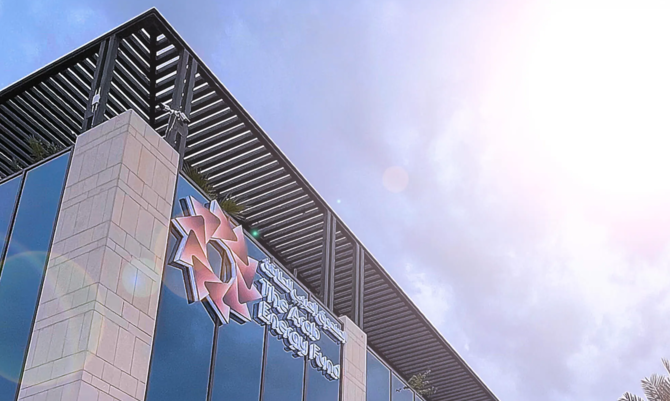
Arab Energy Fund arranges $346m financing for Iraq oil field expansion 

The Arab Energy Fund is committed to advancing the sustainable development of national energy sectors across its member states. The Arab Energy Fund
Short Url
Updated 18 February 2026
Follow

Arab Energy Fund arranges $346m financing for Iraq oil field expansion 

RIYADH: The Arab Energy Fund has led and closed a $346 million reserve-based financing facility for Kuwait Energy Basra Limited, the operator of Block 9 in southern Iraq, in a move that will support the next phase of expansion and development at the field,

The facility will also enable KEBL — a wholly owned subsidiary of Hong Kong-listed United Energy Group Limited — to continue drilling activities, optimize infrastructure, and enhance production capacity at Block 9, contributing to increased output and supporting Iraq’s efforts to strengthen its energy sector. 

The facility’s closing comes at a pivotal time for Iraq’s broader energy strategy as the country seeks to expand oil production capacity and navigate operational uncertainties at major fields. 

Nicolas Thevenot, chief banking officer of the Arab Energy Fund, said: “This successful close reflects the Arab Energy Fund’s ability to structure and lead sophisticated financing solutions grounded in real operational needs, as well as our deep understanding of upstream project fundamentals.”  

He added: “We are proud to partner with UEG, KFH, and Trafigura to support the continued expansion of Block 9 and contribute to strengthening Iraq’s energy ecosystem.”  

The Arab Energy Fund was appointed initial mandated lead arranger and structuring bank in 2024 and managed the transaction through financial close.

Kuwait Finance House B.S.C. and commodity trader Trafigura Pte. Ltd. joined during syndication as mandated lead arrangers. 

The Faihaa Field is regarded as a strategic upstream asset within Iraq’s long-term production outlook and a contributor to the country’s energy security objectives. 

The Arab Energy Fund said it remains committed to advancing the sustainable development of national energy sectors across its member states and the wider Middle East and North Africa region. 

Iraq’s oil ministry has outlined plans to lift crude oil production capacity to more than 6 million barrels per day by 2029, targeting several upstream expansion projects across southern basins to bolster output and fiscal revenues. 

Concurrently, geopolitical and operational developments have affected key assets such as the West Qurna-2 field, one of Iraq’s largest. Recent government action to assume control of operations following international sanctions on the previous operator underscores the challenges facing foreign investment and production continuity in the sector. 


Acwa signs key terms to develop 5GW of renewable energy capacity in Turkiye

Updated 23 February 2026
Follow

Acwa signs key terms to develop 5GW of renewable energy capacity in Turkiye

JEDDAH: Saudi utility giant Acwa has signed key investment agreements with Turkiye’s Ministry of Energy and Natural Resources to develop up to 5 gigawatts of renewable energy capacity, starting with 2GW of solar power across two plants in Sivas and Taseli.

Under the investment agreement, Acwa will develop, finance, and construct, as well as commission and operate both facilities, according to a press release.

The program builds on the company’s first investment in Turkiye, the 927-megawatt Kirikkale Independent Power Plant, valued at $930 million, which offsets approximately 1.8 million tonnes of carbon dioxide annually, the statement added.

A separate power purchase agreement has been concluded with Elektrik Uretim Anonim Sirketi for the sale of electricity generated by each facility.

Turkiye aims to boost solar and wind capacity to 120GW by 2035, supported by around $80 billion in investment, while recent projects have already helped prevent 12.5 million tonnes of CO2 emissions and reduced reliance on imported natural gas.

Turkiye’s energy sector has undergone a rapid transformation in recent years, with renewable power emerging as a central pillar of its strategy.

Raad Al-Saady, vice chairman and managing director of ACWA, said: “The signing of the IA (implementation agreement) and PPA key terms marks a pivotal moment in Acwa’s partnership with Turkiye, reflecting the country’s strong potential as a clean energy leader and manufacturing powerhouse.”

He added: “Building on our long-standing presence, including the 927MW Kirikkale Power Plant commissioned in 2017, this step elevates our partnership to a new level,” Al-Saady said.

In its statement, Acwa said the 5GW renewable energy program will deliver electricity at fixed prices, enhancing predictability for grid planning and supporting long-term industrial investment.

By replacing imported fossil fuels with domestically generated clean energy, the initiative is expected to reduce Turkiye’s exposure to global energy market volatility, strengthening energy security and lowering long-term power costs.

The company added that the economic impact will extend beyond the anticipated investment of up to $5 billion in foreign direct investment, with thousands of jobs expected during the construction phase and hundreds of high-skilled roles created during operations.

The energy firm concluded that its existing progress in Turkiye reflects a strong appreciation for Turkish engineering, construction, and manufacturing capacity, adding that localization has been a strategic priority, and it has already achieved 100 percent local employment at its developments in the country.