

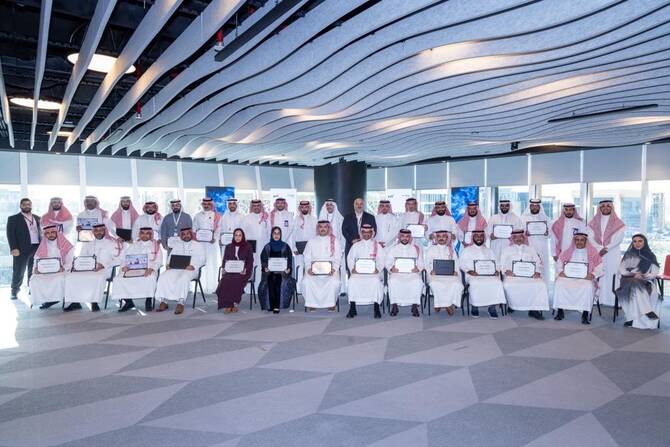
PwC Middle East and Sirar by stc’s CISO500 program advances cyber leadership

Short Url
Updated 15 February 2026
Follow

PwC Middle East and Sirar by stc’s CISO500 program advances cyber leadership

The fifth edition of the CISO500 program ran from Feb. 8-12. Delivered in partnership between PwC Middle East and Sirar by stc, the program featured five intensive days of rich discussions and hands-on practical experiences, aimed at strengthening leadership capabilities in cybersecurity and keeping pace with rapid technological transformation.

The program is designed to develop the capabilities of executive cybersecurity leaders and enhance their strategic role in supporting organizations’ digital transformation. It equips participants to address contemporary challenges in the cyber landscape and expand their influence within decision-making ecosystems.

Yasser Al-Swailem, CEO of Sirar by stc, said that the program represents an important step toward strengthening the readiness of cyber leaders in the region. He noted that the CISO500 program is a fundamental pillar in the journey toward building a secure and trusted Saudi cyberspace aligned with national ambitions. He added that investing in national cybersecurity leadership is no longer optional but a strategic necessity for ensuring sustainable digital development. The program reflects a commitment to empowering national talent to lead the digital security landscape according to the highest global standards.

He further emphasized that such initiatives contribute to strengthening digital security ecosystems and enabling organizations to confidently and sustainably address future challenges.

Samer Omar, cybersecurity and digital trust leader at PwC Middle East, added: “CISO500 is a long-term investment in Saudi leadership. Over the past year, we’ve seen how bringing together senior Saudi cybersecurity professionals in a structured executive environment accelerates capability, builds confidence and deepens collaboration. As the program enters its second year, our focus remains on equipping Saudi CISOs with the strategic perspective and technical depth required to secure the Kingdom’s digital ambitions.”

The program addressed a range of advanced topics, including common cyber transformation pitfalls, mechanisms for securing enterprise digital transformation, and cybersecurity budgeting and financial governance. These topics enhanced leaders’ ability to translate cyber risks and security investments into financial indicators that support executive decision-making.

It also covered the latest technological developments, particularly artificial intelligence, emerging technologies, quantum computing, and the protection of critical and operational infrastructure. Emphasis was placed on the importance of security governance for AI technologies and strengthening enterprise-wide risk management perspectives associated with them.

The program adopted an interactive learning methodology combining strategic discussions, collaborative work, and creative practical exercises, contributing to a deeper understanding of concepts and enabling their translation into applicable organizational practices.

Abdullah Al-Asmari, global cybersecurity director at the Saudi Research and Media Group and one of the program participants, said that the experience added significant strategic and practical value: “The program provided a rich experience that strengthened the leadership perspective of cybersecurity, particularly in linking technical practices with strategic and financial dimensions within the organization. It also offered valuable space for exchanging expertise on emerging technologies such as AI and quantum computing, and the challenges of securing critical infrastructure. This experience enhances cyber leaders’ ability to adopt a more influential role in supporting digital transformation and enabling decision-making based on a comprehensive understanding of risk and value.”

He added that the program facilitated the exchange of insights on emerging challenges and strengthened the ability to align cybersecurity with institutional objectives and executive decision requirements.

Participants said that the program constituted a valuable professional and knowledge-driven experience that enhanced the readiness of cyber leaders to keep pace with rapid digital transformation, reinforcing cybersecurity’s role as a strategic enabler that supports innovation while preserving business trust, reliability, and sustainability.


BYD launches 2nd-gen Blade Battery and FLASH charging technology

Updated 11 March 2026
Follow

BYD launches 2nd-gen Blade Battery and FLASH charging technology

BYD, a global tech leader and pioneer in new energy vehicles, has unveiled the second generation of its Blade Battery alongside its new ultra-fast FLASH charging technology. The announcement marks a significant leap in electric vehicle innovation, further enhancing the appeal of EVs in markets witnessing rapid growth in adoption. Among these markets is Saudi Arabia, which is increasingly emerging as one of the most promising markets in the Middle East for electric mobility, driven by the Kingdom’s vision for a more sustainable future and its commitment to adopting advanced transportation technologies.

Combining a driving range exceeding 1,000 km on a single charge with ultra-fast charging capabilities, the new technology offers a practical and reliable driving experience for EV users in the Kingdom. The second-generation Blade Battery opens new possibilities for long-distance electric travel while significantly reducing the need for frequent charging. The new battery supports ultra-fast charging, enabling vehicles to charge from 10 percent to 70 percent in just five minutes, and reach 97 percent within nine minutes.

The technology also maintains strong performance under extreme weather conditions. Charging from 20 percent to 97 percent at –30°C requires only three additional minutes compared to charging at room temperature.

In a statement, BYD said: “The combination of long driving range and ultra-fast charging represents one of the most important advantages of BYD’s new generation of batteries. With this technology, electric vehicles can travel longer distances with ease. Some models equipped with the second-generation Blade Battery can exceed 1,000 km of range, making this battery particularly suited to the long-distance travel patterns and road networks in Saudi Arabia.”

The second-generation Blade Battery relies on an innovative ion-transfer system known as FlashPass, which combines three advanced technologies designed to enhance charging speed and battery performance. The Flash-Release Cathode enables rapid lithium-ion release, while the Flash-Flow Electrolyte, developed using artificial intelligence, improves ionic conductivity. The Flash-Intercalate Anode enables faster and more efficient lithium-ion insertion, further improving overall battery performance.

The battery also features an advanced restructuring of its electrode design. Graphite particles within the anode are arranged vertically in a structured formation, reducing resistance to lithium-ion transfer and enabling faster, more efficient charging while increasing energy density by more than 5 percent compared with the first-generation Blade Battery.

In addition, the battery incorporates an ultra-thin and highly durable solid electrolyte interface layer, which supports high ionic conductivity while maintaining chemical stability. A dynamic self-repair mechanism further helps preserve battery performance over time.

In terms of safety, the second-generation Blade Battery exceeds the requirements of China’s new national EV battery safety standard GB 38031-2025 and has passed a range of rigorous tests. These include the world’s first combined ultra-fast charging and nail penetration safety test, completed without thermal runaway, smoke, or fire. The battery also successfully passed thermal runaway testing following simultaneous short-circuiting in four battery cells without fire or explosion, as well as undercarriage impact testing at energy levels 10 times higher than those required by the new national safety standard.

Technical innovations in the new battery have also helped reduce capacity degradation by 2.5 percent, improving long-term operational life and efficiency.

Alongside the battery technology, BYD introduced its FLASH ultra-fast charging system, which includes one of the most powerful mass-produced charging units in the world, delivering up to 1,500 kW per charging port.

The company has also developed an integrated energy storage and charging system that operates both as an energy storage unit that helps reduce pressure on the power grid and as a power booster capable of delivering high-capacity charging to vehicles. This approach enables ultra-fast charging while maintaining grid stability and improving overall energy efficiency.

BYD has also introduced an innovative FLASH charger design focused on user convenience. The charger features the world’s first T-shaped cable reel system, which allows the charging cable to remain suspended and prevents contact with the ground. It also includes a “gravity-free” charging connector that can be easily operated with one hand.

In addition, the system supports Plug and Charge functionality with automatic payment, allowing users to simply connect their vehicle and begin charging immediately after initial registration through the application.

As part of its broader strategy to support the growth of electric mobility, BYD is actively building a large network of FLASH charging stations. As of March 5, the company had established 4,239 charging stations across China, with plans to expand the network to 20,000 stations by the end of 2026.

The launch of these new technologies builds on BYD’s long-term vision first introduced in 2006 under the concept of “Three Green Dreams.” This vision focuses on developing an integrated ecosystem that includes solar energy, energy storage, and charging infrastructure, helping accelerate the global transition to electric mobility and support a more sustainable future.