

UN Security Council condemns Islamabad mosque bombing claimed by Daesh

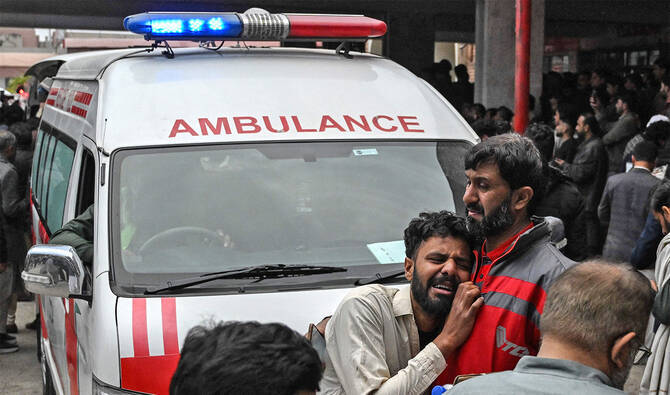
People mourn the death of their relatives following a suicide bombing at a Shiite mosque, outside a hospital in Islamabad on February 6, 2026. (AFP/File)
Short Url
Updated 13 February 2026
Follow

UN Security Council condemns Islamabad mosque bombing claimed by Daesh

  • The Council urges accountability, calls for cooperation with Pakistan
  • A suicide bomber targeted the mosque during prayers, killing 32 people

ISLAMABAD: The United Nations Security Council said on Friday it condemned a suicide bombing at a mosque on the outskirts of Islamabad that killed at least 32 people, calling the attack “heinous and cowardly” and urging accountability for those responsible.

The blast targeted the Qasr-e-Khadijatul Kubra mosque and imambargah in the Tarlai Kallan area during Friday prayers on Feb. 6, when mosques across the country were packed with worshippers. Daesh claimed responsibility, saying one of its militants detonated an explosive vest inside the congregation.

In a press statement issued by Council President James Kariuki of the United Kingdom, members of the 15-nation body expressed “deepest sympathy and condolences” to the families of the victims and to the government and people of Pakistan.

“The members of the Security Council condemned in the strongest terms the heinous and cowardly suicide bombing terrorist attack,” the statement said, reaffirming that “terrorism in all its forms and manifestations constitutes one of the most serious threats to international peace and security.”

The Council underlined the need to hold “perpetrators, organizers, financiers and sponsors” accountable and urged all states to cooperate actively with the Pakistan government in accordance with international law and relevant UN resolutions.

Pakistan, which is currently serving as a non-permanent member of the Security Council for the 2025–2026 term, has faced intense militant violence in recent years, including attacks claimed by Tehreek-e-Taliban Pakistan, Balochistan Liberation Army and Daesh affiliates.

The administration in Islamabad said the day after the attack that a police officer was killed and four suspects were arrested in overnight raids in the northwestern cities of Peshawar and Nowshera.

Among those detained was an Afghan national alleged to have worked for Daesh and to have masterminded the bombing, authorities said.

The Security Council reiterated that acts of such militant violence were criminal and unjustifiable regardless of motivation and reaffirmed the need for states to combat threats to international peace and security in line with the UN Charter and international law.

Earlier this week, Pakistani religious scholars also condemned the bombing at a meeting presided over by Religious Affairs Minister Sardar Muhammad Yousuf, saying the attack was contrary to Islamic teachings.


Pakistan says Sri Lanka to ease visa restrictions after Colombo talks

Updated 5 sec ago
Follow

Pakistan says Sri Lanka to ease visa restrictions after Colombo talks

  • Pakistan Interior Minister Mohsin Naqvi meets Sri Lankan President Anura Kumara Dissanayake in Colombo
  • Naqvi informs Sri Lankan president about visa-related difficulties being faced by Pakistani nationals

KARACHI: Sri Lankan President Anura Kumara Dissanayake has assured Islamabad that the island nation will ease visa restrictions for Pakistani citizens, the Pakistani interior ministry said on Tuesday.

Pakistan’s Interior Minister Mohsin Naqvi, who is also the chairman of the Pakistan Cricket Board (PCB), met Dissanayake during a visit to the country on Tuesday. The Pakistani minister arrived in Sri Lanka last week to watch the T20 World Cup cricket clash between India and Pakistan in Colombo on Sunday. 

Naqvi informed the Sri Lankan president about visa-related difficulties being faced by Pakistani nationals during the meeting, the interior ministry said in a statement. 

“The Sri Lankan president took immediate notice and directed that Pakistan be removed from all such lists without delay,” it said. 

Both sides held detailed discussions on counterterrorism, counternarcotics and joint training between their security forces, the statement added. 

Naqvi thanked Dissanayake for the arrangements the government had taken to accommodate Pakistan’s matches in Sri Lanka. The Sri Lankan president reaffirmed his commitment to strengthen ties with Pakistan further. 

Dissanayake also conveyed a message of thanks for Pakistan’s Prime Minister Shehbaz Sharif for allowing the national men’s cricket team to play its cricket match against India. 

Pakistan’s government earlier this month announced it would not allow the cricket team to play against India to express solidarity with Bangladesh. The International Cricket Council (ICC) last month replaced Bangladesh with Scotland after the former said it would not play its matches in India owing to security concerns. The move drew sharp protests from the cricket boards of Pakistan and Bangladesh. 

Pakistan withdrew its decision and cleared the national team to play against India following negotiations with the ICC. Dissanayake had also spoken to Sharif and requested Pakistan to call off its boycott against India. 

Pakistan and Sri Lanka share long-standing ties with cooperation across various sectors. In December last year, Pakistan provided assistance to Sri Lanka in the form of relief aid and rescue workers following disastrous floods across the tropical island nation.