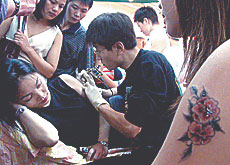
After their often unsavory reputations in previous decades, tattoos have gained popularity in today’s world. As the young move at full speed ahead towards embracing technology in every aspect of their life, they are also attracted to these primitive marks permanently on their bodies. In the West, tattoo is a hot business. According to a magazine article in the US, a tattoo parlor opens every day somewhere in the country. The article ranked tattooing as the sixth fastest growing retail venture of the 1990s, right behind Internet, paging services, bagels, computer and cellular phone service. Search Engine Lycos, ranks the Top 50 search terms every week. “Tattoos” was the third most popular search term in 2002; the fourth most popular in 2001, seventh in 2000, and the eleventh in 1999. “Tattoo and tattoos” is one of only seven terms which have never been out of the Top 50 search items in the 199 weeks since Lycos has been keeping track. The other six are Dragon Ball, Pamela Anderson, Jennifer Lopez, Britney Spears, Las Vegas and the WWE/WWF.
It is believed that tattooing by puncture — with a sharp tool or needle which introduces a dye under the top layer of skin — was first practiced in ancient Egypt. Clay dolls fashioned then are the earliest evidence of tattooing which have been preserved. Tattooing has always played an important role in the social life of those who practiced it and throughout history it has appeared in many forms and served different purposes: As a distinguishing mark for royalty, a symbol of religious devotion, a decoration for bravery in battle, a sexual lure, a pledge of love, a symbol of group identification, a sign of individuality, a punishment and a means of marking and identifying slaves, outcasts and convicts. But what about today? Why this fascination with a process that causes relative pain and changes the body for life?
Although the practice continues in certain regions and among some tribes in the Middle East, it was never common among the general public. In recent years, however, tattoos have begun to appear on the bodies of the young who often follow Western trends. Among Muslims, this is surprising since tattooing is prohibited in Islam. It is still not a very common practice in the Kingdom and there are no tattoo parlours but tattoos are seen on both men and women.
“I had mine done five years ago when I was studying in Cairo,”said 25-year-old Noha. She found out about the artist through a friend and visited his shop three times before making the decision to have a special design tattooed on her upper left shoulder. “I did not make a point of telling my parents before having it done nor did I hide it from them afterward, but when my mom saw it, she didn’t comment,”Noha said. She confesses that when she had it done she did not think much about the religious aspect but two years later she became more religious. “I don’t think it’s a barrier between me and God. Religion does not have to do with what you like; it is about your essence and what you do,” she explained. She does not have a problem with the tattoo being forever and is not thinking about removing it one day. She chose a design that represented femininity,
freedom, and rebellion. “I did not want something common like a flower and I didn’t do it to look like anyone; I wanted to be different. It is something personal, I did it for me but I was shocked by people’s reaction who kept asking me why?”she said. Other Saudis have tattoos because they think them sexy, especially men. Another young woman and her fiancé had their initials tattooed on their arms and of course, when they broke up later, they were stuck with the tattoos. One middle-aged woman had a heart tattooed on her chest and another on her ankle; her husband gave his approval but neither knew at the time that Islam prohibits tattooing and now she is thinking of having it removed. Most Saudis who have tattoos had them done abroad but there are a few who manage to find someone here. It is usually a makeup artist who performs it discretely, either at a salon or at the person’s residence. The most popular tattoos here are what is referred to as ‘permanent makeup’: Tattooing eyebrows, eyeliners and lip liners and filling the lips. Ghadeer tattooed her eyebrows two years ago when she was 19. “It is very convenient and it makes me look good,”she said to Arab News. Many women she knows of all ages have had facial tattoos. “I know that tattooing is prohibited in Islam but I didn’t change my body and I don’t regret it,” she said. She did not, however, tell her parents before having it done and they were upset about it.
A Lebanese makeup artist trained and licensed in Paris has been tattooing women here for 15 years. Most of it is the permanent makeup tattoo but she does simple body tattoos as well. “I don’t do it for girls under 17 and I don’t like to do big complex designs,” she said to Arab News. She said that five years ago, body tattoos were very popular among the young but now with temporary tattoos, that demand has fallen. At Eid Clinic which specializes in plastic, dermatology and cosmetic surgery, people come all the time asking for tattoos to be removed. “Most of them had the tattoo done abroad when they were young and then regretted it, especially after returning here where it is not really socially or religiously acceptable,” said Dr. Mohammed Eid. The removal is usually done by laser surgery. There are no health risks in having a tattoo as long as the needles are sterile; if not, all kinds of infections and diseases can be transmitted, warned Dr. Eid.