

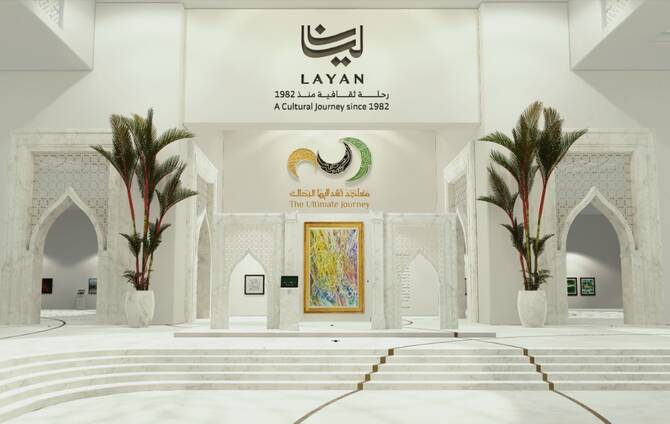

OXFORD, UK: The Oxford Centre for Islamic Studies has launched a landmark exhibition titled “The Ultimate Journey,” inviting visitors to reflect on Islam’s holiest sites and their enduring legacy.
Launched in collaboration with the Saudi-based Layan Cultural Foundation, the Oxford presentation is the latest iteration of the exhibition, which has previously been shown in other formats and venues internationally.
The exhibition also marks the 40th anniversary of the Oxford Centre for Islamic Studies as well as just over 20 years since Makkah was designated the first capital of Islamic culture by the Islamic Educational, Scientific and Cultural Organization in 2005.
“The Ultimate Journey” brings together 36 artists from Saudi Arabia, Lebanon, Indonesia, Australia, the UK and beyond.
Their works span different styles and techniques — from calligraphy to abstract art — ultimately representing and honoring Islam’s three sacred sites: the Grand Mosque in Makkah, the Prophet’s Mosque in Madinah and the Al-Aqsa Mosque in Jerusalem.
The collection includes works by both Muslim and non-Muslim artists including Dia Aziz Dia, Peter Gould, Nassar Mansour, Ahmed Mater, Bill West, Abdullah Al-Shalti and Reem Nazir.
“The idea was simple but deeply personal,” Ghada Al-Tobaishi, managing director of the Layan Cultural Foundation, told Arab News. “Artists from around the world were asked one question: How do you feel about the three holy mosques? They were invited to translate faith, memory and pilgrimage into their own visual language.”
Founded in 1985, the Oxford Centre for Islamic Studies was established to promote the multidisciplinary academic study of Islam and contemporary Muslim societies. Its founder and director, Dr. Farhan Ahmad Nizami, said cultural engagement has always been central to the center’s mission.
“From day one, the study of art, culture and civilization was very much part of the center’s remit,” Nizami told Arab News. “Inter-civilizational understanding rests on sound academic engagement with history, culture and people, and from that emerges a more accurate understanding of the Muslim world.”
Nizami said that presenting Islam’s holy sites through contemporary art enables audiences — Muslim and non-Muslim alike — to engage with their spiritual significance beyond text or ritual.
The exhibition is drawn from a growing collection developed by Layan Culture, a not-for-profit cultural institution founded in 2007 by Prince Faisal bin Abdullah bin Mohammad Al-Saud.
Describing itself as a “custodian of cultural legacy,” the foundation preserves Islamic heritage through research, knowledge gathering and public exhibitions, showcasing the transformative power of the arts.
The institution is dedicated to safeguarding Saudi Arabian heritage, Islamic arts and Arab culture through curated collections, educational publications and cultural initiatives.
Exhibition consultant and catalogue producer Richard Wilding said the exhibition’s works explore not only religious devotion, but also the historical and human dimensions of the sacred cities. “Makkah, Madinah and Jerusalem are holy spaces, but they are also ancient cities,” he said. “You see pilgrims, historic settings and personal moments — artists responding emotionally to places that carry deep meaning.”
Wilding, who is non-Muslim and has worked extensively in Saudi Arabia, added that the exhibition speaks to broad audiences. “You don’t have to be Muslim to respect or revere these places,” he said. “This exhibition offers an opportunity — especially for UK audiences — to encounter these sacred cities through art, sometimes for the first time.”
The exhibition also honors Prince Khalid Al-Faisal, governor of the Makkah Region, Oxford alumnus, poet and artist, whose vision has long championed the intersection of culture, faith and artistic expression.
Housed within the Oxford Centre for Islamic Studies’ purpose-built home, which blends classical Islamic architecture with traditional Oxford design, “The Ultimate Journey” positions art as a bridge between scholarship and spirituality, history and lived experience.
It welcomes visitors to reconsider the contemporary significance and enduring legacy of Islam’s most sacred spaces.


