

Iran protest instigators will receive no leniency, judicial chief says

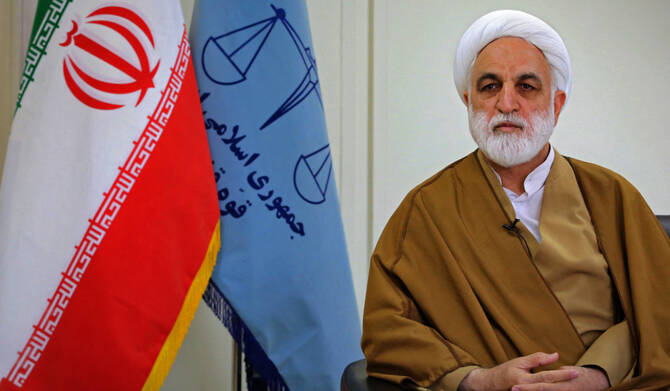
The chief of Iran's judiciary authority, Gholamhossein Mohseni-Ejei. (AFP)
Short Url
Updated 26 January 2026
Follow

Iran protest instigators will receive no leniency, judicial chief says

  • The Iranian government has put the death toll from the protests at 3,117, including 2,427 people it has labeled “martyrs”

TEHRAN: The head of Iran’s judiciary warned that those behind a recent wave of anti-government protests could expect punishment “without the slightest leniency.”
What began earlier this month as demonstrations against the high cost of living boiled over into a broader protest movement that represented the gravest challenge to the leadership in years.
The protests have abated under an internet blackout that left the country largely cut off from the outside world.
“The people rightly demand that the accused and the main instigators of the riots and the acts of terrorism and violence be tried as quickly as possible and punished if found guilty,” judicial chief Gholamhossein Mohseni Ejei was quoted as saying by the official Mizan online news portal.
He went on to say “the greatest rigor must be applied in the investigations,” but insisted that “justice entails judging and punishing without the slightest leniency the criminals who took up arms and killed people, or committed arson, destruction, and massacres.”
The Iranian government has put the death toll from the protests at 3,117, including 2,427 people it has labeled “martyrs” — a term used to distinguish members of the security forces and innocent bystanders from those described by authorities as “rioters” incited by the US and Israel.
Rights groups have accused authorities of repeatedly using live ammunition on protesters, but Col. Mehdi Sharif Kazemi, commander of Iran’s special police, maintained authorities had used only non-lethal measures such as water cannon to quell the unrest.
“The use of weapons (by the police) during this operation has sparked some criticism, but in fact, the police did not resort to using any firearms,” he was quoted as saying by the Mehr news agency.
“We used non-lethal means in order to guarantee the safety of the population and avoid any killings.”
Italian Foreign Minister Antonio Tajani urged the EU to list Iran’s Revolutionary Guards Corps as a “terrorist organization” following the crackdown on protests.
Tajani said he would propose the idea “in coordination with other partners” at a meeting of EU foreign ministers in Brussels on Thursday.
“The losses suffered by the civilian population during the protests demand a clear response,” he wrote on X.
He also called for the EU to levy individual sanctions against those responsible.

The EU has already sanctioned several hundred Iranian officials over crackdowns on previous protest movements and over Tehran’s support for Russia’s war on Ukraine.

The bloc has also banned the export to Iran of a raft of components that could be used in the country’s drone and missile manufacturing.
Last week, EU chief Ursula von der Leyen announced plans to ban additional exports of critical drone and missile technologies.
An EU official on Friday confirmed that the proposal to designate the IRGC as a terrorist organization was on the table for this week’s meeting, but said it requires unanimity for approval and that “we are not yet there.”


Libya’s Ramadan celebrations tempered by economic woes

Updated 6 sec ago
Follow

Libya’s Ramadan celebrations tempered by economic woes

  • Libya’s other economic problems included the absence of a unified national budget, in light of its political divide, as well as uncoordinated public spending due to parallel state institutions, Tetteh said
  • Refills of gas cylinders, officially priced at 1.5 dinars ($0.24) but often unavailable through state-run distributors, now sell for 75 dinars ($11.85) on the black market and at times more

TRIPOLI: Libyans have been enjoying Ramadan with feasts and fireworks — but soaring prices, a devalued currency and political divisions have left many with little to celebrate.
Fifteen years on from the fall of longtime leader Muammar Qaddafi, the country remains split between east and west, while shortages of goods, including fuel, disrupt daily life, despite Libya sitting atop vast oil and gas reserves.
During the Muslim holy month of Ramadan, shoppers stock up on treats, as families gather for lavish meals before and after the daytime fast that stretches from sunrise to sunset.
But this year supermarkets have been rationing their goods, while many petrol stations are short of gas. In the capital Tripoli, most ATMs were out of cash this week.
Firas Zreeg, 37, told AFP while weaving through a crowded supermarket that the economy was deteriorating, blaming currency speculators for the fall in the dinar, “which has negative repercussions on our daily lives.”
The price of cooking oil has doubled in recent weeks, while meat and poultry prices rose by half.
Refills of gas cylinders, officially priced at 1.5 dinars ($0.24) but often unavailable through state-run distributors, now sell for 75 dinars ($11.85) on the black market and at times more.

- ‘Burden on citizens’ -

Libya has struggled to recover from the chaos that erupted following the 2011 Arab Spring uprising that toppled Qaddafi.
It remains divided between a UN-recognized government based in Tripoli and an eastern administration backed by military strongman Khalifa Haftar.
The country has largely been stable in recent years although there have been bouts of deadly violence, including the killing of Qaddafi’s son and heir apparent Seif Al-Islam this month.
With security holding, many Libyans are more focused on their livelihoods.
Last month, the central bank in the western territory devalued the dinar — the second time in less than a year — by nearly 15 percent, “aimed at preserving financial and monetary stability and ensuring the sustainability of public resources.”
In an address this week, Prime Minister Abdulhamid Dbeibah acknowledged that the devaluation had once again “put the burden on citizens.”
Hanna Tetteh, head of the United Nations Support Mission in Libya, warned on Wednesday that “poverty and pressure on society [are] increasing.”
“The situation, in addition to the fragile security landscape, should be a matter for concern as such conditions can lead to unexpected political and security challenges,” she told the UN Security Council.
Libya’s other economic problems included the absence of a unified national budget, in light of its political divide, as well as uncoordinated public spending due to parallel state institutions, Tetteh said.
Revenues from the oil industry were also declining, she added, while the central bank has said public spending is growing at an unsustainable pace.
On Tuesday, Libya marked 15 years since the start of the uprising that eventually toppled Qaddafi, with fireworks lighting up the sky in Tripoli, but for many Libyans life remains a struggle.
“Minor improvements in security were made over the past three years,” Zreeg told AFP, but Libyans are still faced with huge economic challenges.