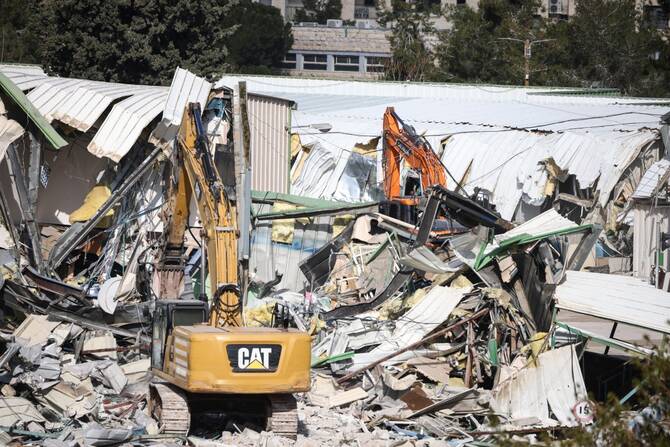
JERUSALEM: The United Nations’ agency for Palestinian refugees said Sunday that its partially demolished headquarters in occupied East Jerusalem was set on fire.
The agency, UNRWA, did not offer details on the cause of the incident at their premises, which Israeli authorities seized and began dismantling last week after banning the organization from operating in the country in 2025.
“After having been stormed and demolished by the Israeli authorities, the UNRWA Headquarters in occupied East Jerusalem has now been set on fire,” the agency said in a statement.
It described the blaze as part of an “ongoing attempt to dismantle the status of Palestine Refugees.”
The fire and rescue service said early Sunday that it had responded to a call at the facility, where it was working to “extinguish the blaze and prevent it from spreading,” also without offering a cause.
The UN had slammed last week’s seizure and demolitions, and UNRWA insisted that its property remained protected by the privileges and immunities of the UN, a view it repeated on Sunday.
“Like any UN Member State anywhere in the world, without exception, Israel is legally obliged to protect and respect UN facilities,” UNRWA spokesman Jonathan Fowler told AFP on Sunday.
UNRWA was created specifically for the hundreds of thousands of Palestinians displaced during the creation of Israel in 1948, and provides refugee status registration and health and education services.
Its compound in Israeli-annexed east Jerusalem has been empty of staff since January 2025, when the law banning its operations took effect.
Israel accuses UNRWA of providing cover for Hamas militants, and a series of investigations found “neutrality-related issues” at the agency but held that Israel had not provided conclusive evidence.
UNRWA still operates in the occupied West Bank and Gaza.

UN Palestinian refugee agency says demolished HQ set on fire
https://arab.news/56ean
UN Palestinian refugee agency says demolished HQ set on fire
- UNRWA described the blaze as part of an “ongoing attempt to dismantle the status of Palestine Refugees”
- Its compound in Israeli-occupied East Jerusalem has been empty of staff since January 2025
Survival in Gaza ‘on the edge,’ living conditions ‘brutal’ despite easing of hunger, UN officials warn
- ‘The situation remains extremely precarious … Having an entire population living on the brink is just not acceptable,’ says UNICEF deputy executive director
- ‘Hundreds of thousands of people are shivering in fabric tents that don’t keep the heat in or the rain out,’ adds World Food Programme deputy executive director
NEW YORK CITY: Survival in Gaza remains “on the edge” and the conditions there are “extremely brutal,” senior UN officials said on Monday, despite some easing of the situation compared with last year.
They warned that the entire population of the battered enclave is living on the brink, in what they described as an unacceptable situation. Urgent decisions are needed to ensure humanitarian access remains open, and to prevent fragile gains from being reversed they added.
“The situation remains extremely precarious, with survival at the edge,” the deputy executive director of UNICEF, Ted Chaiban, told reporters after returning from a visit to Gaza and the West Bank.
“Having an entire population living on the brink is just not acceptable.”
Carl Skau, the World Food Programme’s deputy executive director, who accompanied Chaiban on the visit, said the living conditions for hundreds of thousands of displaced people were “just brutal,” with families sheltering in flimsy tents or heavily damaged buildings in Gaza as winter storms batter the territory.
“Hundreds of thousands of people are shivering in fabric tents that don’t keep the heat in or the rain out,” Skau said.
“I met a woman, who had given birth just 10 days earlier, sitting on a wet mattress in a cold tent on the beach. It was absolutely brutal.”
Both officials said the situation had improved compared with a year ago, when Gaza was on the brink of famine, but stressed that the gains were fragile and could easily be reversed.
“The ceasefire has allowed us to rein in famine,” Skau said. “Most people I spoke to were eating at least once a day. But there is still a very long way to go. The situation is extremely fragile.”
Chaiban said that more aid and commercial goods were entering Gaza and the availability of food had improved, but he warned that the humanitarian crisis remained deadly, for children in particular.
“More than 100 children have been reported killed since the ceasefire,” he said, adding that about 100,000 youngsters are still acutely malnourished and require long-term care.
About 1.3 million people, many of them children, still lack proper shelter, Chaiban added, as families continue to live in flimsy tents or bombed-out buildings, exposed to heavy rain, strong winds and freezing temperatures.
At least 10 children reportedly have died of hypothermia since winter began.
“It really is miserable in those tents,” Chaiban said.
Skau said hundreds of thousands of people remain displaced, unable to return to homes that had been reduced to rubble, and struggling to survive with little protection from the elements.
“I spoke to a woman who had lost her husband, most of her relatives and her home,” he said. “She was left with four children and absolutely nothing.”
Both officials highlighted moments of resilience amid the devastation, including children who had returned to learning and families who were attempting to rebuild fragments of normal life, but said such signs of hope should not obscure the sheer scale of the ongoing suffering.
“The gains we’ve made can easily be reversed,” Skau said. “So much more needs to be done now.”
Both of the officials said further progress would depend on the continuation of the ceasefire agreement and predictable humanitarian access, including the opening and sustained operation of multiple border crossings, and routes into and within Gaza. Aid workers need safe conditions in which to operate at scale, they added.
Shelter remains the most urgent need as winter storms continue; Skau said the immediate priority was to “flood the strip with shelter,” while Chaiban said decisions were urgently needed to ensure access for essential supplies and to restore basic services.
The coming weeks will be critical, Chaiban said, adding: “We have a window to change the trajectory for children in Gaza. We can’t waste it.”